Department of Diagnostic Pathology, Faculty of Medicine, Oita University, Oita, Japan.
PLoS One. 2023 Feb 13;18(2):e0281647. doi: 10.1371/journal.pone.0281647. eCollection 2023.
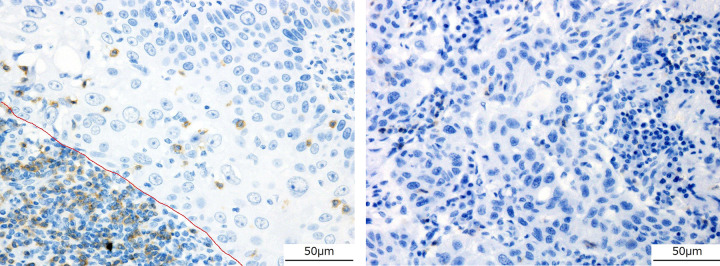
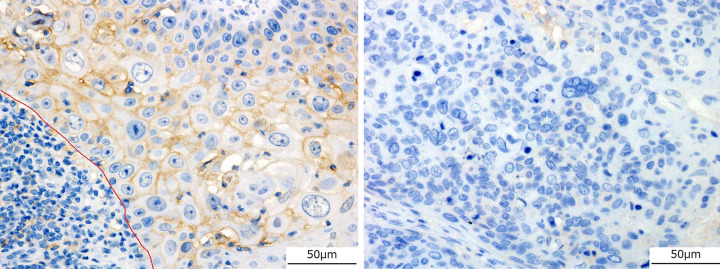
In recent years, several immune checkpoint inhibitors targeting programmed death-ligand 1 (PD-L1) or PD-1 have been developed for cancer therapy. The genetic background of tumors and factors that influence PD-L1 expression in tumor tissues are not yet elucidated in cutaneous squamous cell carcinoma (cSCC). CD8-positive tumor-infiltrating lymphocytes (TILs) are known to be related to tumor immunity. Here, we aimed to study the relationship between CD8/PD-L1 immunohistochemical reactivity and gene alterations in cSCC. Tumorigenic genes were examined to identify gene alterations using next-generation sequencing (NGS). We collected 27 cSCC tissue samples (from 13 metastatic and 14 non-metastatic patients at primary diagnosis). We performed immunohistochemical staining for CD8 and PD-L1, and NGS using a commercially available sequencing panel (Illumina Cancer Hotspot Panel V2) that targets 50 cancer-associated genes. Immunohistochemically, CD8-positive TILs showed a high positive score in cSCC without metastasis; in these cases, cSCC occurred predominantly in sun-exposed areas, the tumor size was smaller, and the total gene variation numbers were notably low. The tumor depth, PD-L1 positivity, and gene variation number with or without tumor metastasis were not related, but the gene variation number tended to be higher in cSCCs arising in non-sun-exposed areas. Tumor metastasis was more common in cSCC arising in non-sun-exposed areas, which decreased the number of TILs or CD8-positive cells. From a genetic perspective, the total gene alterations were higher in cSCC with metastasis. Among them, ERBB4 and NPM1 are presumably involved in cSCC tumorigenesis; in addition, GNAQ, GNAS, JAK2, NRAS, IDH2, and CTNNB1 may be related to tumor metastasis. These results provide information on potential genes that can be targeted for cSCC therapy and on immune checkpoint inhibitors that may be used for cSCC therapy.
近年来,已有多种针对程序性死亡配体 1(PD-L1)或 PD-1 的免疫检查点抑制剂被开发用于癌症治疗。然而,皮肤鳞状细胞癌(cSCC)中肿瘤的遗传背景和影响肿瘤组织中 PD-L1 表达的因素尚不清楚。已知 CD8 阳性肿瘤浸润淋巴细胞(TIL)与肿瘤免疫有关。在此,我们旨在研究 cSCC 中 CD8/PD-L1 免疫组化反应性与基因改变之间的关系。使用下一代测序(NGS)检查肿瘤发生基因,以鉴定基因改变。我们收集了 27 例 cSCC 组织样本(来自 13 例转移性和 14 例初诊时非转移性患者)。我们进行了 CD8 和 PD-L1 的免疫组织化学染色,并使用了一种商业可用的测序面板(Illumina Cancer Hotspot Panel V2)进行 NGS,该面板靶向 50 个与癌症相关的基因。免疫组化结果显示,无转移的 cSCC 中 CD8 阳性 TIL 呈高阳性评分;在这些病例中,cSCC 主要发生在阳光暴露区域,肿瘤体积较小,总基因突变数量明显较低。肿瘤深度、PD-L1 阳性率以及有无肿瘤转移的基因突变数量没有相关性,但无阳光暴露区域发生的 cSCC 中基因突变数量较高。无阳光暴露区域发生的 cSCC 更常见肿瘤转移,这减少了 TIL 或 CD8 阳性细胞的数量。从遗传角度来看,转移性 cSCC 的总基因突变数量较高。其中,ERBB4 和 NPM1 可能参与了 cSCC 的肿瘤发生;此外,GNAQ、GNAS、JAK2、NRAS、IDH2 和 CTNNB1 可能与肿瘤转移有关。这些结果提供了有关可能成为 cSCC 治疗靶点的潜在基因的信息,以及可能用于 cSCC 治疗的免疫检查点抑制剂的信息。