Oyegue-Liabagui Sandrine Lydie, Mbani Mpega Ntigui Chérone Nancy, Ada Mengome Mérédith Flore, Kouna Lady Charlene, Tsafack Tegomo Nathalie Pernelle, Longo Pendy Neil Michel, Lekana-Douki Jean-Bernard
Unité d'Evolution Epidémiologie et Résistances Parasitaires (UNEEREP), Centre Interdisciplinaire de Recherches Médicales de Franceville (CIRMF), Franceville, Gabon.
Ecole Doctorale Régionale d'Afrique Centrale en Infectiologie Tropicale (ECODRAC), Université des Sciences et Techniques de Masuku, Franceville, Gabon.
PLoS One. 2023 Feb 14;18(2):e0280818. doi: 10.1371/journal.pone.0280818. eCollection 2023.
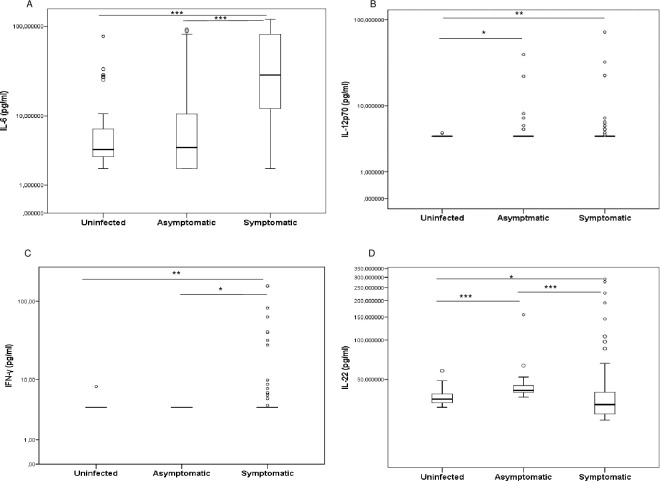
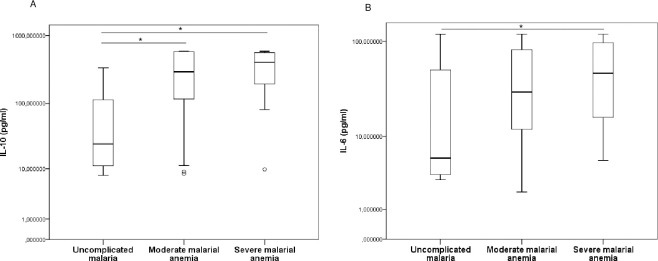
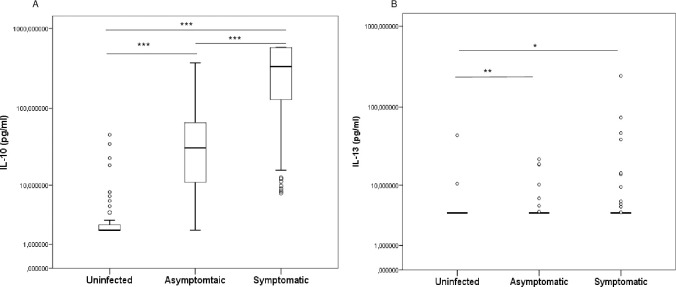
Plasmodium falciparum is a parasite that causes asymptomatic or symptomatic malaria infections in humans depending on various factors. These infections are also a major cause of anemia in intertropical countries such as Gabon. Past studies have clearly demonstrated that inflammatory markers such as cytokines play a key role in the pathogenesis of malaria disease. However, the clinical manifestations of severe malaria vary according to the level of transmission and more information is needed to gain a better understanding of the factors involved. As such, the objective of this study was to investigate the circulating levels of nine cytokines in asymptomatic and symptomatic P. falciparum infections in Gabonese children and their roles in the pathogenesis of anemia. Blood samples were collected from 241 children aged 3 to 180 months in Lastourville, south-eastern Gabon. Diagnosis of P. falciparum infection was performed using Rapid Diagnosis Tests, microscopy and nested PCR. Levels in the plasma of the Th1 (IFN-γ, TNF-α, IL-6 and IL-12p70), Th17 (IL-17A and IL-22) and Th2 (IL-10, IL-4 and IL-13) cytokines were measured by ELISA. Data showed that IL-6, IFN-γ, IL-12p70, IL-10, and IL-13 levels were significantly higher in children with symptomatic P. falciparum infection compared to uninfected children. IL-10 levels were significantly higher in symptomatic children than in asymptomatic children, who had moderately increased levels compared to uninfected controls. Moreover, only IL-10 and IL-6 levels were significantly higher in children with severe malarial anemia compared to children with uncomplicated malaria who had significantly lower IL-10 levels than children with moderate malarial anemia. These data indicate that the progression of P. falciparum infection towards an advanced stage in children is accompanied by a significant increase in type Th1 and/or Th2 cytokines. These inflammatory mediators could serve as potential predictors of anemia for malaria patients.
恶性疟原虫是一种寄生虫,根据多种因素,它会在人类身上引发无症状或有症状的疟疾感染。在加蓬等热带国家,这些感染也是贫血的主要原因。过去的研究清楚地表明,细胞因子等炎症标志物在疟疾发病机制中起关键作用。然而,重症疟疾的临床表现因传播水平而异,需要更多信息来更好地了解其中涉及的因素。因此,本研究的目的是调查加蓬儿童无症状和有症状恶性疟原虫感染中九种细胞因子的循环水平及其在贫血发病机制中的作用。从加蓬东南部拉斯图维尔的241名3至180个月大的儿童中采集血样。使用快速诊断测试、显微镜检查和巢式PCR进行恶性疟原虫感染的诊断。通过ELISA检测Th1(IFN-γ、TNF-α、IL-6和IL-12p70)、Th17(IL-17A和IL-22)和Th2(IL-10、IL-4和IL-13)细胞因子在血浆中的水平。数据显示,有症状恶性疟原虫感染儿童的IL-6、IFN-γ、IL-12p70、IL-10和IL-13水平明显高于未感染儿童。有症状儿童的IL-10水平明显高于无症状儿童,与未感染对照组相比,无症状儿童的IL-10水平略有升高。此外,与无并发症疟疾儿童相比,重症疟疾贫血儿童的IL-10和IL-6水平明显更高,无并发症疟疾儿童的IL-10水平明显低于中度疟疾贫血儿童。这些数据表明,儿童恶性疟原虫感染进展到晚期伴随着Th1型和/或Th2型细胞因子的显著增加。这些炎症介质可能是疟疾患者贫血的潜在预测指标。