Social Sciences and Management, Catholic University of Central Africa, Yaounde, Centre, Cameroon
Department of Mathematics and Physical Sciences, National Advanced School of Engineering, University of Yaoundé 1, Yaoundé, Centre, Cameroon.
BMJ Open. 2023 Feb 14;13(2):e063392. doi: 10.1136/bmjopen-2022-063392.
Across sub-Saharan Africa, urogenital schistosomiasis (UGS), in particular female genital schistosomiasis (FGS), is a significant waterborne parasitic disease, with its direct burden on the sexual and reproductive health (SRH) of sufferers infrequently measured. UGS has an established control plan, which in most endemic regions as in Cameroon, still excludes FGS considerations. Highlighting existent associations between UGS and FGS could increase the management of FGS within UGS interventions. This study seeks to identify current associations among FGS and UGS with some reproductive health indicators, to provide formative information for better integrated control.
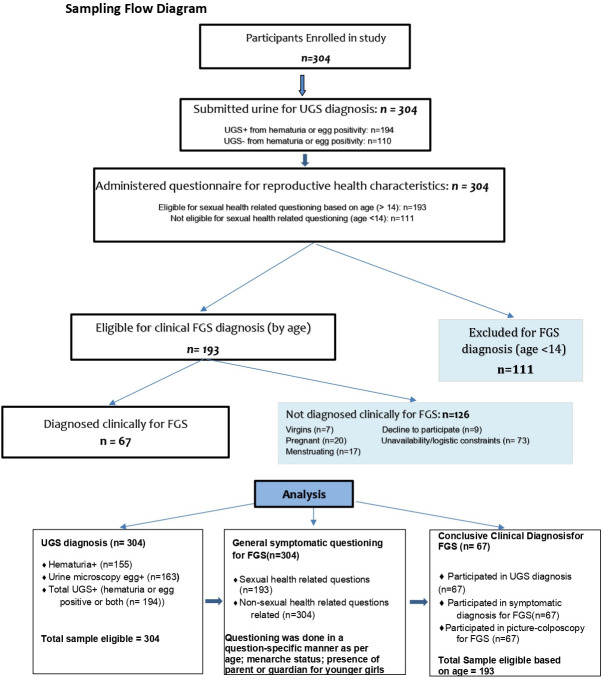
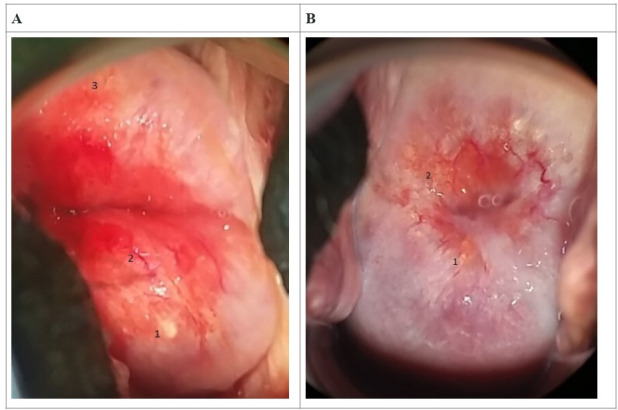
304 females aged 5-69 years were all examined for UGS by urine filtration and microscopy. Among these, 193 women and girls were eligible for clinical FGS assessment based on age (>13). After selective questioning for FGS symptoms, a subgroup of 67 women and girls consented for clinical examination for FGS using portable colposcopy, with observed sequelae classified according to the WHO FGS pocket atlas.
Overall UGS and FGS prevalence was measured, with FGS-related/UGS-related reproductive health symptoms recorded. Associations between FGS and UGS were investigated by univariate and multivariate logistic regression analyses.
Overall UGS prevalence was 63.8% (194/304), where FGS prevalence (subgroup) was 50.7% (34/67). FGS manifestation increased significantly with increasing age, while a significant decrease with ascending age was observed for UGS. Lower abdominal pain (LAP) vaginal itches (VI) and coital pain (CP) were identified as the main significant shared symptoms of both FGS and UGS, while LAP with menstrual irregularity (MI) appeared a strong symptomatic indicator for FGS.
LAP, MI, CP and VI are the potential SRH indicators that could be exploited in future for targeting of praziquantel provision to FGS sufferers within primary care, complementary with existing praziquantel distribution for UGS sufferers in endemic areas.
在撒哈拉以南非洲地区,尿路生殖系统血吸虫病(UGS),特别是女性生殖系统血吸虫病(FGS),是一种严重的水传播寄生虫病,其对患者的性和生殖健康(SRH)的直接负担很少被测量。UGS 有一个既定的控制计划,但在大多数流行地区,如喀麦隆,该计划仍然排除了对 FGS 的考虑。强调 UGS 和 FGS 之间现有的关联可以增加 FGS 在 UGS 干预措施中的管理。本研究旨在确定 FGS 与一些生殖健康指标之间目前的关联,为更好地综合控制提供基础信息。
304 名年龄在 5-69 岁的女性均接受尿液过滤和显微镜检查以确定 UGS。其中,193 名年龄在 13 岁以上的女性和女孩有资格进行基于年龄的临床 FGS 评估。在对 FGS 症状进行选择性询问后,一小部分 67 名女性和女孩同意使用便携式阴道镜进行临床 FGS 检查,根据世界卫生组织 FGS 袖珍图谱对观察到的后遗症进行分类。
测量了 UGS 和 FGS 的总体患病率,并记录了与 FGS 相关/与 UGS 相关的生殖健康症状。通过单变量和多变量逻辑回归分析调查了 FGS 与 UGS 之间的关联。
LAP、MI、CP 和 VI 是潜在的 SRH 指标,可以在未来用于针对初级保健中 FGS 患者提供吡喹酮,并补充在流行地区针对 UGS 患者提供吡喹酮的现有措施。