Gastroenterology and Digestive Endoscopy, IRCCS Ospedale San Raffaele and Vita-Salute San Raffaele University, Milan, Italy.
Comparative Health Outcomes, Policy, and Economics Institute, University of Washington, Seattle, WA, USA.
Inflamm Bowel Dis. 2023 Nov 2;29(11):1723-1729. doi: 10.1093/ibd/izad016.
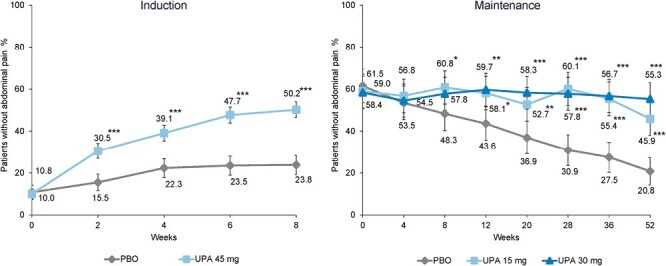
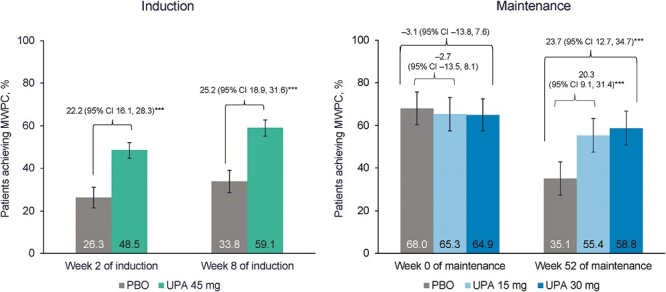
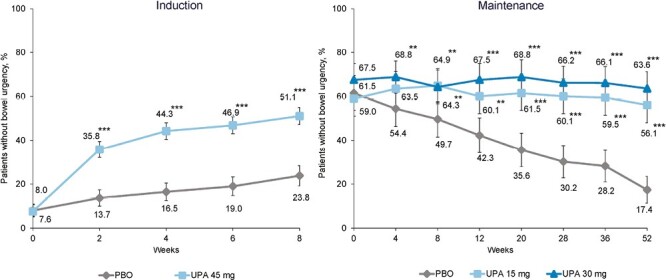
This post hoc analysis of a large, phase 3 program evaluated the effects of upadacitinib on fatigue, bowel urgency, and abdominal pain in patients with moderately to severely active ulcerative colitis.
Induction data were pooled from 2 identical studies, the U-ACHIEVE induction and U-ACCOMPLISH studies. Patients in these studies received upadacitinib 45 mg once daily or placebo as induction treatment. Responders to induction treatment were rerandomized in the U-ACHIEVE maintenance study to upadacitinib 15 mg once daily, upadacitinib 30 mg, or placebo. The percentage of patients reporting no abdominal pain and no bowel urgency daily via an electronic diary and a meaningful within-person change (≥5 points) in the Functional Assessment of Chronic Illness Therapy-Fatigue score were evaluated.
The results demonstrated a statistically significantly greater percentage of patients reporting no abdominal pain and absence of bowel urgency observed from week 2 (P < .001), with upadacitinib induction treatment and clinically meaningful improvements in Functional Assessment of Chronic Illness Therapy-Fatigue score observed at week 8 (P < .001), when compared with placebo. The maintenance study showed that significant and meaningful improvements in abdominal pain, bowel urgency, and Functional Assessment of Chronic Illness Therapy-Fatigue score achieved during induction were sustained through 52 weeks of maintenance treatment in upadacitinib- vs placebo-treated patients.
The findings of this study support the additional benefit of upadacitinib in treating moderately to severely active ulcerative colitis by demonstrating a statistically significant impact on clinically meaningful symptoms of fatigue, bowel urgency, and abdominal pain.(U-ACHIEVE induction and maintenance studies; NCT02819635; U-ACCOMPLISH induction study; NCT03653026).
这项大型三期临床试验的事后分析评估了乌帕替尼在中重度活动性溃疡性结肠炎患者中的疲劳、排便急迫和腹痛的影响。
诱导数据来自两项相同研究(U-ACHIEVE 诱导研究和 U-ACCOMPLISH 研究)的汇总。这些研究中的患者接受乌帕替尼 45mg 每日一次或安慰剂作为诱导治疗。诱导治疗应答者在 U-ACHIEVE 维持研究中重新随机分配至乌帕替尼 15mg 每日一次、乌帕替尼 30mg 或安慰剂。通过电子日记评估每日报告无腹痛和无排便急迫的患者比例,以及功能评估慢性疾病治疗疲劳评分(Functional Assessment of Chronic Illness Therapy-Fatigue score)有意义的个体内变化(≥5 分)。
结果显示,与安慰剂相比,乌帕替尼诱导治疗和功能性评估慢性疾病治疗疲劳评分在第 8 周观察到有临床意义的改善,从第 2 周开始,报告无腹痛和无排便急迫的患者比例有统计学意义的增加(P<0.001)。维持研究显示,在诱导期实现的腹痛、排便急迫和功能性评估慢性疾病治疗疲劳评分的显著和有意义的改善在乌帕替尼治疗患者中维持至 52 周的维持治疗。
这项研究的结果支持乌帕替尼在治疗中重度活动性溃疡性结肠炎方面的额外益处,因为它显示了对疲劳、排便急迫和腹痛的临床有意义症状有统计学意义的影响。(U-ACHIEVE 诱导和维持研究;NCT02819635;U-ACCOMPLISH 诱导研究;NCT03653026)。