
患者和疾病特征、治疗实践以及结直肠癌患者的肿瘤学结局:一项基于人群的分析。
Patient and disease characteristics, treatment practices and oncologic outcomes among patients with colorectal cancer: a population-based analysis.
机构信息
From the Department of Surgery, University of Calgary, Calgary, Alta. (Farooq, Keehn, Xu, Kong, Quan, MacLean); the Department of Community Health Sciences, University of Calgary, Calgary, Alta. (Keehn, Xu, Kong, Cheung, Quan); and the Department of Oncology, University of Calgary, Calgary, Alta. (Xu, Kong, Cheung, Quan).
From the Department of Surgery, University of Calgary, Calgary, Alta. (Farooq, Keehn, Xu, Kong, Quan, MacLean); the Department of Community Health Sciences, University of Calgary, Calgary, Alta. (Keehn, Xu, Kong, Cheung, Quan); and the Department of Oncology, University of Calgary, Calgary, Alta. (Xu, Kong, Cheung, Quan)
出版信息
Can J Surg. 2023 Feb 15;66(1):E71-E78. doi: 10.1503/cjs.024320. Print 2023 Jan-Feb.
BACKGROUND
The incidence of colorectal cancer (CRC) is increasing among young adults. We sought to report on patient and disease characteristics, treatment practice patterns and outcomes in this population.
METHODS
We conducted a retrospective cohort study using administrative health data from the Alberta Cancer Registry (2004-2015), including demographic and tumour characteristics, and treatment received. Outcome measures included overall and cancer-specific deaths. We used Cox regression and Kaplan-Meier curves to assess for factors associated with survival.
RESULTS
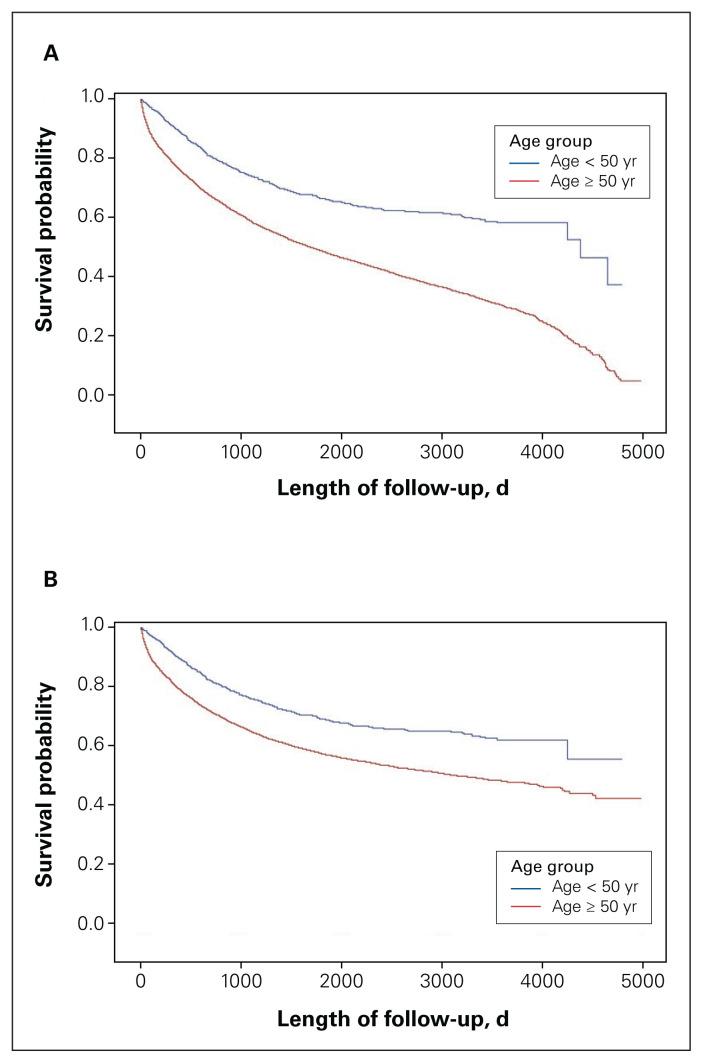
We included 18 070 patients with CRC ( = 1583 [8.8%] < 50 yr, = 16 487 [91.2 %] ≥ 50 yr). Younger patients were more likely to present with locally advanced disease (21.0% v. 18.0%, < 0.0001), stage III (16.4 % v. 14.6%, < 0.0001) or metastatic (16.7% v. 13.8%, < 0.0001) involvement. Younger patients were more likely to receive surgery (87.2% v. 80.9%, < 0.0001), chemotherapy (59.6% v. 34.1%, < 0.0001) or radiation therapy (49.5% v. 37.2%, < 0.001). At 5 years, overall and cancer-specific survival was better among younger patients than older patients (30.6% v. 51.5% overall deaths, 27.5% v. 38.4% cancer-specific deaths, < 0.0001).
CONCLUSION
Despite higher stage and higher grade disease, young patients with CRC had more favourable oncologic outcomes than stage-matched older patients, which may be related to younger patients receiving more aggressive treatment. Further investigation should focus on optimal treatment patterns for young patients with CRC.
背景
结直肠癌(CRC)在年轻人中的发病率正在上升。我们旨在报告该人群的患者和疾病特征、治疗实践模式和结果。
方法
我们使用来自艾伯塔省癌症登记处(2004-2015 年)的行政健康数据进行了回顾性队列研究,包括人口统计学和肿瘤特征以及所接受的治疗。结果测量包括总生存率和癌症特异性生存率。我们使用 Cox 回归和 Kaplan-Meier 曲线评估与生存相关的因素。
结果
我们纳入了 18070 例 CRC 患者(<50 岁 1583 例[8.8%],≥50 岁 16487 例[91.2%])。年轻患者更有可能出现局部晚期疾病(21.0%比 18.0%,<0.0001)、III 期(16.4%比 14.6%,<0.0001)或转移性疾病(16.7%比 13.8%,<0.0001)。年轻患者更有可能接受手术(87.2%比 80.9%,<0.0001)、化疗(59.6%比 34.1%,<0.0001)或放疗(49.5%比 37.2%,<0.001)。5 年时,年轻患者的总生存率和癌症特异性生存率均优于年长患者(总死亡 30.6%比 51.5%,癌症特异性死亡 27.5%比 38.4%,<0.0001)。
结论
尽管年轻患者的疾病分期和分级更高,但他们的肿瘤学结果优于分期匹配的年长患者,这可能与年轻患者接受更积极的治疗有关。进一步的研究应集中在为年轻 CRC 患者确定最佳治疗模式上。


 Zotero 插件