From the Division of General Surgery, Department of Surgery, McMaster University, Hamilton, Ont. (Griffiths, McKechnie, Lee, Springer, Doumouras, Hong, Eskicioglu); the Michael G. DeGroote School of Medicine, McMaster University, Hamilton, Ont. (McKechnie, Lee); and the Division of General Surgery, Department of Surgery, St. Joseph Healthcare, Hamilton, Ont. (Doumouras, Hong, Eskicioglu).
Can J Surg. 2021 Feb 18;64(1):E91-E100. doi: 10.1503/cjs.013019.
The incidence of colorectal cancer in North America is rising among patients younger than 50 years. Available data are conflicting regarding presentation and outcomes in this population. This review aimed to synthesize literature regarding young patients with colorectal cancer with respect to patient demographics, disease extent and survival, compared with patients older than 50 years.
We searched Medline, Embase, the Cochrane Central Register of Controlled Trials and PubMed for articles published between 1990 and the time of search. Articles comparing North American patients with colorectal cancer younger and older than 50 years were eligible for inclusion. We used a random-effects model to pool odds ratios.
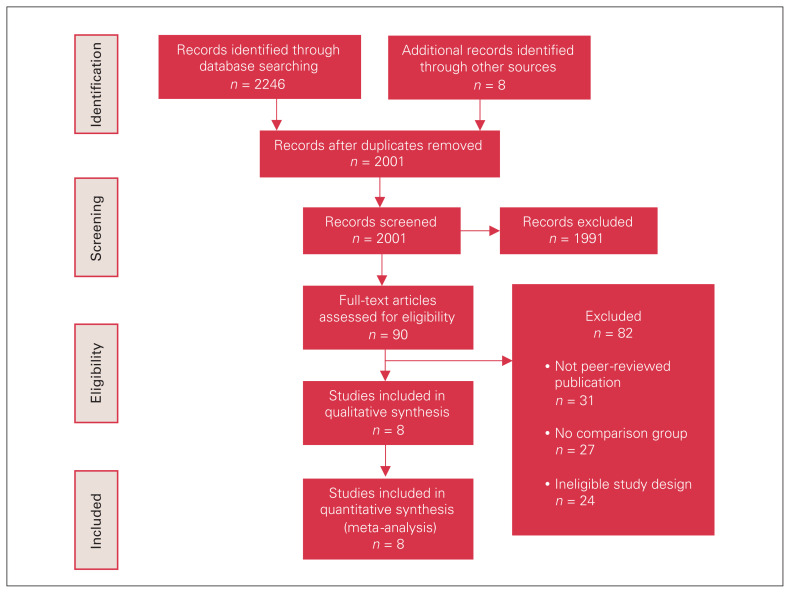
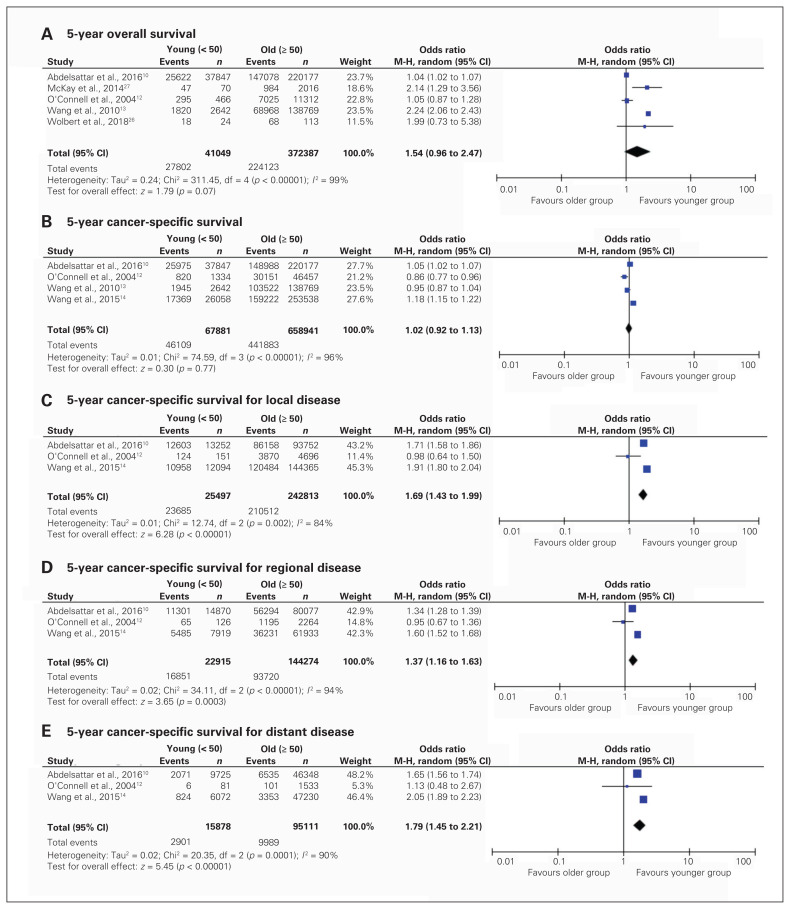
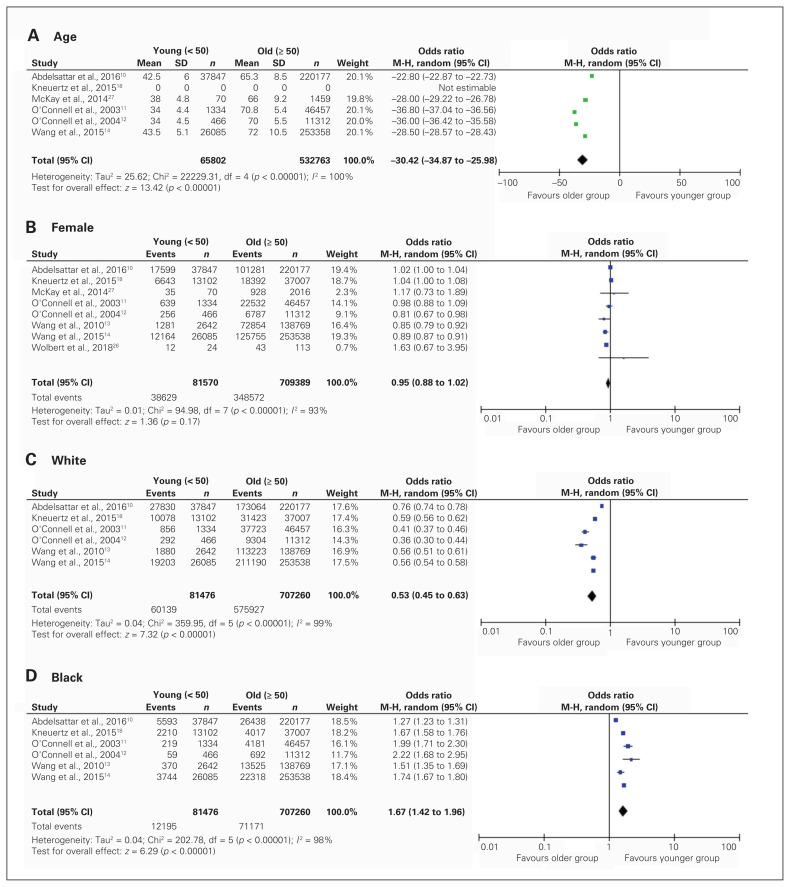
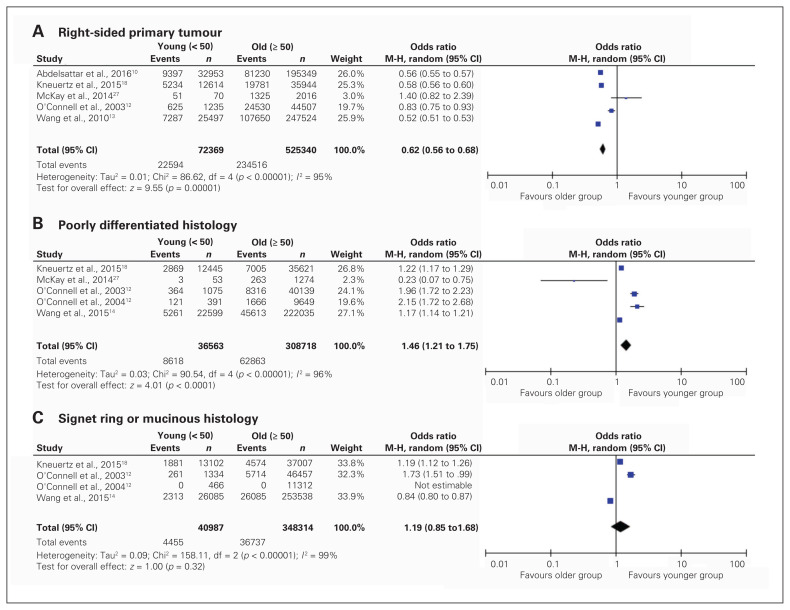
Eight retrospective studies were eligible for inclusion (n = 790 959). Mean age was 42.6 years (standard deviation [SD] 5.07) in the younger group, and 69.1 years (SD 9.25) in the older group. Young patients were more likely to present with regional (odds ratio [OR] 1.27, 95% confidence interval [CI] 1.16-1.40) and distant disease (OR 1.47, 95%CI 1.30-1.67). Considering patients at all stages of disease, differences in 5-year overall survival (OR 1.54, 95%CI 0.96-2.47) and cancer-specific survival (OR 1.01, 95%CI 0.91-1.13) were not statistically significant between groups. However, when controlling for disease extent, 5-year cancer-specific survival was significantly higher among young patients with local (OR 1.69, 95%CI 1.43-1.99), regional (OR 1.37, 95%CI 1.16-1.63) and distant disease (OR 1.79, 95%CI 1.45-2.21).
North American patients presenting with colorectal cancer before the age of 50 years are more likely to have advanced disease. Although overall and cancer-specific survival is not significantly different between these groups, younger patients have improved survival when controlling for cancer stage.
北美 50 岁以下人群的结直肠癌发病率正在上升。关于这一人群的临床表现和结局,现有数据存在矛盾。本综述旨在综合有关年轻结直肠癌患者的文献,比较 50 岁以上患者的患者人口统计学、疾病程度和生存情况。
我们检索了 Medline、Embase、Cochrane 中央对照试验注册库和 PubMed,以获取 1990 年至检索时发表的文章。比较北美 50 岁以下和 50 岁以上结直肠癌患者的文章符合纳入标准。我们使用随机效应模型来汇总比值比。
有 8 项回顾性研究符合纳入标准(n=790959)。年轻组的平均年龄为 42.6 岁(标准差[SD]5.07),老年组为 69.1 岁(SD 9.25)。年轻患者更有可能出现局部(比值比[OR]1.27,95%置信区间[CI]1.16-1.40)和远处疾病(OR 1.47,95%CI 1.30-1.67)。考虑到所有疾病阶段的患者,两组之间 5 年总生存率(OR 1.54,95%CI 0.96-2.47)和癌症特异性生存率(OR 1.01,95%CI 0.91-1.13)差异无统计学意义。然而,当控制疾病程度时,局部(OR 1.69,95%CI 1.43-1.99)、区域(OR 1.37,95%CI 1.16-1.63)和远处疾病(OR 1.79,95%CI 1.45-2.21)的年轻患者 5 年癌症特异性生存率显著更高。
北美 50 岁以下出现结直肠癌的患者更有可能患有晚期疾病。尽管这些组之间的总生存率和癌症特异性生存率无显著差异,但在控制癌症分期后,年轻患者的生存率有所提高。