Department of Research and Evaluation, Kaiser Permanente Southern California, Pasadena, California, USA; Department of Health Systems Science, Kaiser Permanente Bernard J. Tyson School of Medicine, Pasadena, California, USA.
Division of General Medicine, Columbia University Irving Medical Center, New York, New York, USA.
J Am Coll Cardiol. 2023 Feb 21;81(7):623-632. doi: 10.1016/j.jacc.2022.11.051.
Young adults may have high long-term atherosclerotic cardiovascular disease (ASCVD) risk despite low short-term risk.
In this study, we sought to compare the performance of short-term and long-term ASCVD risk prediction tools in young adults and evaluate ASCVD incidence associated with predicted short-term and long-term risk.
We included adults aged 18 to 39 years, from 2008 to 2009 in a U.S. integrated health care system, and followed them through 2019. We calculated 10-year and 30-year ASCVD predicted risk and assessed ASCVD incidence.
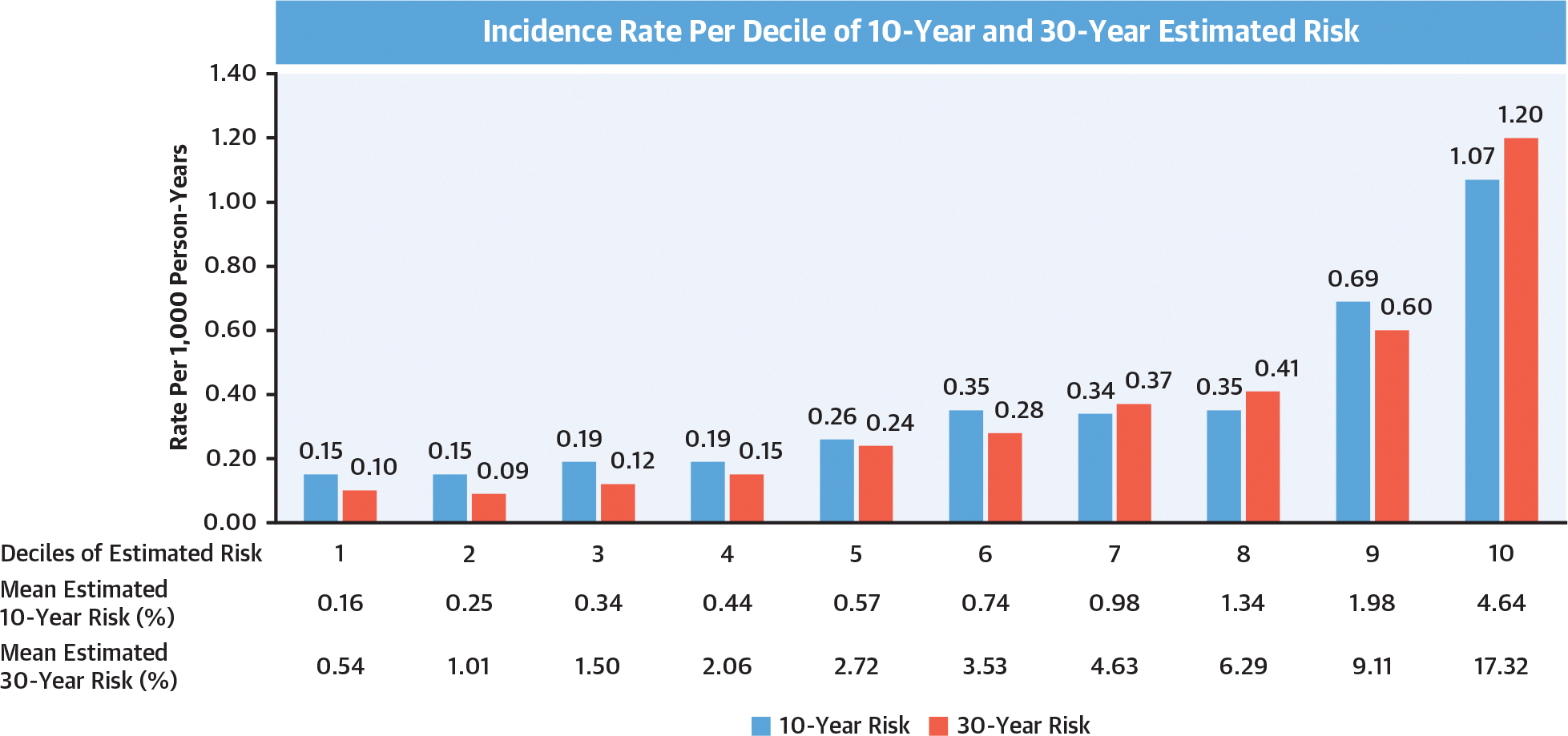
Among 414,260 young adults, 813 had an incident ASCVD event during a median of 4 years (maximum 11 years). Compared with 10-year predicted risk, 30-year predicted risk improved reclassification (net reclassification index: 16%) despite having similar discrimination (Harrell's C: 0.749 vs 0.726). Overall, 1.0% and 2.2% of young adults were categorized as having elevated 10-year (≥7.5%) and elevated 30-year (≥20%) predicted risk, respectively, and 1.6% as having low 10-year (<7.5%) but elevated 30-year predicted risk. The ASCVD incidence rate per 1,000 person-years was 2.60 (95% CI: 1.92-3.52) for those with elevated 10-year predicted risk, 1.87 (95% CI: 1.42-2.46) for those with low 10-year but elevated 30-year predicted risk, and 0.32 (95% CI: 0.30-0.35) for those with low 10-year and 30-year predicted risk. The age- and sex-adjusted incidence rate ratio was 3.04 (95% CI: 2.25-4.10) comparing those with low 10-year but elevated 30-year predicted risk and those with low 10-year and 30-year predicted risk.
Long-term ASCVD risk prediction tools further discriminate a subgroup of young adults with elevated observed risk despite low estimated short-term risk.
尽管短期风险较低,但年轻人可能存在较高的长期动脉粥样硬化性心血管疾病(ASCVD)风险。
本研究旨在比较短期和长期 ASCVD 风险预测工具在年轻人中的表现,并评估与预测短期和长期风险相关的 ASCVD 发生率。
我们纳入了 2008 年至 2009 年期间在美国综合医疗保健系统中年龄在 18 至 39 岁的成年人,并对他们进行了 2019 年的随访。我们计算了 10 年和 30 年 ASCVD 预测风险,并评估了 ASCVD 的发生率。
在 414260 名年轻人中,有 813 人在中位 4 年(最长 11 年)内发生 ASCVD 事件。与 10 年预测风险相比,尽管具有相似的判别力(哈雷尔 C:0.749 与 0.726),但 30 年预测风险改善了重新分类(净重新分类指数:16%)。总的来说,1.0%和 2.2%的年轻人被归类为 10 年风险升高(≥7.5%)和 30 年风险升高(≥20%),1.6%的年轻人被归类为 10 年风险低(<7.5%)但 30 年风险升高。每 1000 人年 ASCVD 的发生率为 2.60(95%CI:1.92-3.52),预测风险升高的发生率为 1.87(95%CI:1.42-2.46),10 年风险低但 30 年风险升高的发生率为 0.32(95%CI:0.30-0.35),10 年和 30 年风险低的发生率为 0.32(95%CI:0.30-0.35)。年龄和性别调整后的发病率比为 3.04(95%CI:2.25-4.10),与 10 年风险低但 30 年风险升高的患者相比。
尽管短期风险估计较低,但长期 ASCVD 风险预测工具仍能进一步区分出一组观察到风险升高但短期风险较低的年轻人群。