School of Psychology, University of Sydney, Sydney, NSW, 2006, Australia.
Division of Psychology & Language Sciences, University College London, London, UK.
Cogn Affect Behav Neurosci. 2023 Jun;23(3):838-843. doi: 10.3758/s13415-023-01068-6. Epub 2023 Feb 15.
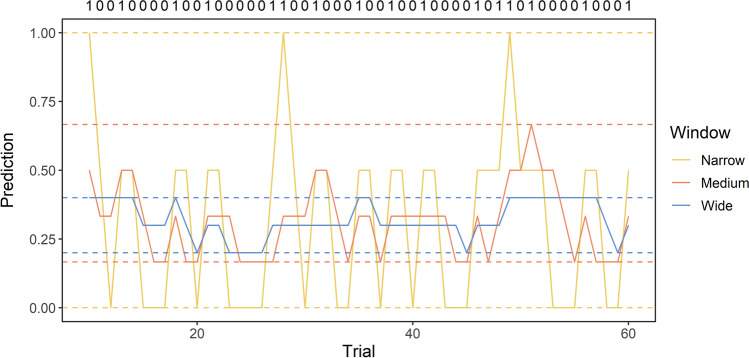
This opinion piece considers the construct of tolerance of uncertainty and suggests that it should be viewed in the context of three psychological factors: uncertainty aversion, uncertainty interpretation, and uncertainty determinability. Uncertainty aversion refers to a dislike of situations in which the outcomes are not deterministic and is similar to conventional conceptions of (in)tolerance of uncertainty. Uncertainty interpretation refers to the extent to which variability in an observed outcome is interpreted as random fluctuation around a relatively stable base-rate versus frequent and rapid changes in the base-rate. Uncertainty determinability refers to the (actual or perceived) capacity of the individual to generate any meaningful expectancy of the uncertain outcome, which may be undeterminable if predictions are updated too quickly. We argue that uncertainty interpretation and determinability are psychological responses to the experience of probabilistic events that vary among individuals and can moderate negative affect experienced in response to uncertainty. We describe how individual differences in basic parameters of associative learning (modelled by a simple learning window) could lead to this variation. To explain these hypotheses, we utilise the distinction between aleatory uncertainty (the inherent unpredictability of individual stochastic events) and epistemic uncertainty (obtainable knowledge that the individual lacks or perceives to be lacking). We argue that when expectancies are updated quickly, epistemic uncertainty will dominate the individual's representation of the events around them, leading to a subjective experience of the world as one that is volatile and unpredictable.
这篇观点文章探讨了不确定性容忍度的结构,并提出应该从三个心理因素的角度来看待它:不确定性回避、不确定性解释和不确定性可确定性。不确定性回避是指不喜欢结果不确定的情况,类似于对(不)容忍不确定性的传统概念。不确定性解释是指在观察到的结果中,可变性被解释为围绕相对稳定的基础比率随机波动的程度,而不是基础比率的频繁和快速变化。不确定性可确定性是指个体(实际或感知)产生不确定结果的任何有意义的预期的能力,如果预测更新得太快,可能无法确定。我们认为,不确定性解释和可确定性是对概率事件的个体差异的心理反应,可以调节对不确定性的负面反应。我们描述了个体在联想学习的基本参数(由简单的学习窗口建模)方面的差异如何导致这种差异。为了解释这些假设,我们利用了机遇性不确定性(单个随机事件的固有不可预测性)和认识不确定性(个体缺乏或感知到的可获得知识)之间的区别。我们认为,当期望更新得很快时,认识不确定性将主导个体对周围事件的表现,导致个体对世界的主观体验是不稳定和不可预测的。