Bart's Health NHS Trust, London, UK.
Kamuzu University of Health Sciences, Blantyre, Malawi.
BMC Med Educ. 2023 Feb 15;23(1):111. doi: 10.1186/s12909-023-04077-8.
A key strategy to building surgical capacity in low income countries involves training care providers, particularly in the interventions highlighted by the Lancet Commission for Global Surgery, including the management of open fractures. This is a common injury, especially in areas with a high incidence of road traffic incidents. The aim of this study was to use a nominal group consensus method to design a course on open fracture management for clinical officers in Malawi.
The nominal group meeting was held over two days, including clinical officers and surgeons from Malawi and the UK with various levels of expertise in the fields of global surgery, orthopaedics and education. The group was posed with questions on course content, delivery and evaluation. Each participant was encouraged to suggest an answer and the advantages and disadvantages of each suggestion were discussed before voting through an anonymous online platform. Voting included use of a Likert scale or ranking available options. Ethical approval for this process was obtained from the College of Medicine Research and Ethics Committee Malawi and the Liverpool School of Tropical Medicine.
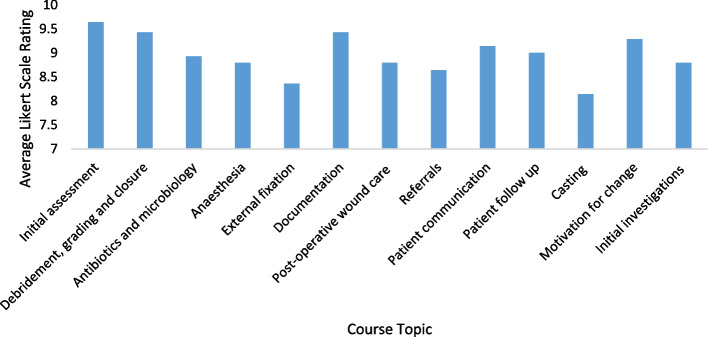
All suggested course topics received an average score of greater than 8 out of 10 on a Likert scale and were included in the final programme. Videos was the highest ranking option as a method for delivering pre-course material. The highest ranking methods for each course topic included lectures, videos and practicals. When asked what practical skill should be tested at the end of the course, the highest ranking option was "initial assessment".
This work outlines how a consensus meeting can be used to design an educational intervention to improve patient care and outcomes. Through combining the perspectives of both the trainer and trainee, the course aligns both agendas so that it is relevant and sustainable.
在低收入国家建立外科能力的一个关键策略是培训医护人员,特别是在柳叶刀全球外科委员会强调的干预措施方面,包括开放性骨折的管理。这是一种常见的损伤,特别是在道路交通事件发生率较高的地区。本研究旨在使用名义小组共识方法为马拉维的临床医生设计一门开放性骨折管理课程。
为期两天的名义小组会议包括来自马拉维和英国的临床医生和外科医生,他们在全球外科、骨科和教育领域具有不同水平的专业知识。小组被提出有关课程内容、教学和评估的问题。鼓励每位参与者提出一个答案,并在匿名在线平台上投票之前讨论每个建议的优缺点。投票包括使用李克特量表或对可用选项进行排名。该过程的伦理批准得到了马拉维医学院研究和伦理委员会以及利物浦热带医学院的批准。
所有建议的课程主题在李克特量表上的平均得分均高于 8 分,并包含在最终方案中。视频是作为预课程材料的最佳教学方法。每个课程主题的最高排名方法包括讲座、视频和实践。当被问及在课程结束时应测试哪种实践技能时,排名最高的选项是“初步评估”。
这项工作概述了如何使用共识会议来设计一项教育干预措施,以改善患者的护理和结果。通过结合培训师和学员的观点,该课程使双方的议程保持一致,使课程具有相关性和可持续性。