
用于神经肌肉骨骼疾病的手动针刺:刺激参数的选择及相应效果。
Manual acupuncture for neuromusculoskeletal disorders: The selection of stimulation parameters and corresponding effects.
作者信息
Wang Bing-Gan, Xu Liu-Liu, Yang Hua-Yuan, Xie Jian, Xu Gang, Tang Wen-Chao
机构信息
School of Acupuncture-Moxibustion and Tuina, Shanghai University of Traditional Chinese Medicine, Shanghai, China.
Department of Acupuncture and Moxibustion, Yuhuan Hospital of Traditional Chinese Medicine, Taizhou, Zhejiang, China.
出版信息
Front Neurosci. 2023 Jan 30;17:1096339. doi: 10.3389/fnins.2023.1096339. eCollection 2023.
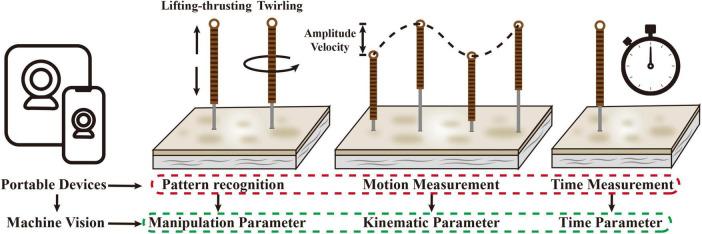
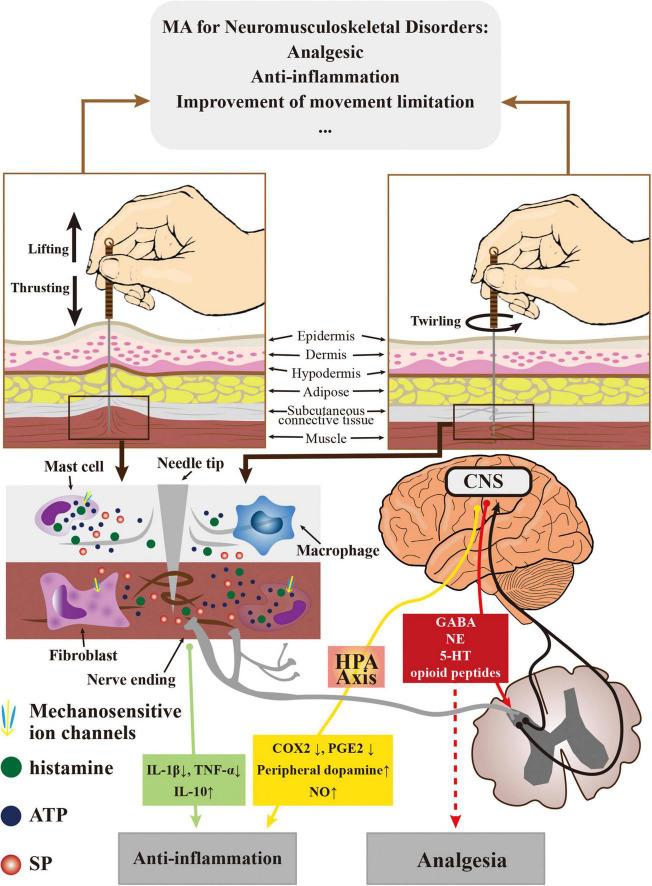
As a minimally invasive method of physical stimulation, manual acupuncture (MA) is used globally as a sort of therapy for neuromusculoskeletal disorders. In addition to selecting appropriate acupoints, acupuncturists should also determine the stimulation parameters of needling, such as the manipulation (lifting-thrusting or twirling), needling amplitude, velocity, and stimulation time. At present, most studies focus on acupoint combination and mechanism of MA, the relationship between stimulation parameters and their therapeutic effects, as well as the influence on mechanism of action are relatively scattered, and lack of systematic summary and analysis. This paper reviewed the three types of stimulation parameters of MA, their common options and values, corresponding effects and potential mechanisms of action. The purpose of such efforts is to provide a useful reference for the dose-effect relationship of MA and the quantification and standardization of its clinical treatment of neuromusculoskeletal disorders to further promote the application of acupuncture in the world.
作为一种微创物理刺激方法,手动针刺(MA)在全球范围内被用作治疗神经肌肉骨骼疾病的一种疗法。除了选择合适的穴位外,针灸师还应确定针刺的刺激参数,如手法(提插或捻转)、针刺幅度、速度和刺激时间。目前,大多数研究集中在手动针刺的穴位配伍和作用机制上,刺激参数与其治疗效果之间的关系以及对作用机制的影响相对分散,缺乏系统的总结和分析。本文综述了手动针刺的三种刺激参数、其常见选择和数值、相应效果及潜在作用机制。这样做的目的是为手动针刺的量效关系及其在神经肌肉骨骼疾病临床治疗中的量化和标准化提供有益参考,以进一步推动针灸在世界范围内的应用。
 Zotero 插件