The William Harvey Research Institute, Queen Mary University of London, London, United Kingdom.
Front Immunol. 2023 Jan 30;13:1084394. doi: 10.3389/fimmu.2022.1084394. eCollection 2022.
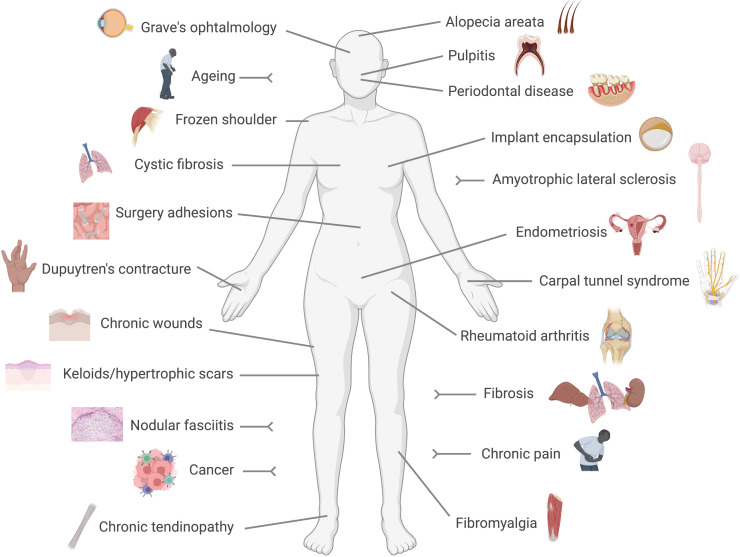
Stromal cells have emerged as central drivers in multiple and diverse diseases, and consequently, as potential new cellular targets for the development of novel therapeutic strategies. In this review we revise the main roles of fibroblasts, not only as structural cells but also as players and regulators of immune responses. Important aspects like fibroblast heterogeneity, functional specialization and cellular plasticity are also discussed as well as the implications that these aspects may have in disease and in the design of novel therapeutics. An extensive revision of the actions of fibroblasts on different conditions uncovers the existence of numerous diseases in which this cell type plays a pathogenic role, either due to an exacerbation of their 'structural' side, or a dysregulation of their 'immune side'. In both cases, opportunities for the development of innovative therapeutic approaches exist. In this regard, here we revise the existing evidence pointing at the melanocortin pathway as a potential new strategy for the treatment and management of diseases mediated by aberrantly activated fibroblasts, including scleroderma or rheumatoid arthritis. This evidence derives from studies involving models of primary fibroblasts, models of disease as well as ongoing human clinical trials. Melanocortin drugs, which are pro-resolving mediators, have shown ability to reduce collagen deposition, activation of myofibroblasts, reduction of pro-inflammatory mediators and reduced scar formation. Here we also discuss existing challenges, both in approaching fibroblasts as therapeutic targets, and in the development of novel melanocortin drug candidates, that may help advance the field and deliver new medicines for the management of diseases with high medical needs.
基质细胞已成为多种不同疾病的核心驱动因素,因此成为开发新型治疗策略的潜在新细胞靶点。在这篇综述中,我们回顾了成纤维细胞的主要作用,不仅作为结构细胞,而且作为免疫反应的参与者和调节剂。还讨论了成纤维细胞的异质性、功能特化和细胞可塑性等重要方面,以及这些方面在疾病和新型治疗药物设计中的可能影响。对成纤维细胞在不同条件下作用的广泛回顾揭示了存在许多疾病,其中这种细胞类型发挥致病作用,要么是由于其“结构”方面的加剧,要么是由于其“免疫”方面的失调。在这两种情况下,都存在开发创新治疗方法的机会。在这方面,我们回顾了现有的证据,这些证据表明黑色素皮质素途径是治疗和管理由异常激活的成纤维细胞介导的疾病的一种潜在新策略,包括硬皮病或类风湿关节炎。这些证据来自于涉及原代成纤维细胞模型、疾病模型以及正在进行的人类临床试验的研究。作为促分解代谢介质的黑色素皮质素药物已显示出减少胶原蛋白沉积、肌成纤维细胞激活、减少促炎介质和减少瘢痕形成的能力。在这里,我们还讨论了在将成纤维细胞作为治疗靶点以及开发新型黑色素皮质素药物候选物方面存在的现有挑战,这些挑战可能有助于推动该领域的发展,并为具有高医疗需求的疾病提供新的治疗药物。