Delaval Aurélien, Bendall Victoria, Hetherington Stuart J, Skaug Hans J, Frost Michelle, Jones Catherine S, Noble Leslie R
Faculty of Biosciences and Aquaculture Nord University Bodø Norway.
Centre for Environment Fisheries and Aquaculture Science (CEFAS) Lowestoft UK.
Evol Appl. 2022 Sep 3;16(2):461-473. doi: 10.1111/eva.13474. eCollection 2023 Feb.
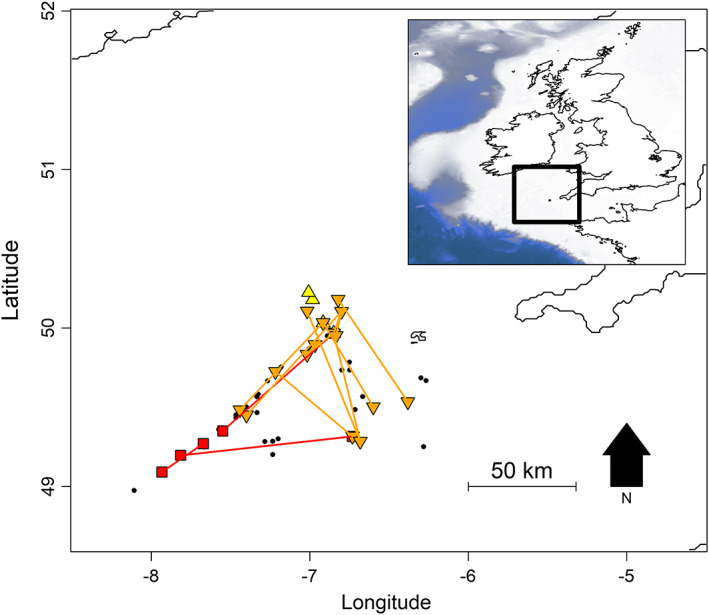
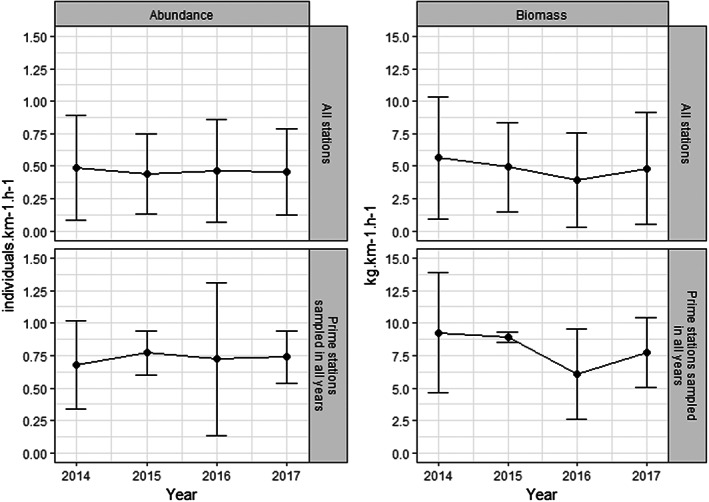
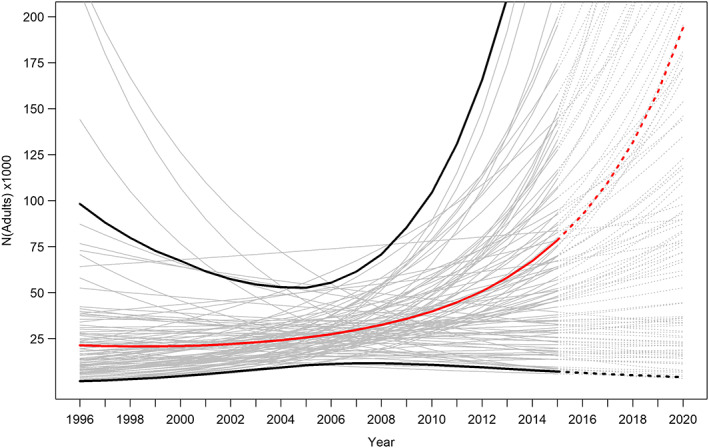
Estimating the demographic parameters of contemporary populations is essential to the success of elasmobranch conservation programmes, and to understanding their recent evolutionary history. For benthic elasmobranchs such as skates, traditional fisheries-independent approaches are often unsuitable as the data may be subject to various sources of bias, whilst low recapture rates can render mark-recapture programmes ineffectual. Close-kin mark-recapture (CKMR), a novel demographic modelling approach based on the genetic identification of close relatives within a sample, represents a promising alternative approach as it does not require physical recaptures. We evaluated the suitability of CKMR as a demographic modelling tool for the critically endangered blue skate () in the Celtic Sea using samples collected during fisheries-dependent trammel-net surveys that ran from 2011 to 2017. We identified three full-sibling and 16 half-sibling pairs among 662 skates, which were genotyped across 6291 genome-wide single nucleotide polymorphisms, 15 of which were cross-cohort half-sibling pairs that were included in a CKMR model. Despite limitations owing to a lack of validated life-history trait parameters for the species, we produced the first estimates of adult breeding abundance, population growth rate, and annual adult survival rate for in the Celtic Sea. The results were compared to estimates of genetic diversity, effective population size ( ), and to catch per unit effort estimates from the trammel-net survey. Although each method was characterized by wide uncertainty bounds, together they suggested a stable population size across the time-series. Recommendations for the implementation of CKMR as a conservation tool for data-limited elasmobranchs are discussed. In addition, the spatio-temporal distribution of the 19 sibling pairs revealed a pattern of site fidelity in , and supported field observations suggesting an area of critical habitat that could qualify for protection might occur near the Isles of Scilly.
估计当代种群的人口统计学参数对于板鳃亚纲动物保护计划的成功以及了解它们近期的进化历史至关重要。对于像鳐鱼这样的底栖板鳃亚纲动物,传统的与渔业无关的方法往往并不适用,因为数据可能存在各种偏差来源,而低重捕率会使标记重捕计划无效。近亲标记重捕(CKMR)是一种基于样本中近亲遗传识别的新型人口统计学建模方法,它是一种很有前景的替代方法,因为它不需要实际重捕。我们利用2011年至2017年依赖渔业的刺网调查期间收集的样本,评估了CKMR作为凯尔特海极度濒危蓝鳐()人口统计学建模工具的适用性。我们在662条鳐鱼中识别出3对全同胞和16对半同胞对,它们在6291个全基因组单核苷酸多态性位点上进行了基因分型,其中15对跨群体半同胞对被纳入CKMR模型。尽管由于缺乏该物种经过验证的生活史特征参数存在局限性,但我们首次对凯尔特海蓝鳐的成年繁殖丰度、种群增长率和成年年存活率进行了估计。将结果与遗传多样性估计值、有效种群大小()以及刺网调查的单位努力捕捞量估计值进行了比较。尽管每种方法的不确定性范围都很宽,但综合起来它们表明整个时间序列中的种群大小是稳定的。讨论了将CKMR作为数据有限的板鳃亚纲动物保护工具的实施建议。此外,19对同胞对的时空分布揭示了蓝鳐的位点忠实模式,并支持了实地观察结果,表明锡利群岛附近可能存在一个有资格获得保护的关键栖息地区域。