Netherlands Pharmacovigilance Centre Lareb, 's-Hertogenbosch, Netherlands.
School of Pharmacy, Biotechnology, and Sport Sciences, University of Bologna, Bologna, Italy.
Front Immunol. 2023 Jan 30;14:1078736. doi: 10.3389/fimmu.2023.1078736. eCollection 2023.
Albeit the need for sex-disaggregated results of adverse events after immunization (AEFIs) is gaining attention since the COVID-19 pandemic, studies with emphasis on sexual dimorphism in response to COVID-19 vaccination are relatively scarce. This prospective cohort study aimed to assess differences in the incidence and course of reported AEFIs after COVID-19 vaccination between males and females in the Netherlands and provides a summary of sex-disaggregated outcomes in published literature.
Patient reported outcomes of AEFIs over a six month period following the first vaccination with BioNTech-Pfizer, AstraZeneca, Moderna or the Johnson&Johnson vaccine were collected in a Cohort Event Monitoring study. Logistic regression was used to assess differences in incidence of 'any AEFI', local reactions and the top ten most reported AEFIs between the sexes. Effects of age, vaccine brand, comorbidities, prior COVID-19 infection and the use of antipyretic drugs were analyzed as well. Also, time-to-onset, time-to-recovery and perceived burden of AEFIs was compared between the sexes. Third, a literature review was done to retrieve sex-disaggregated outcomes of COVID-19 vaccination.
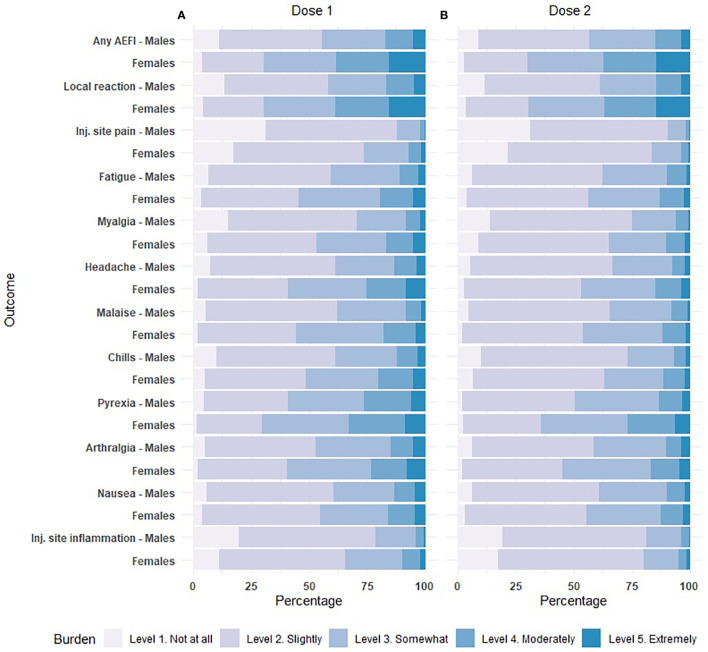
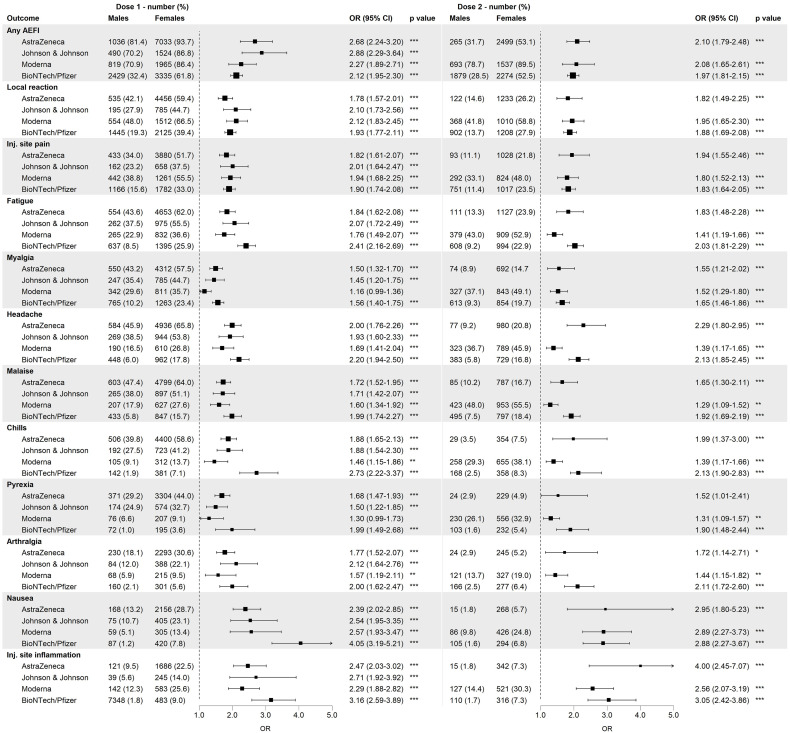
The cohort included 27,540 vaccinees (38.5% males). Females showed around two-fold higher odds of having any AEFI as compared to males with most pronounced differences after the first dose and for nausea and injection site inflammation. Age was inversely associated with AEFI incidence, whereas a prior COVID-19 infection, the use of antipyretic drugs and several comorbidities were positively associated. The perceived burden of AEFIs and time-to-recovery were slightly higher in females.
The results of this large cohort study correspond to existing evidence and contribute to the knowledge gain necessary to disentangle the magnitude of the effect sex in response to vaccination. Whilst females have a significant higher probability of experiencing an AEFI than males, we observed that the course and burden is only to a minor extent different between the sexes.
尽管自 COVID-19 大流行以来,人们越来越关注免疫后不良事件(AEFI)的性别分类结果,但强调 COVID-19 疫苗接种反应性别差异的研究相对较少。本前瞻性队列研究旨在评估荷兰男性和女性接种 COVID-19 疫苗后报告的 AEFI 的发生率和病程差异,并提供已发表文献中性别分类结果的总结。
在一项队列事件监测研究中,收集了接种 BioNTech-Pfizer、AstraZeneca、Moderna 或 Johnson&Johnson 疫苗后 6 个月内患者报告的 AEFI 结果。使用逻辑回归评估性别之间“任何 AEFI”、局部反应和前 10 名报告最多的 AEFI 的发生率差异。还分析了年龄、疫苗品牌、合并症、既往 COVID-19 感染和使用解热药的影响。此外,还比较了性别之间 AEFI 的发病时间、恢复时间和感知负担。第三,进行文献回顾以检索 COVID-19 疫苗接种的性别分类结果。
该队列包括 27540 名疫苗接种者(38.5%为男性)。与男性相比,女性发生任何 AEFI 的几率约为男性的两倍,在第一剂和恶心和注射部位炎症时差异最明显。年龄与 AEFI 发生率呈负相关,而既往 COVID-19 感染、解热药的使用和几种合并症与 AEFI 发生率呈正相关。女性对 AEFI 的感知负担和恢复时间稍长。
这项大型队列研究的结果与现有证据相符,并有助于获得必要的知识来区分接种疫苗时性别的影响程度。虽然女性经历 AEFI 的可能性明显高于男性,但我们观察到性别之间的病程和负担仅在很小程度上有所不同。