E Haoran, Yang Chenlu, Wu Jun, Wu Junqi, Xu Long, Wang Tao, Zhang Lei, Jiang Gening, Zhu Yuming, Chen Chang, Zhao Deping
Department of Thoracic Surgery, Shanghai Pulmonary Hospital, School of Medicine, Tongji University, Shanghai, China.
Ann Cardiothorac Surg. 2023 Jan 31;12(1):34-40. doi: 10.21037/acs-2022-urats-140. Epub 2022 Dec 30.
The clinical efficacy of robot-assisted thoracic surgeries has been explored by numerous recent studies. Nonetheless, since current standard robotic systems (da Vinci Xi system) were intended for multiportal surgical processes and robotic staplers were still unavailable in the developing world, obstacles still remain concerning the feasibility of uniportal robotic surgeries.
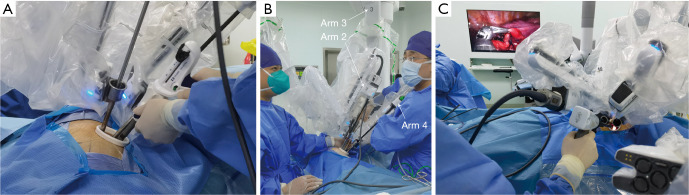
A hybrid uniportal robotic-assisted thoracoscopic surgery (RATS) modality utilizing video-assisted thoracoscopic surgery (VATS) staplers was investigated in Shanghai Pulmonary Hospital. Clinicopathological characteristics and perioperative outcomes concerning patients receiving hybrid uniportal RATS between August 2022 and September 2022 were collected.
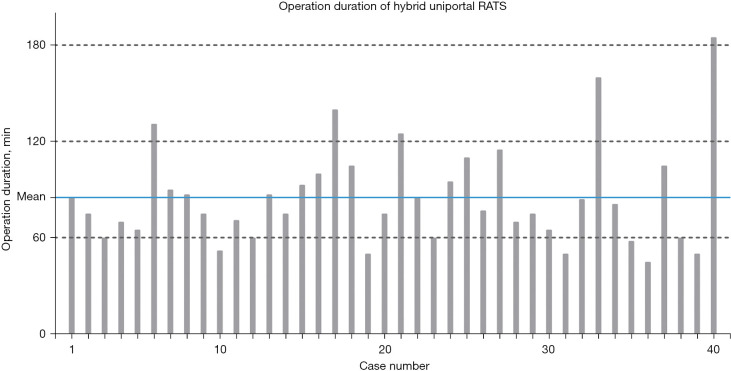
A total of 40 patients were included in this study. Most of the patients (23/40, 57.5%) received hybrid uniportal RATS lobectomies. One conversion from uniportal RATS to biportal process was encountered due to extensive adhesions discovered intraoperatively. The median procedural duration was 76 min [interquartile range (IQR), 61-99 min], and the median blood loss volume was 50 mL (IQR, 50-50 mL). A median stay length of three days (IQR, 2-4 days) was recorded. Eleven patients (27.5%) developed Clavien-Dindo grade I-II postoperative complications, while no grade III-IV complications were observed. Aside from this, none of the patients were readmitted or died within 30 days post-surgery.
The feasibility of hybrid uniportal RATS procedures using VATS staplers has been preliminarily validated. For early-stage non-small cell lung cancer patients, such a procedure might clinical efficacy comparable to that of uniportal RATS utilizing robotic staplers.
近期众多研究探讨了机器人辅助胸外科手术的临床疗效。然而,由于当前的标准机器人系统(达芬奇Xi系统)旨在用于多端口手术过程,且在发展中国家仍无法获得机器人吻合器,单端口机器人手术的可行性仍然存在障碍。
在上海肺科医院研究了一种利用电视辅助胸腔镜手术(VATS)吻合器的混合单端口机器人辅助胸腔镜手术(RATS)模式。收集了2022年8月至2022年9月期间接受混合单端口RATS手术患者的临床病理特征和围手术期结果。
本研究共纳入40例患者。大多数患者(23/40,57.5%)接受了混合单端口RATS肺叶切除术。由于术中发现广泛粘连,1例患者从单端口RATS转换为双端口手术。手术中位持续时间为76分钟[四分位间距(IQR),61 - 99分钟],中位失血量为50毫升(IQR,50 - 50毫升)。记录的中位住院时间为三天(IQR,2 - 4天)。11例患者(27.5%)发生了Clavien-Dindo I-II级术后并发症,未观察到III-IV级并发症。除此之外,术后30天内无患者再次入院或死亡。
使用VATS吻合器的混合单端口RATS手术的可行性已得到初步验证。对于早期非小细胞肺癌患者,这种手术可能具有与使用机器人吻合器的单端口RATS相当的临床疗效。