Department of Medicine, University of Alabama at Birmingham, Birmingham, Alabama, United States.
Math-Science Department, Alabama School of Fine Arts, Birmingham, Alabama, United States.
Am J Physiol Renal Physiol. 2023 Apr 1;324(4):F423-F430. doi: 10.1152/ajprenal.00295.2022. Epub 2023 Feb 16.
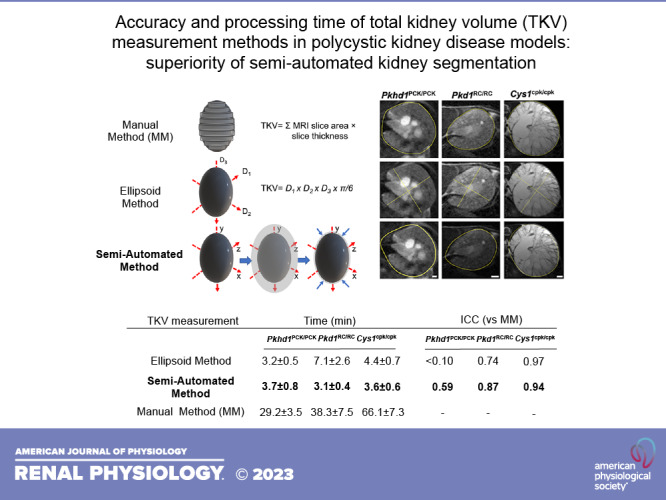
Measurement of total kidney volume (TKV) using magnetic resonance imaging (MRI) is a valuable approach for monitoring disease progression in autosomal dominant polycystic kidney disease (PKD) and is becoming more common in preclinical studies using animal models. Manual contouring of kidney MRI areas [i.e., manual method (MM)] is a conventional, but time-consuming, way to determine TKV. We developed a template-based semiautomatic image segmentation method (SAM) and validated it in three commonly used PKD models: mice, mice, and rats ( = 10 per model). We compared SAM-based TKV with that obtained by clinical alternatives including the ellipsoid formula-based method (EM) using three kidney dimensions, the longest kidney length method (LM), and MM, which is considered the gold standard. Both SAM and EM presented high accuracy in TKV assessment in mice [interclass correlation coefficient (ICC) ≥ 0.94]. SAM was superior to EM and LM in mice (ICC = 0.87, 0.74, and <0.10 for SAM, EM, and LM, respectively) and rats (ICC = 0.59, <0.10, and <0.10, respectively). Also, SAM outperformed EM in processing time in mice (3.6 ± 0.6 vs. 4.4 ± 0.7 min/kidney) and mice (3.1 ± 0.4 vs. 7.1 ± 2.6 min/kidney, both < 0.001) but not in rats (3.7 ± 0.8 vs. 3.2 ± 0.5 min/kidney). LM was the fastest (∼1 min) but correlated most poorly with MM-based TKV in all studied models. Processing times by MM were longer for mice, mice, and rats (66.1 ± 7.3, 38.3 ± 7.5, and 29.2 ± 3.5 min). In summary, SAM is a fast and accurate method to determine TKV in mouse and rat PKD models. Total kidney volume (TKV) is a valuable readout in preclinical studies for autosomal dominant and autosomal recessive polycystic kidney diseases (ADPKD and ARPKD). Since conventional TKV assessment by manual contouring of kidney areas in all images is time-consuming, we developed a template-based semiautomatic image segmentation method (SAM) and validated it in three commonly used ADPKD and ARPKD models. SAM-based TKV measurements were fast, highly reproducible, and accurate across mouse and rat ARPKD and ADPKD models.
使用磁共振成像(MRI)测量总肾体积(TKV)是监测常染色体显性多囊肾病(PKD)疾病进展的一种有价值的方法,并且在使用动物模型的临床前研究中越来越普遍。肾脏 MRI 区域的手动轮廓绘制[即手动方法(MM)]是确定 TKV 的传统但耗时的方法。我们开发了一种基于模板的半自动图像分割方法(SAM),并在三种常用的 PKD 模型中进行了验证:小鼠、大鼠和仓鼠(每个模型 10 只)。我们将基于 SAM 的 TKV 与临床替代方法(包括基于椭球公式的方法(EM)使用三个肾脏尺寸、最长肾脏长度方法(LM)和 MM,后者被认为是金标准)进行了比较。SAM 和 EM 在评估小鼠中的 TKV 方面均具有很高的准确性[组内相关系数(ICC)≥0.94]。SAM 在评估小鼠和大鼠中的 TKV 方面优于 EM 和 LM(SAM、EM 和 LM 的 ICC 分别为 0.87、0.74 和 <0.10)。此外,SAM 在处理时间方面优于 EM,在小鼠(3.6±0.6 与 4.4±0.7 分钟/肾)和大鼠(3.1±0.4 与 7.1±2.6 分钟/肾,均<0.001)中,而在大鼠中则无差异(3.7±0.8 与 3.2±0.5 分钟/肾)。LM 是最快的(约 1 分钟),但在所有研究模型中与 MM 基于 TKV 的相关性最差。在所有研究的模型中,MM 的处理时间在小鼠、大鼠和仓鼠中均较长(66.1±7.3、38.3±7.5 和 29.2±3.5 分钟)。总之,SAM 是一种快速准确的方法,可用于确定小鼠和大鼠 PKD 模型中的 TKV。总肾体积(TKV)是常染色体显性和常染色体隐性多囊肾病(ADPKD 和 ARPKD)临床前研究中的有价值的指标。由于对所有图像中的肾脏区域进行手动轮廓绘制来常规评估 TKV 非常耗时,因此我们开发了一种基于模板的半自动图像分割方法(SAM),并在三种常用的 ADPKD 和 ARPKD 模型中进行了验证。SAM 基于 TKV 的测量快速、高度可重复且在小鼠和大鼠的 ARPKD 和 ADPKD 模型中均准确。