Department of Medicine, The Ottawa Hospital, University of Ottawa, Ottawa, Ontario, Canada.
Department of Physical Medicine and Rehabilitation, Bruyère Research Institute, Ottawa, Ontario, Canada.
J Gerontol A Biol Sci Med Sci. 2023 Dec 1;78(12):2348-2355. doi: 10.1093/gerona/glad044.
Assessing an older adult's fitness-to-drive is an important part of clinical decision making. However, most existing risk prediction tools only have a dichotomous design, which does not account for subtle differences in risk status for patients with complex medical conditions or changes over time. Our objective was to develop an older driver risk stratification tool (RST) to screen for medical fitness-to-drive in older adults.
Participants were active drivers aged 70 and older from 7 sites across 4 Canadian provinces. They underwent in-person assessments every 4 months with an annual comprehensive assessment. Participant vehicles were instrumented to provide vehicle and passive Global Positioning System (GPS) data. The primary outcome measure was police-reported, expert-validated, at-fault collision adjusted per annual kilometers driven. Predictor variables included physical, cognitive, and health assessment measures.
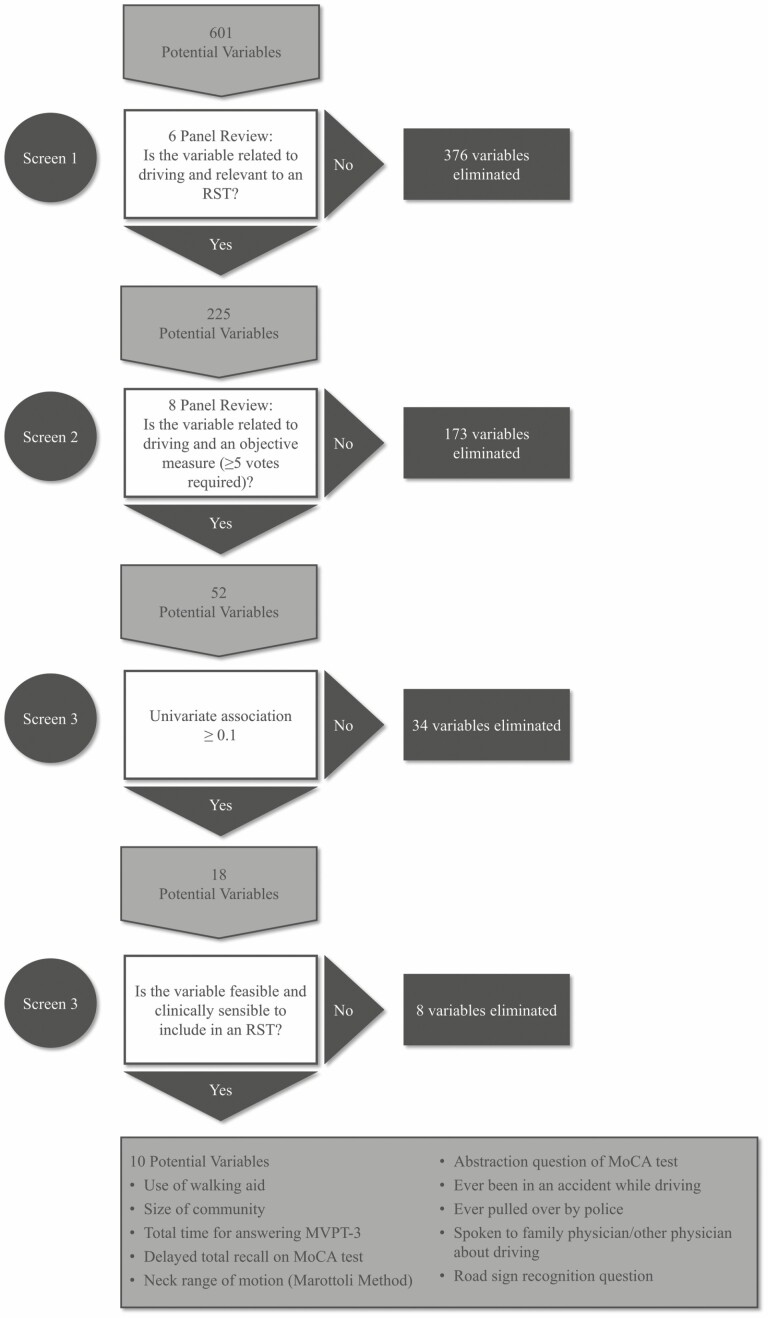
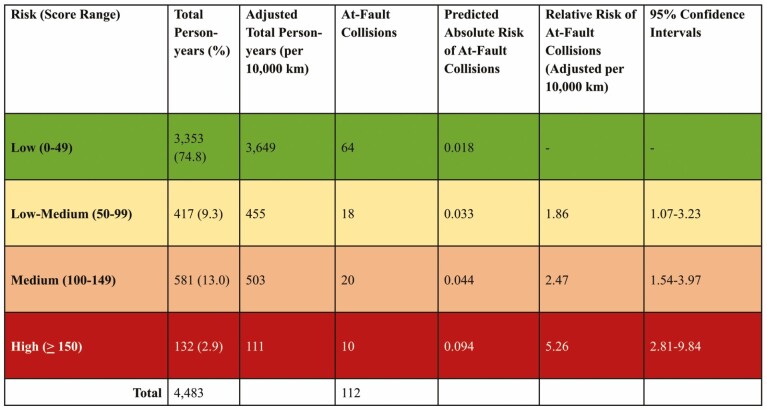
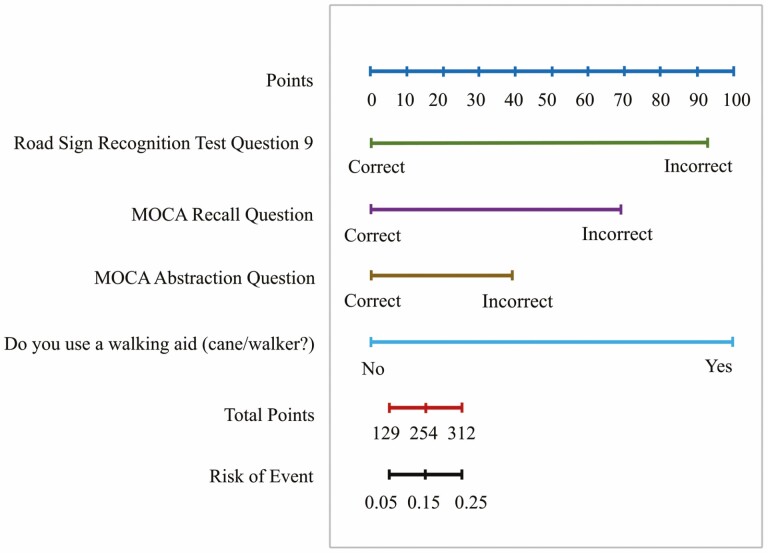
A total of 928 older drivers were recruited for this study beginning in 2009. The average age at enrollment was 76.2 (standard deviation [SD] = 4.8) with 62.1% male participants. The mean duration for participation was 4.9 (SD = 1.6) years. The derived Candrive RST included 4 predictors. Out of 4 483 person-years of driving, 74.8% fell within the lowest risk category. Only 2.9% of person-years were in the highest risk category where the relative risk for at-fault collisions was 5.26 (95% confidence interval = 2.81-9.84) compared to the lowest risk group.
For older drivers whose medical conditions create uncertainty regarding their fitness-to-drive, the Candrive RST may assist primary health care providers when initiating a conversation about driving and to guide further evaluation.
评估老年人的驾驶能力是临床决策的重要组成部分。然而,大多数现有的风险预测工具仅采用二分法设计,无法考虑患有复杂疾病的患者的风险状况细微差异或随时间的变化。我们的目标是开发一种老年驾驶员风险分层工具(RST),以筛选老年人的医学驾驶适宜性。
参与者是来自加拿大 4 个省的 7 个地点的 70 岁及以上的活跃驾驶员。他们每 4 个月接受一次面对面评估,每年进行一次全面评估。参与者的车辆配备了仪器,可提供车辆和被动全球定位系统(GPS)数据。主要结局指标是警察报告、专家验证、按每年行驶公里数调整的有责碰撞。预测变量包括身体、认知和健康评估测量。
本研究于 2009 年开始招募了 928 名老年驾驶员。入组时的平均年龄为 76.2(标准差[SD] = 4.8),其中 62.1%为男性参与者。参与的平均时间为 4.9(SD = 1.6)年。推导的 Candrive RST 包括 4 个预测因素。在 4483 人年的驾驶中,74.8%属于最低风险类别。只有 2.9%的人年属于最高风险类别,在此类别中,有责碰撞的相对风险为 5.26(95%置信区间[CI] = 2.81-9.84),与最低风险组相比。
对于那些其医疗状况对其驾驶适宜性存在不确定性的老年驾驶员,Candrive RST 可帮助初级保健提供者在启动关于驾驶的对话时提供帮助,并指导进一步评估。