
产科术前贫血管理的当前概念。
Current concepts in preoperative anemia management in obstetrics.
机构信息
Department of Anaesthesiology, Evangelisches Diakoniekrankenhaus, Freiburg, Germany.
Department of Anaesthesiology, Intensive Care, Emergency and Pain Medicine, University Hospital Wuerzburg, Wuerzburg.
出版信息
Curr Opin Anaesthesiol. 2023 Jun 1;36(3):255-262. doi: 10.1097/ACO.0000000000001252. Epub 2023 Feb 27.
PURPOSE OF REVIEW
The purpose of this article is to provide an overview of currently recommended treatment approaches for anemia during pregnancy, with a special focus on iron deficiency and iron deficiency anemia (IDA).
RECENT FINDINGS
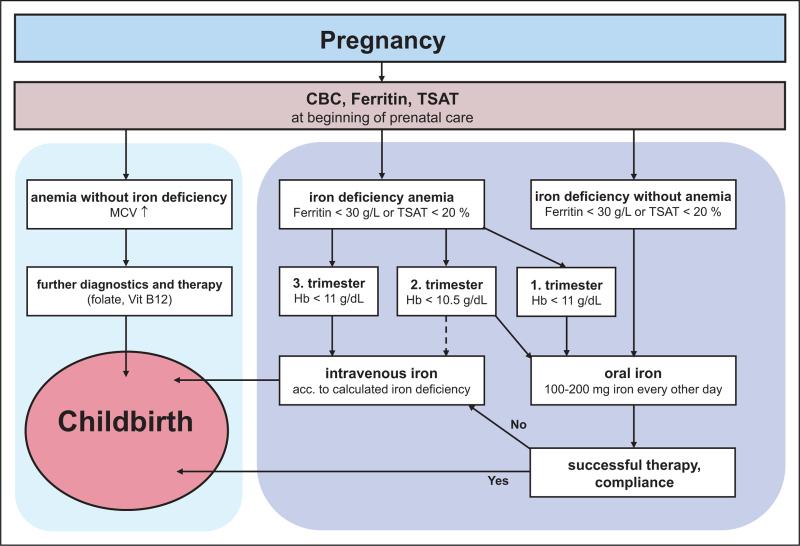
As consistent patient blood management (PBM) guidelines in obstetrics are still lacking, recommendations regarding the timing of anemia screening and the treatment recommendations for iron deficiency and IDA during pregnancy are still controversial. Based on increasing evidence, early screening for anemia and iron deficiency should be recommended at the beginning of each pregnancy. To reduce maternal and fetal burden, any iron deficiency, even without anemia, should be treated as early as possible during pregnancy. While oral iron supplements administered every other day are the standard treatment in the first trimester, the use of intravenous iron supplements is increasingly suggested from the second trimester onwards.
SUMMARY
The treatment of anemia, and more specifically iron deficiency anemia during pregnancy, holds many possibilities for improvement. The fact that the period of risk is known well in advance and thus there is a long optimization phase is per se an ideal prerequisite for the best possible therapy of treatable causes of anemia. Standardization of recommendations and guidelines for screening and treatment of IDA in obstetrics is required for the future. In any case, a multidisciplinary consent is the precondition for a successfully implementation of anemia management in obstetrics to establish an approved algorithm easily enabling detection and treatment of IDA during pregnancy.
目的综述
本文旨在概述目前推荐的妊娠期贫血治疗方法,特别关注缺铁和缺铁性贫血(IDA)。
最新发现
由于产科一致的患者血液管理(PBM)指南仍缺乏,因此关于妊娠期贫血筛查的时机以及缺铁和 IDA 的治疗建议仍存在争议。基于越来越多的证据,建议在每次妊娠开始时就对贫血和缺铁进行早期筛查。为了减轻母婴负担,即使没有贫血,也应尽早在妊娠期治疗任何缺铁。虽然在妊娠早期每两天口服补铁是标准治疗,但从妊娠中期开始,越来越多的建议使用静脉补铁。
总结
妊娠期贫血,特别是缺铁性贫血的治疗有很大的改进空间。风险期众所周知且有很长的优化阶段,这本身就是对可治疗性贫血病因进行最佳治疗的理想前提。未来需要对产科 IDA 的筛查和治疗建议进行标准化。无论如何,多学科的共识是成功实施产科贫血管理的前提,以建立一个经认可的算法,方便在妊娠期检测和治疗 IDA。

 Zotero 插件