Department of Ophthalmology, Hadassah Medical Center, Faculty of Medicine, The Hebrew University of Jerusalem, Jerusalem, Israel.
Reflection Biotechnologies Limited, Hong Kong, China.
Transl Vis Sci Technol. 2023 Feb 1;12(2):27. doi: 10.1167/tvst.12.2.27.
Our analysis estimates BCD prevalence and revealed large differences among various populations. Moreover, it highlights advantages and limitations of the gnomAD database.
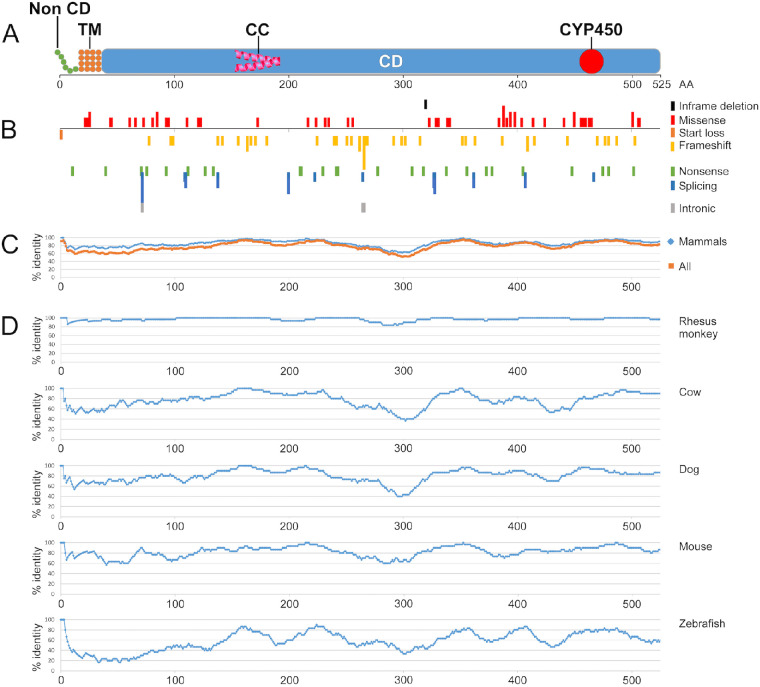
CYP4V2 gnomAD data and reported mutations were used to calculate carrier frequency of each variant. An evolutionary-based sliding window analysis was used to detect conserved protein regions. Potential exonic splicing enhancers (ESEs) were identified using ESEfinder.
Bietti crystalline dystrophy (BCD) is a rare monogenic autosomal recessive (AR) chorioretinal degenerative disease caused by biallelic mutations in CYP4V2. The aim of the current study was to perform an in-depth calculation of worldwide carrier frequency and genetic prevalence of BCD using gnomAD data and comprehensive literature CYP4V2 analysis.
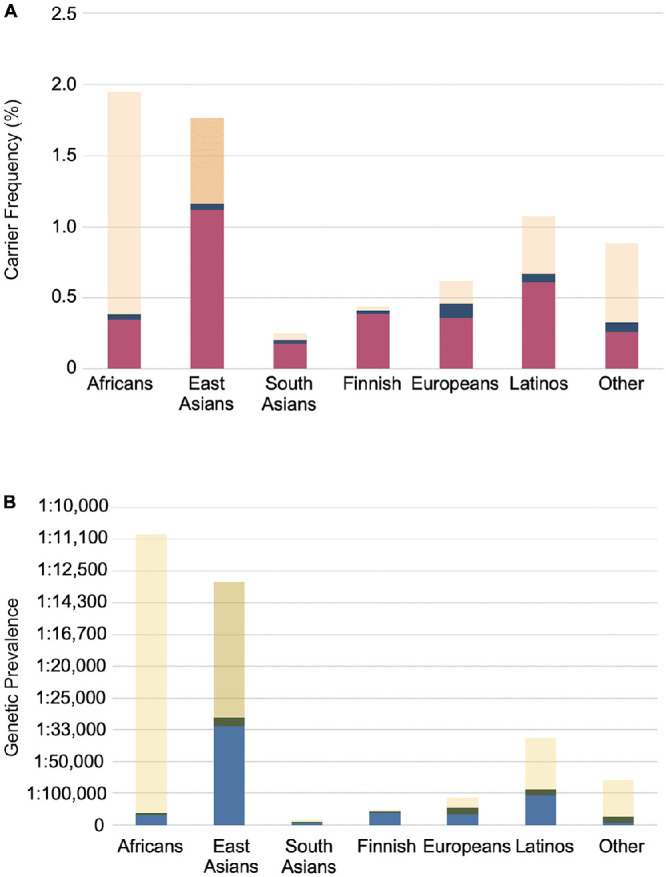
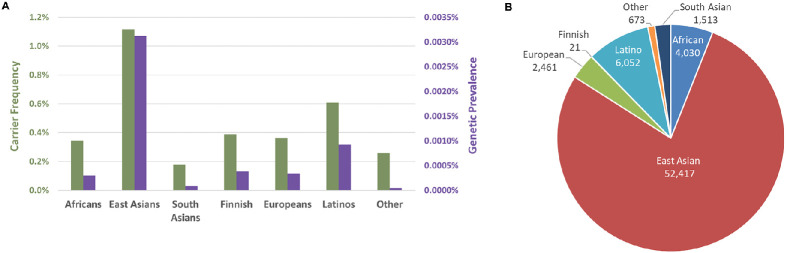
We identified 1171 CYP4V2 variants, 156 of which were considered pathogenic, including 108 reported in patients with BCD. Carrier frequency and genetic prevalence calculations confirmed that BCD is more common in the East Asian population, with ∼19 million healthy carriers and 52,000 individuals who carry biallelic CYP4V2 mutations and are expected to be affected. Additionally, we generated BCD prevalence estimates of other populations, including African, European, Finnish, Latino, and South Asian. Worldwide, the estimated overall carrier frequency of CYP4V2 mutation is 1:210, and therefore, ∼37 million individuals are expected to be healthy carriers of a CYP4V2 mutation. The estimated genetic prevalence of BCD is about 1:116,000, and we predict that ∼67,000 individuals are affected with BCD worldwide.
This analysis is likely to have important implications for genetic counseling in each studied population and for developing clinical trials for potential BCD treatments.
我们的分析估计了 BCD 的患病率,并揭示了不同人群之间的巨大差异。此外,它还突出了 gnomAD 数据库的优势和局限性。
使用 CYP4V2 gnomAD 数据和报道的突变来计算每个变体的携带者频率。使用基于进化的滑动窗口分析来检测保守的蛋白质区域。使用 ESEfinder 识别潜在的外显子剪接增强子(ESE)。
Bietti 结晶性营养不良(BCD)是一种罕见的常染色体隐性(AR)遗传性脉络膜视网膜退行性疾病,由 CYP4V2 的双等位基因突变引起。本研究的目的是使用 gnomAD 数据和全面的 CYP4V2 文献分析,对 BCD 的全球携带者频率和遗传患病率进行深入计算。
我们鉴定了 1171 个 CYP4V2 变体,其中 156 个被认为是致病性的,包括 108 个在 BCD 患者中报道的变体。携带者频率和遗传患病率的计算证实,BCD 在东亚人群中更为常见,约有 1900 万健康携带者,52000 人携带双等位 CYP4V2 突变,预计会受到影响。此外,我们还生成了其他人群的 BCD 患病率估计,包括非洲、欧洲、芬兰、拉丁裔和南亚。全球范围内,预计 CYP4V2 突变的总体携带者频率为 1:210,因此,预计约有 3700 万人是 CYP4V2 突变的健康携带者。预计 BCD 的遗传患病率约为 1:116000,我们预测全球约有 67000 人患有 BCD。
本分析可能对每个研究人群的遗传咨询以及针对潜在 BCD 治疗的临床试验开发具有重要意义。