Institute of Marine Studies, University of California Santa Cruz, Santa Cruz, California, United States of America.
Institute of Biological and Environmental Sciences, School of Biological Sciences, University of Aberdeen, Aberdeen, Scotland, United Kingdom.
PLoS One. 2023 Feb 16;18(2):e0258011. doi: 10.1371/journal.pone.0258011. eCollection 2023.
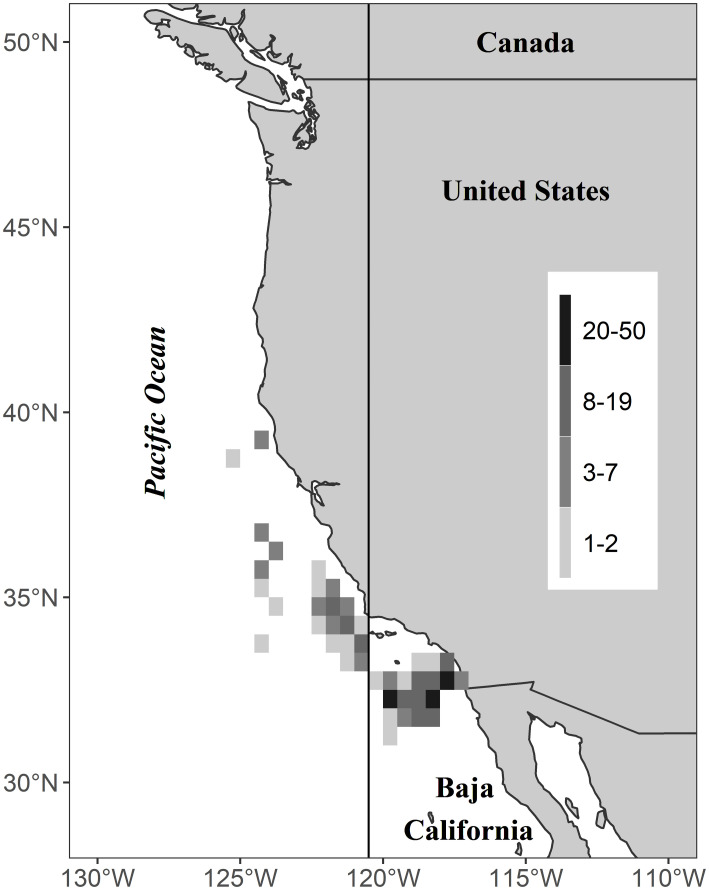
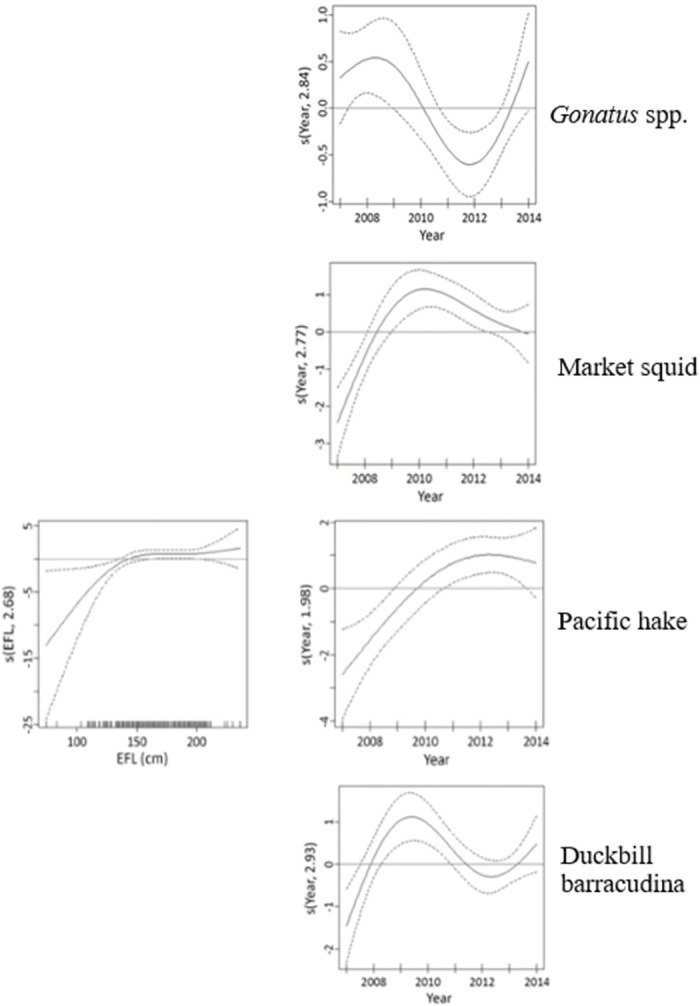
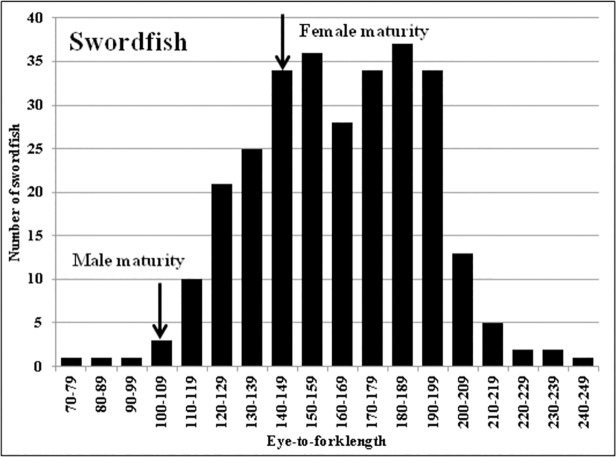
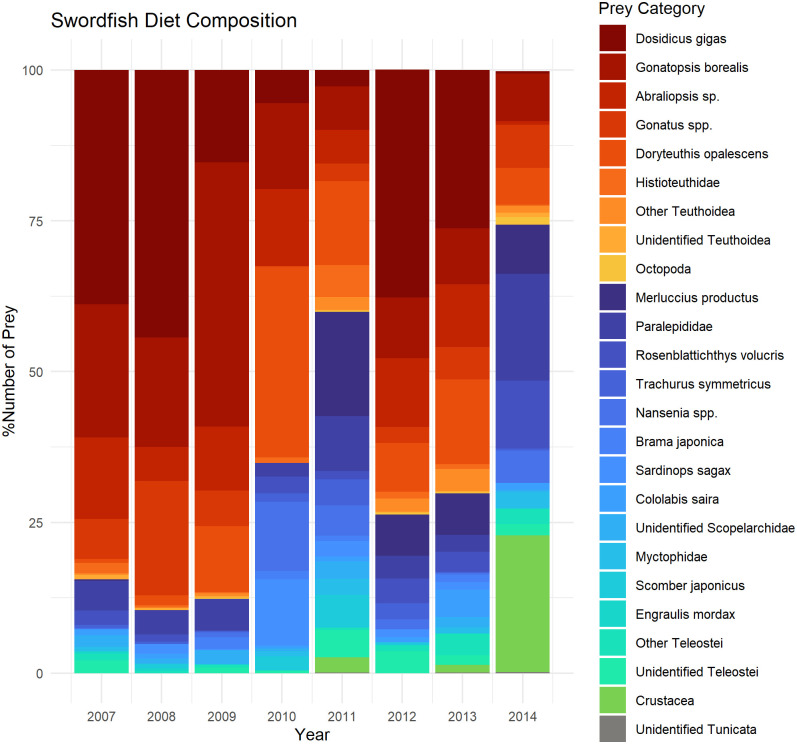
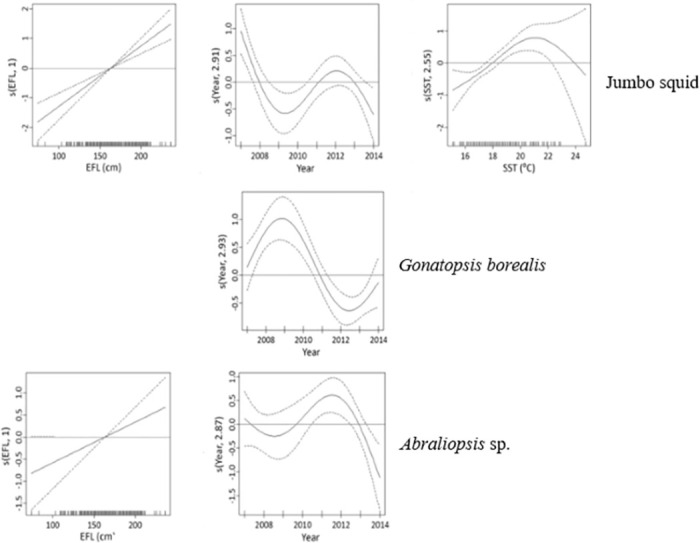
The feeding ecology of broadbill swordfish (Xiphias gladius) in the California Current was described based on analysis of stomach contents collected by fishery observers aboard commercial drift gillnet boats from 2007 to 2014. Prey were identified to the lowest taxonomic level and diet composition was analyzed using univariate and multivariate methods. Of 299 swordfish sampled (74 to 245 cm eye-to-fork length), 292 non-empty stomachs contained remains from 60 prey taxa. Genetic analyses were used to identify prey that could not be identified visually. Diet consisted mainly of cephalopods but also included epipelagic and mesopelagic teleosts. Jumbo squid (Dosidicus gigas) and Gonatopsis borealis were the most important prey based on the geometric index of importance. Swordfish diet varied with body size, location and year. Jumbo squid, Gonatus spp. and Pacific hake (Merluccius productus) were more important for larger swordfish, reflecting the ability of larger specimens to catch large prey. Jumbo squid, Gonatus spp. and market squid (Doryteuthis opalescens) were more important in inshore waters, while G. borealis and Pacific hake predominated offshore. Jumbo squid was more important in 2007-2010 than in 2011-2014, with Pacific hake being the most important prey item in the latter period. Diet variation by area and year probably reflects differences in swordfish preference, prey availability, prey distribution, and prey abundance. The range expansion of jumbo squid that occurred during the first decade of this century may particularly explain their prominence in swordfish diet during 2007-2010. Some factors (swordfish size, area, time period, sea surface temperature) that may influence dietary variation in swordfish were identified. Standardizing methods could make future studies more comparable for conservation monitoring purposes.
基于 2007 年至 2014 年渔业观察员在商业流刺网渔船上收集的胃内容物分析,描述了加利福尼亚海流中宽吻剑鱼(Xiphias gladius)的摄食生态。采用单变量和多变量方法,对猎物进行了最低分类学水平的鉴定,并分析了饮食组成。在所采集的 299 条剑鱼中(眼叉长 74 至 245 厘米),292 个非空胃中含有 60 种猎物残留物。遗传分析用于鉴定肉眼无法识别的猎物。饮食主要由头足类动物组成,但也包括上层和中层鱼类。根据重要几何指数,大王酸浆鱿(Dosidicus gigas)和北方拟沙丁鱼(Gonatopsis borealis)是最重要的猎物。剑鱼的饮食随体型、位置和年份而变化。对于较大的剑鱼,大王酸浆鱿、 Gonatus spp. 和太平洋无须鳕(Merluccius productus)更为重要,这反映了较大标本捕捉大型猎物的能力。在近岸水域,大王酸浆鱿、 Gonatus spp. 和北太平洋鱿鱼(Doryteuthis opalescens)更为重要,而北方拟沙丁鱼和太平洋无须鳕则更为重要。2007-2010 年期间,大王酸浆鱿比 2011-2014 年更为重要,而在后者期间,太平洋无须鳕是最重要的猎物。不同区域和年份的饮食变化可能反映了剑鱼的偏好、猎物的可利用性、猎物的分布和猎物的丰度的差异。本世纪头十年中大王酸浆鱿的范围扩大,可能特别解释了它们在 2007-2010 年期间在剑鱼饮食中的突出地位。确定了一些可能影响剑鱼饮食变化的因素(剑鱼大小、区域、时间段、海面温度)。标准化方法可以使未来的研究更具可比性,以达到保护监测的目的。