Alremeithi Rashed, Sullivan Natalie, Checkeye Hannah, Mazer-Amirshahi Maryann, Pourmand Ali
Department of Emergency Medicine, The George Washington University School of Medicine and Health Sciences, Washington, DC, USA.
Department of Emergency Medicine, MedStar Washington Hospital Center, Georgetown University School of Medicine, Washington, DC, USA.
Clin Exp Emerg Med. 2023 Jun;10(2):147-156. doi: 10.15441/ceem.22.412. Epub 2023 Feb 16.
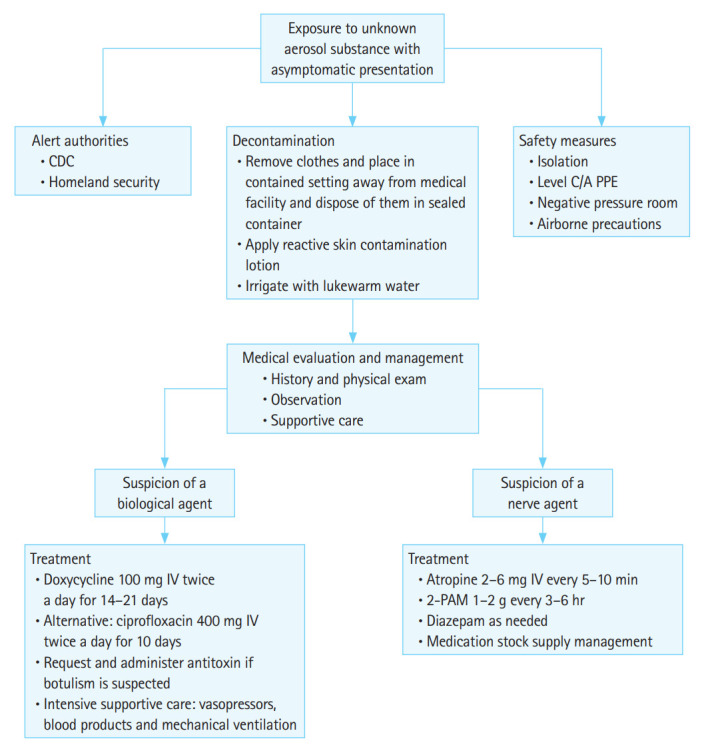
The current heightened international political climate is accompanied by increased risk of chemical or biological agent weaponization. Historical accounts of biochemical warfare are extensive, and considering the recent use of such agents for targeted attacks, clinicians need to recognize and manage these cases. However, agent properties such as the color, odor, ability to be aerosolized, and long incubation period can introduce difficulties in the diagnostic and management approach. We searched PubMed and Scopus for a colorless, odorless, aerosolized substance with an incubation period of at least 4 hours. Data from articles were summarized and reported by agent. Based on data from the available literature, we included agents such as nerve agents, ricin, botulinum toxin, anthrax, tularemia, and psittacosis in this review. We also highlighted potential chemical and biological agents that could be weaponized and the optimal strategies for the diagnosis and treatment of patients exposed to an unknown aerosolized biological or chemical bioterrorism agent.
当前国际政治气候的升温伴随着化学或生物制剂武器化风险的增加。生化战的历史记载广泛,鉴于此类制剂最近被用于针对性攻击,临床医生需要识别并处理这些病例。然而,制剂的特性,如颜色、气味、雾化能力和长潜伏期,可能会给诊断和处理方法带来困难。我们在PubMed和Scopus上搜索了一种无色、无味、可雾化且潜伏期至少为4小时的物质。文章中的数据按制剂进行了总结和报告。基于现有文献的数据,我们在本综述中纳入了神经毒剂、蓖麻毒素、肉毒杆菌毒素、炭疽、兔热病和鹦鹉热等制剂。我们还强调了可能被武器化的潜在化学和生物制剂,以及针对接触未知雾化生物或化学生物恐怖主义制剂患者的最佳诊断和治疗策略。