Instituto de Parasitología y Biomedicina López Neyra, CSIC, Granada, Spain.
Instituto de Salud Carlos III, CIBERONC, Madrid, Spain.
Cell Death Dis. 2023 Feb 17;14(2):135. doi: 10.1038/s41419-023-05666-7.
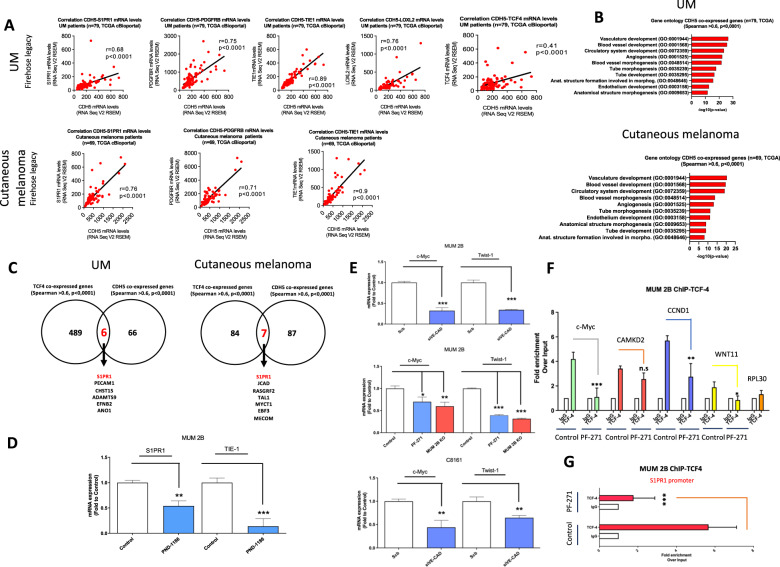
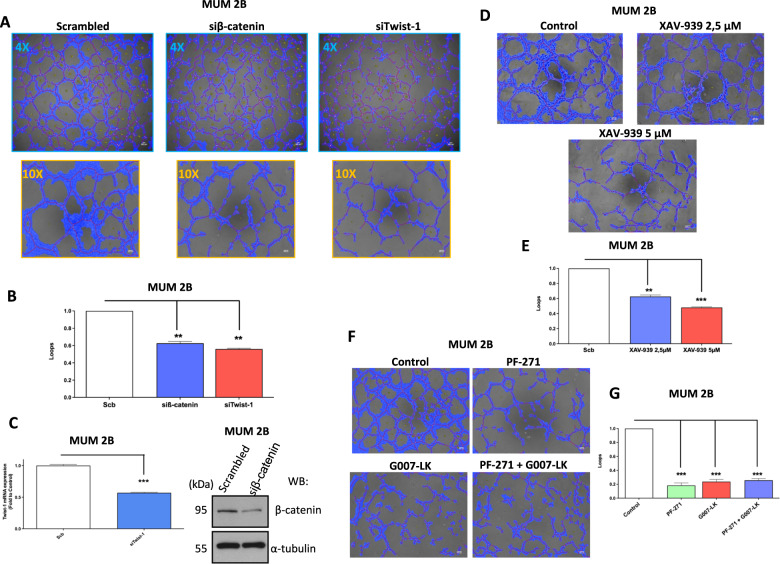
Vasculogenic Mimicry (VM) refers to the capacity to form a blood network from aggressive cancer cells in an independent way of endothelial cells, to provide nutrients and oxygen leading to enhanced microenvironment complexity and treatment failure. In a previous study, we demonstrated that VE-Cadherin and its phosphorylation at Y658 modulated kaiso-dependent gene expression (CCND1 and Wnt 11) through a pathway involving Focal Adhesion kinase (FAK). In the present research, using a proteomic approach, we have found that β-catenin/TCF-4 is associated with nuclear VE-cadherin and enhances the capacity of malignant melanoma cells to undergo VM in cooperation with VE-Cadherin; in addition, preventing the phosphorylation of Y658 of VE-cadherin upon FAK disabling resulted in VE-Cadherin/β-catenin complex dissociation, increased β-catenin degradation while reducing TCF-4-dependent genes transcription (C-Myc and Twist-1). Uveal melanoma cells knockout for VE-Cadherin loses β-catenin expression while the rescue of VE-Cadherin (but not of the phosphorylation defective VE-Cadherin Y658F mutant) permits stabilization of β-catenin and tumor growth reduction in vivo experiments. In vivo, the concomitant treatment with the FAK inhibitor PF-271 and the anti-angiogenic agent bevacizumab leads to a strong reduction in tumor growth concerning the single treatment. In conclusion, the anomalous expression of VE-Cadherin in metastatic melanoma cells (from both uveal and cutaneous origins), together with its permanent phosphorylation at Y658, favors the induction of the aggressive VM phenotype through the cooperation of β-catenin with VE-Cadherin and by enhancing TCF-4 genes-dependent transcription.
血管生成拟态 (VM) 是指癌细胞能够独立于内皮细胞形成血管网络,提供营养和氧气,从而导致微环境复杂性增强和治疗失败。在之前的研究中,我们证明了 VE-钙粘蛋白及其在 Y658 处的磷酸化通过涉及粘着斑激酶 (FAK) 的途径调节 Kaiso 依赖性基因表达 (CCND1 和 Wnt11)。在本研究中,我们使用蛋白质组学方法发现 β-连环蛋白/TCF-4 与核 VE-钙粘蛋白相关,并与 VE-钙粘蛋白协同增强恶性黑色素瘤细胞发生 VM 的能力;此外,在 FAK 失活时阻止 VE-钙粘蛋白 Y658 的磷酸化会导致 VE-钙粘蛋白/β-连环蛋白复合物解离,增加 β-连环蛋白降解,同时降低 TCF-4 依赖性基因转录 (C-Myc 和 Twist-1)。缺乏 VE-钙粘蛋白的葡萄膜黑色素瘤细胞丢失 β-连环蛋白表达,而 VE-钙粘蛋白的挽救(而非磷酸化缺陷的 VE-钙粘蛋白 Y658F 突变体)允许 β-连环蛋白稳定和体内实验中肿瘤生长减少。在体内,FAK 抑制剂 PF-271 和抗血管生成剂 bevacizumab 的联合治疗导致肿瘤生长的强烈减少,与单一治疗相比。总之,转移性黑色素瘤细胞中 VE-钙粘蛋白的异常表达(来自葡萄膜和皮肤来源)及其在 Y658 处的永久磷酸化,通过 β-连环蛋白与 VE-钙粘蛋白的合作以及增强 TCF-4 基因依赖性转录,有利于诱导侵袭性 VM 表型。