Song Xiao-Hui, Liu Bo, Lei Fang, Liu Ye-Mao, Zhang Xingyuan, Chen Ze, Zhang Peng, Zhang Xiao-Jing, She Zhi-Gang, Cai Jingjing, Wang Jin-Hua, Li Hongliang
Department of Cardiology, Renmin Hospital of Wuhan University, Wuhan, People's Republic of China.
Institute of Model Animal, Wuhan University, Wuhan, People's Republic of China.
Diabetes Metab Syndr Obes. 2023 Feb 10;16:373-384. doi: 10.2147/DMSO.S394414. eCollection 2023.
Emerging evidence suggested that metabolic dysfunction-associated fatty liver disease (MAFLD) was significantly associated with atherosclerotic diseases. Atherosclerosis in the peripheral arteries is the most common cause of peripheral arterial disease (PAD), which has not been substantially controlled in the past. We aimed to investigate the association between MAFLD and PAD in the Chinese population.
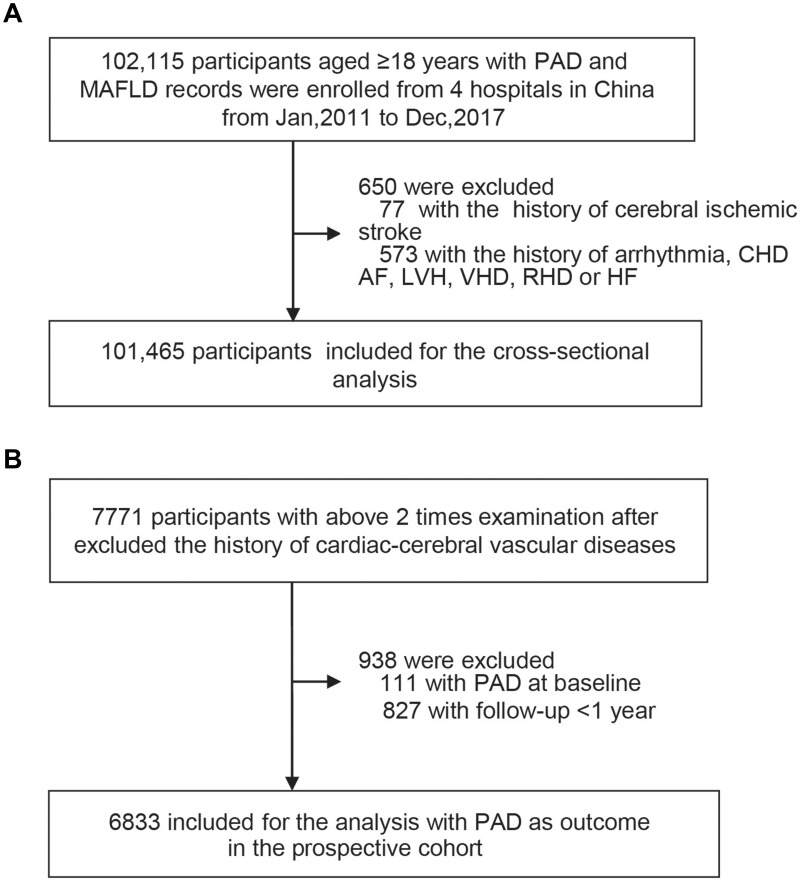
This observational study covered 102,115 participants who underwent health checkups with detailed examinations for PAD and MAFLD. PAD was measured by ankle-brachial index, and MAFLD was diagnosed by abdominal ultrasound. The generalized linear mixed models and random-effects Cox proportional hazards models were used to analyze the relationship between MAFLD and PAD.
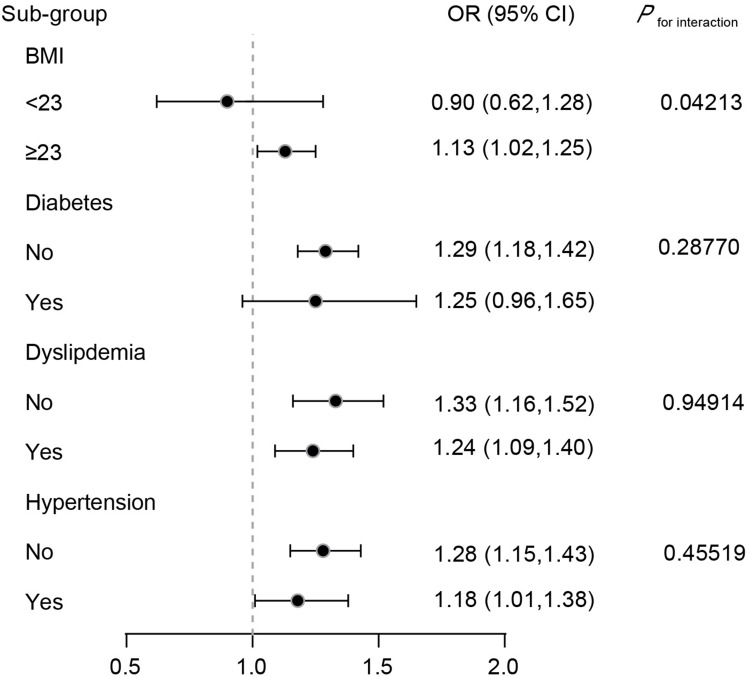
The baseline characteristics showed that patients with MAFLD had higher prevalence of PAD compared with those without MAFLD (2.7% vs 2.2%). Compared to non-MAFLD, the individuals with MAFLD were associated with a higher risk of the presence of PAD (adjusted odds ratio: 1.30, 95% confidence interval (CI): 1.19-1.42, P < 0.001). In the prospective cohort study, 6833 participants underwent a follow-up of 2.76 (standard deviation: 1.36) years, and MAFLD at baseline was a higher risk of associated with incident PAD (adjusted hazards ratio: 1.67, 95% CI: 1.17-2.38, P = 0.005). Moreover, with the accumulation of metabolic abnormalities, the risk of the PAD was increased in the individuals with MAFLD. Furthermore, MAFLD attributed risk of PAD was more evident in participants without metabolic comorbidities.
MAFLD was associated with a significantly higher risk for the prevalence and incidence of PAD in the Chinese population. The finding suggested that individuals with MAFLD are not only have a higher risk of coronary heart diseases but also have an increased risk of atherosclerosis in peripheral arteries.
新出现的证据表明,代谢功能障碍相关脂肪性肝病(MAFLD)与动脉粥样硬化性疾病显著相关。外周动脉粥样硬化是外周动脉疾病(PAD)最常见的病因,过去对此病尚未得到有效控制。我们旨在研究中国人群中MAFLD与PAD之间的关联。
这项观察性研究涵盖了102115名接受健康检查的参与者,这些参与者接受了针对PAD和MAFLD的详细检查。通过踝臂指数测量PAD,通过腹部超声诊断MAFLD。使用广义线性混合模型和随机效应Cox比例风险模型分析MAFLD与PAD之间的关系。
基线特征显示,与无MAFLD的患者相比,MAFLD患者的PAD患病率更高(2.7%对2.2%)。与非MAFLD相比,MAFLD个体发生PAD的风险更高(调整后的优势比:1.30,95%置信区间(CI):1.19 - 1.42,P < 0.001)。在前瞻性队列研究中,6833名参与者接受了2.76(标准差:1.36)年的随访,基线时的MAFLD与发生PAD的较高风险相关(调整后的风险比:1.67,95%CI:1.17 - 2.38,P = 0.005)。此外,随着代谢异常的累积,MAFLD个体发生PAD的风险增加。此外,MAFLD导致的PAD风险在无代谢合并症的参与者中更为明显。
在中国人群中,MAFLD与PAD的患病率和发病率显著较高的风险相关。这一发现表明,MAFLD个体不仅患冠心病的风险更高,而且外周动脉发生动脉粥样硬化的风险也增加。