Department of Biotechnological and Applied Clinical Sciences, University of L'Aquila, Via Vetoio - Loc. Coppito, 67100, L'Aquila, Italy.
Department of Humanities, University of Naples Federico II, Naples, Italy.
Psychol Res. 2023 Oct;87(7):2111-2119. doi: 10.1007/s00426-023-01803-1. Epub 2023 Feb 17.
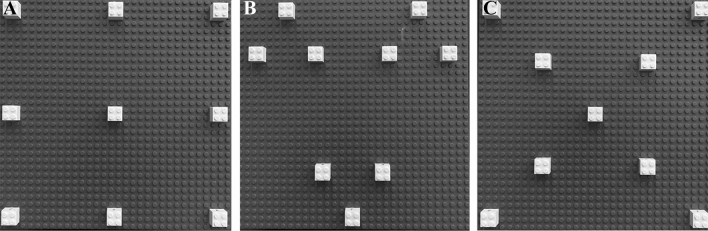
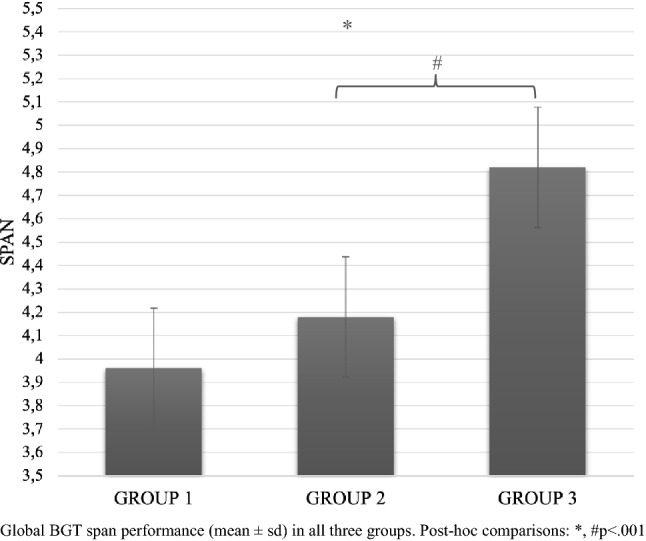
The study of the development of visuospatial memory processes is useful for devising personalized educational interventions as well as for understanding the changes in cognitive functioning in an era characterized by technological progress. The present research is aimed at investigating spatial working memory ability in children that attended the first three years of primary school by means of the Brick Game Task (BGT), a novel visuospatial working memory test. BGT is a small-scale ecological test inspired by behavioral walking tasks with nine white bricks in different spatial configurations as well as to Corsi Block-Tapping test.228 Italian children (121 F; mean age: 7.22 ± 1.18) were assigned to three groups based on the primary school class attended: Group 1 (N = 85; 40 F; mean age 6.18 ± .5), Group 2 (N = 61; 36 F; mean age 7.2 ± .83), and Group 3 (N = 82; 44 F; mean age 8.32 ± .94). All participants were asked to complete the Digit Span test, the Corsi Block-Tapping test, and to explore the three spatial configurations of the BGT with the form of Matrix, M-BGT, Cluster, CL-BGT, Cross, CR-BGT.MANOVA revealed a main significant effect for Group (F = 15.06; p < .0001) indicating that the group of older obtained a better global executive performance than 1 and 2 groups. Multiple linear regression indicated that Corsi Block-Tapping test performance and Age significantly predicted the M-BGT score. Moreover, Corsi Block-Tapping test and Digit Span significantly predicted the CL-BGT performance, showing how a higher score results in a better CL- BGT performance. Finally, Corsi Block-Tapping test, Digit Span, and Age were positively associated with the CR- BGT performance. The present findings evidenced that novel BGT is a sensible visuospatial working memory task suggesting thus its use to assess the children's executive performance in ecological way. These results open to the development of personalized educational interventions.
研究视空间记忆过程的发展对于设计个性化的教育干预措施以及理解在技术进步时代认知功能的变化非常有用。本研究旨在通过 Brick Game Task (BGT) 来研究刚上小学一至三年级的儿童的空间工作记忆能力,BGT 是一种新的视空间工作记忆测试,灵感来自于行为行走任务,其中有九个白色砖块以不同的空间配置以及 Corsi 方块 - 敲击测试呈现。228 名意大利儿童(121 名女性;平均年龄:7.22 ± 1.18)根据所上的小学年级被分为三组:第 1 组(N=85;40 名女性;平均年龄 6.18 ±.5)、第 2 组(N=61;36 名女性;平均年龄 7.2 ±.83)和第 3 组(N=82;44 名女性;平均年龄 8.32 ±.94)。所有参与者都被要求完成数字跨度测试、Corsi 方块 - 敲击测试,并以矩阵、M-BGT、集群、CL-BGT、十字、CR-BGT 的形式探索 BGT 的三个空间配置。MANOVA 显示出组间存在显著的主要效应(F=15.06;p<.0001),表明年龄较大的组在整体执行表现上优于 1 组和 2 组。多元线性回归表明,Corsi 方块 - 敲击测试表现和年龄显著预测 M-BGT 分数。此外,Corsi 方块 - 敲击测试和数字跨度显著预测 CL-BGT 表现,表明分数越高,CL-BGT 表现越好。最后,Corsi 方块 - 敲击测试、数字跨度和年龄与 CR-BGT 表现呈正相关。本研究结果证明了新型 BGT 是一种灵敏的视空间工作记忆任务,因此建议将其用于以生态方式评估儿童的执行表现。这些结果为个性化教育干预措施的发展开辟了道路。