Department of Ophthalmology, The Second Affiliated Hospital of Guangzhou University of Chinese Medicine, 111 Dade Road, Guangzhou, 510120, China.
State Key Laboratory of Ophthalmology, Zhongshan Ophthalmic Center, Sun Yat-sen University, 54 Xianlie Road, Guangzhou, 510060, China.
BMC Complement Med Ther. 2023 Feb 18;23(1):55. doi: 10.1186/s12906-023-03884-2.
Age-related macular degeneration (AMD) is a leading cause of vision loss in elderly people, and dry AMD is the most common type of AMD. Oxidative stress and alternative complement pathway activation may play essential roles in the pathogenesis of dry AMD. There are no available drugs for dry AMD. Qihuang Granule (QHG) is an herbal formula for the treatment of dry AMD, and it achieves a good clinical effect in our hospital. However, its potential mechanism is unclear. Our study investigated the effects of QHG on oxidative stress-associated retinal damage to reveal its underlying mechanism.
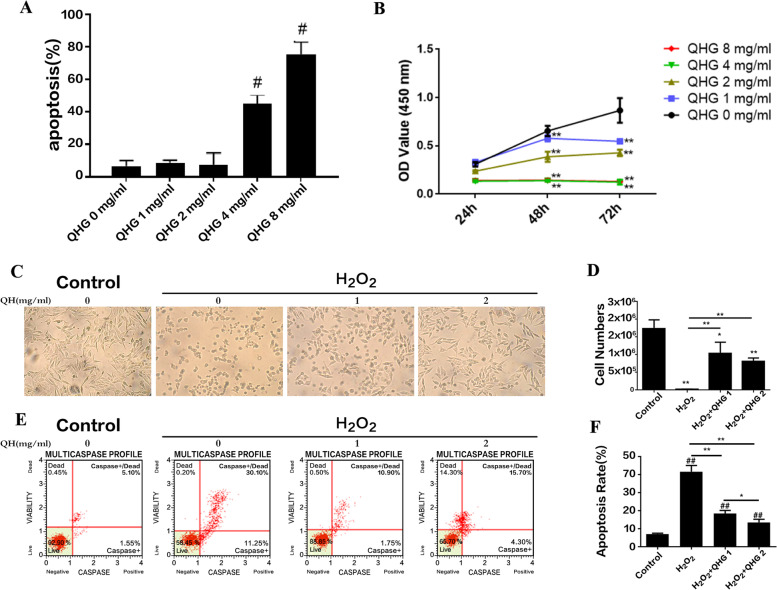
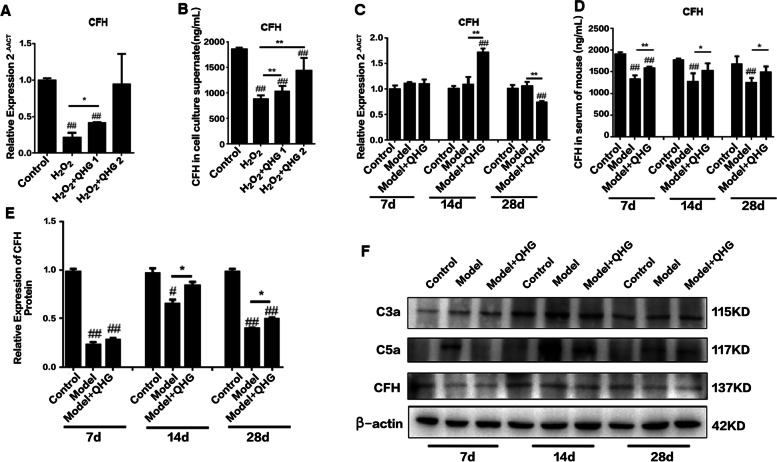
Oxidative stress models were established using HO and NaIO in ARPE-19 cells and C57BL/6 mice. Cell apoptosis and viability were assessed using phase contrast microscopy and flow cytometry, respectively. Alterations in the mouse retinal structure were evaluated using Masson staining and transmission electron microscopy (TEM). The expression of complement factor H (CFH), complement component 3a (C3a) and complement component 5a (C5a) in retinal pigment epithelium (RPE) cells and mice was measured using RT‒PCR, Western blot analysis and ELISA.
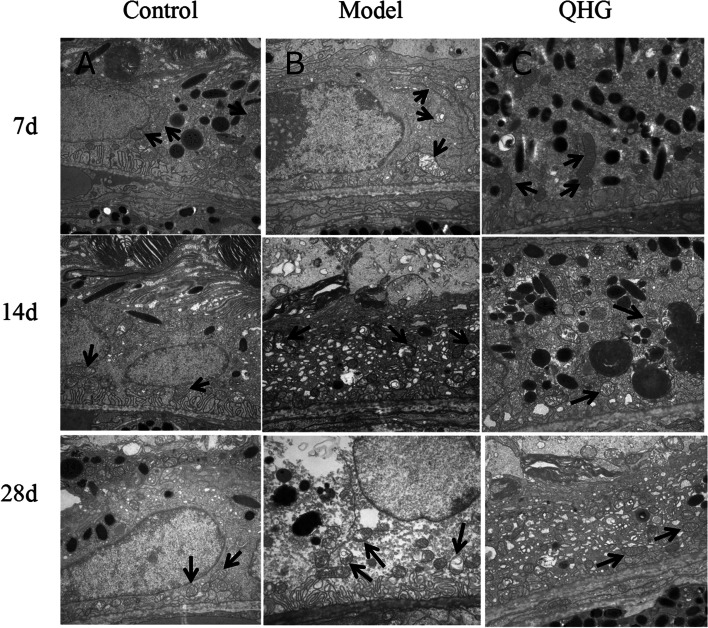
Pretreatment with QHG significantly prevented cell apoptosis and disorder of the RPE and inner segment/outer segment (IS/OS) in HO-treated RPE cells and NaIO-injected mice. QHG alleviated mitochondrial damage in mouse RPE cells, as shown by TEM. QHG also promoted CFH expression and inhibited the expression of C3a and C5a.
The results suggest that QHG protects the retinal pigment epithelium from oxidative stress, likely by regulating the alternative complement pathway.
年龄相关性黄斑变性(AMD)是老年人视力丧失的主要原因,而干性 AMD 是最常见的 AMD 类型。氧化应激和替代补体途径的激活可能在干性 AMD 的发病机制中发挥重要作用。目前尚无治疗干性 AMD 的药物。芪黄颗粒(QHG)是一种治疗干性 AMD 的中药方剂,在我院疗效良好。然而,其潜在机制尚不清楚。本研究探讨了 QHG 对氧化应激相关视网膜损伤的影响,以揭示其潜在机制。
采用 HO 和 NaIO 在 ARPE-19 细胞和 C57BL/6 小鼠中建立氧化应激模型。相差显微镜和流式细胞术分别评估细胞凋亡和活力。采用 Masson 染色和透射电镜(TEM)评估小鼠视网膜结构的改变。采用 RT-PCR、Western blot 分析和 ELISA 检测视网膜色素上皮(RPE)细胞和小鼠中补体因子 H(CFH)、补体成分 3a(C3a)和补体成分 5a(C5a)的表达。
QHG 预处理可显著预防 HO 处理的 RPE 细胞和 NaIO 注射小鼠中的细胞凋亡和 RPE 及内节/外节(IS/OS)紊乱。QHG 通过 TEM 减轻了小鼠 RPE 细胞的线粒体损伤。QHG 还促进了 CFH 的表达,抑制了 C3a 和 C5a 的表达。
结果表明,QHG 通过调节替代补体途径保护视网膜色素上皮免受氧化应激。