Department of Medical Imaging, Huizhou Municipal Central Hospital, No. 41, North Eling Road, Huizhou, 516001, People's Republic of China.
Department of Radiology, Shandong Tumor Hospital, No.44, Jiyan Road, Jinan, 250117, People's Republic of China.
Sci Rep. 2023 Feb 19;13(1):2910. doi: 10.1038/s41598-023-30041-z.
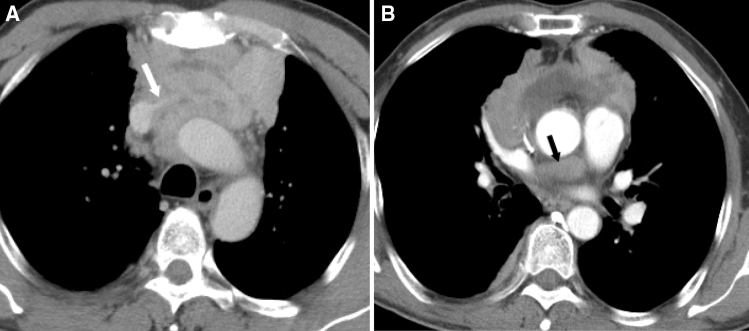
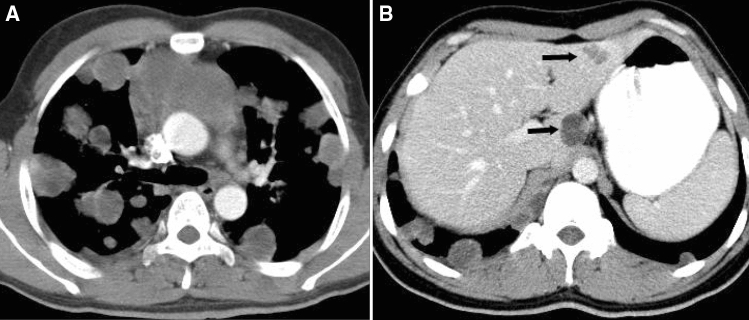
To determine the prognostic CT features in patients with untreated thymic epithelial tumors (TETs). Clinical data and CT imaging features of 194 patients with pathologically confirmed TETs were retrospectively reviewed. The subjects included 113 male and 81 female patients between 15 and 78 years of age, with a mean age of 53.8 years. Clinical outcomes were categorized according to whether relapse, metastasis or death occurred within 3 years after the first diagnosis. Associations between clinical outcomes and CT imaging features were determined using univariate and multivariate logistic regression analyses, while the survival status was analyzed by Cox regression. In this study, we analyzed 110 thymic carcinomas, 52 high-risk thymomas and 32 low-risk thymomas. Percentages of poor outcome and patient death in thymic carcinomas were much higher than those in patients with high-risk and low-risk thymomas. In the thymic carcinomas groups, 46 patients (41.8%) experienced tumor progression, local relapse or metastasis and were categorized as having poor outcomes; vessel invasion and pericardial mass were confirmed to be independent predictors by logistic regression analysis (p < 0.01). In the high-risk thymoma group, 11 patients (21.2%) were categorized as having poor outcomes, and the CT feature pericardial mass was confirmed to be an independent predictor (p < 0.01). In survival analysis, Cox regression showed that CT features of lung invasion, great vessel invasion, lung metastasis and distant organ metastasis were independent predictors for worse survival in the thymic carcinoma group (p < 0.01), while lung invasion and pericardial mass were independent predictors for worse survival in high-risk thymoma group. No CT features were related to poor outcome and worse survival in the low-risk thymoma group. Patients with thymic carcinoma had poorer prognosis and worse survival than those with high-risk or low-risk thymoma. CT can serve as an important tool for predicting the prognosis and survival of patients with TETs. In this cohort, CT features of vessel invasion and pericardial mass were related to poorer outcomes in those with thymic carcinoma and pericardial mass in those with high-risk thymoma. Features including lung invasion, great vessel invasion, lung metastasis and distant organ metastasis indicate worse survival in thymic carcinoma, whereas lung invasion and pericardial mass indicate worse survival in high-risk thymoma.
为了确定未经治疗的胸腺瘤患者的预后 CT 特征。回顾性分析了 194 例经病理证实的胸腺瘤患者的临床资料和 CT 影像学特征。受试者包括 113 名男性和 81 名女性,年龄在 15 至 78 岁之间,平均年龄为 53.8 岁。根据首次诊断后 3 年内是否复发、转移或死亡,将临床结局分为复发、转移或死亡组和无复发、转移或死亡组。采用单因素和多因素逻辑回归分析比较两组 CT 影像学特征的差异,采用 COX 回归分析生存状态。本研究共分析了 110 例胸腺癌、52 例高危胸腺瘤和 32 例低危胸腺瘤。胸腺癌患者的不良预后和死亡比例明显高于高危和低危胸腺瘤患者。在胸腺癌组中,46 例(41.8%)患者发生肿瘤进展、局部复发或转移,预后不良;血管侵犯和心包肿块被证实是独立的预测因素(p<0.01)。在高危胸腺瘤组中,11 例(21.2%)患者预后不良,心包肿块是独立的预测因素(p<0.01)。在生存分析中,COX 回归显示 CT 特征肺侵犯、大血管侵犯、肺转移和远处器官转移是胸腺癌患者生存不良的独立预测因素(p<0.01),而肺侵犯和心包肿块是高危胸腺瘤患者生存不良的独立预测因素。低危胸腺瘤组 CT 特征与不良预后和生存不良无关。胸腺癌患者的预后和生存明显差于高危和低危胸腺瘤患者。CT 可作为预测胸腺瘤患者预后和生存的重要工具。在本队列中,血管侵犯和心包肿块与胸腺癌较差的预后有关,而心包肿块与高危胸腺瘤的预后有关。肺侵犯、大血管侵犯、肺转移和远处器官转移等 CT 特征提示胸腺癌患者的生存较差,而肺侵犯和心包肿块则提示高危胸腺瘤患者的生存较差。