Suprewicz Łukasz, Skłodowski Karol, Walewska Alicja, Deptuła Piotr, Sadzyńska Alicja, Eljaszewicz Andrzej, Moniuszko Marcin, Janmey Paul A, Bucki Robert
Department of Medical Microbiology and Biomedical Engineering, Medical University of Białystok, Białystok, Poland.
Department of Regenerative Medicine and Immune Regulation, Medical University of Białystok, Białystok, Poland.
Microbiol Spectr. 2023 Feb 21;11(2):e0408222. doi: 10.1128/spectrum.04082-22.
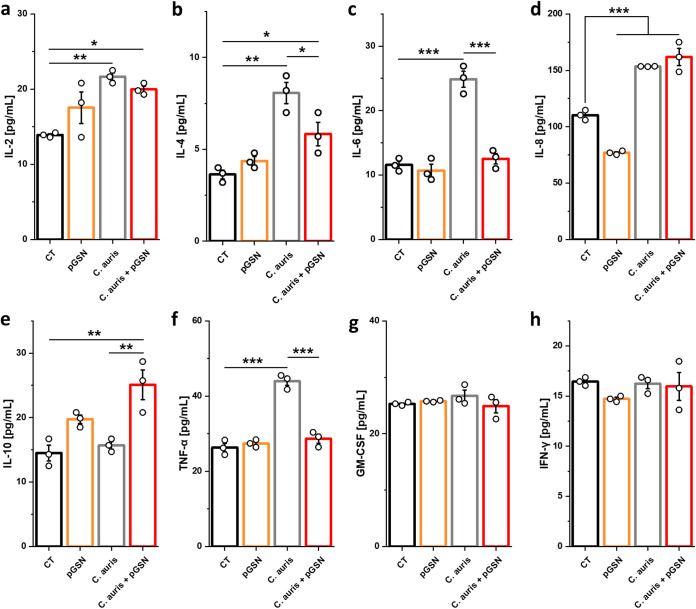
In addition to its role as an actin-depolymerizing factor in the blood, plasma gelsolin (pGSN) binds bacterial molecules and stimulates the phagocytosis of bacteria by macrophages. Here, using an system, we assessed whether pGSN could also stimulate phagocytosis of the fungal pathogen Candida auris by human neutrophils. The extraordinary ability of C. auris to evade immune responses makes it particularly challenging to eradicate in immunocompromised patients. We demonstrate that pGSN significantly enhances C. auris uptake and intracellular killing. Stimulation of phagocytosis was accompanied by decreased neutrophil extracellular trap (NET) formation and reduced secretion of proinflammatory cytokines. Gene expression studies revealed pGSN-dependent upregulation of scavenger receptor class B (SR-B). Inhibition of SR-B using sulfosuccinimidyl oleate (SSO) and block lipid transport-1 (BLT-1) decreased the ability of pGSN to enhance phagocytosis, indicating that pGSN potentiates the immune response through an SR-B-dependent pathway. These results suggest that the response of the host's immune system during C. auris infection may be enhanced by the administration of recombinant pGSN. The incidence of life-threatening multidrug-resistant Candida auris infections is rapidly growing, causing substantial economic costs due to outbreaks in hospital wards. Primary and secondary immunodeficiencies in susceptible individuals, such as those with leukemia, solid organ transplants, diabetes, and ongoing chemotherapy, often correlate with decreased plasma gelsolin concentration (hypogelsolinemia) and impairment of innate immune responses due to severe leukopenia. Immunocompromised patients are predisposed to superficial and invasive fungal infections. Morbidity caused by C. auris among immunocompromised patients can be as great as 60%. In the era of ever-growing fungal resistance in an aging society, it is critical to seek novel immunotherapies that may help combat these infections. The results reported here suggest the possibility of using pGSN as an immunomodulator of the immune response by neutrophils during C. auris infection.
除了作为血液中肌动蛋白解聚因子的作用外,血浆凝溶胶蛋白(pGSN)还能结合细菌分子并刺激巨噬细胞对细菌的吞噬作用。在此,我们使用一个系统评估了pGSN是否也能刺激人类中性粒细胞对真菌病原体耳念珠菌的吞噬作用。耳念珠菌逃避免疫反应的非凡能力使得在免疫功能低下的患者中根除它特别具有挑战性。我们证明pGSN能显著增强耳念珠菌的摄取和细胞内杀伤。吞噬作用的刺激伴随着中性粒细胞胞外陷阱(NET)形成的减少和促炎细胞因子分泌的减少。基因表达研究揭示了pGSN依赖的B类清道夫受体(SR-B)上调。使用油酸琥珀酰亚胺酯(SSO)抑制SR-B和阻断脂质转运-1(BLT-1)降低了pGSN增强吞噬作用的能力,表明pGSN通过SR-B依赖途径增强免疫反应。这些结果表明,在耳念珠菌感染期间,给予重组pGSN可能会增强宿主免疫系统的反应。危及生命的多重耐药耳念珠菌感染的发病率正在迅速上升,由于医院病房的爆发导致了巨大的经济成本。易感个体,如白血病患者、实体器官移植患者、糖尿病患者和正在接受化疗的患者的原发性和继发性免疫缺陷,通常与血浆凝溶胶蛋白浓度降低(凝溶胶蛋白血症过低)以及由于严重白细胞减少导致的先天免疫反应受损有关。免疫功能低下的患者易患浅表和侵袭性真菌感染。免疫功能低下患者中耳念珠菌引起的发病率可达60%。在老龄化社会中真菌耐药性不断增加的时代,寻找可能有助于对抗这些感染的新型免疫疗法至关重要。此处报道的结果表明,在耳念珠菌感染期间,pGSN有可能作为中性粒细胞免疫反应的免疫调节剂。