Ding Ying, Zhuang Hemu, Zhou Junxin, Xu Lijie, Yang Yi, He Jintao, Liang Min, Jia Shicheng, Guo Xiuliu, Han Xinhong, Liu Haiyang, Zhang Linghong, Jiang Yan, Yu Yunsong
Department of Intensive Care Unit, Sir Run Run Shaw Hospital Qiantang Campus, Zhejiang University School of Medicine, Hangzhou, Zhejiang Province, China.
Key Laboratory of Microbial Technology and Bioinformatics of Zhejiang Province, Hangzhou, Zhejiang Province, China.
Microbiol Spectr. 2023 Feb 21;11(2):e0401022. doi: 10.1128/spectrum.04010-22.
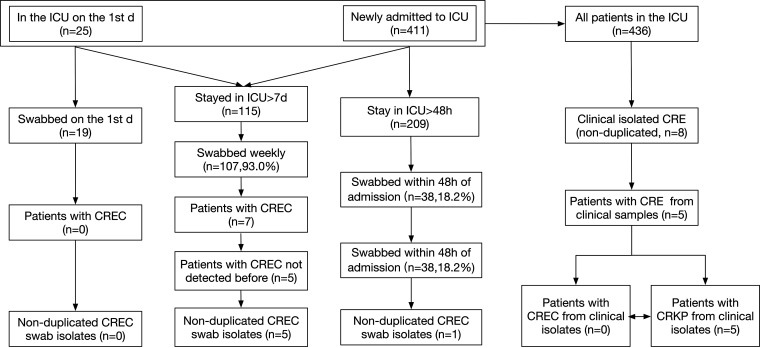
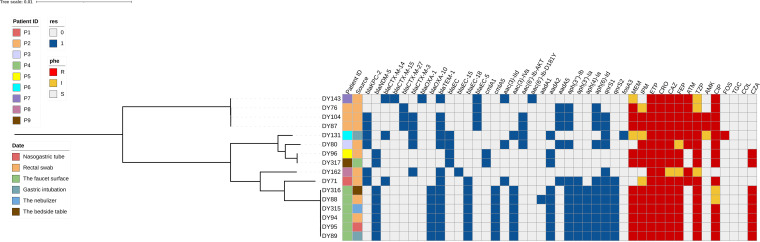
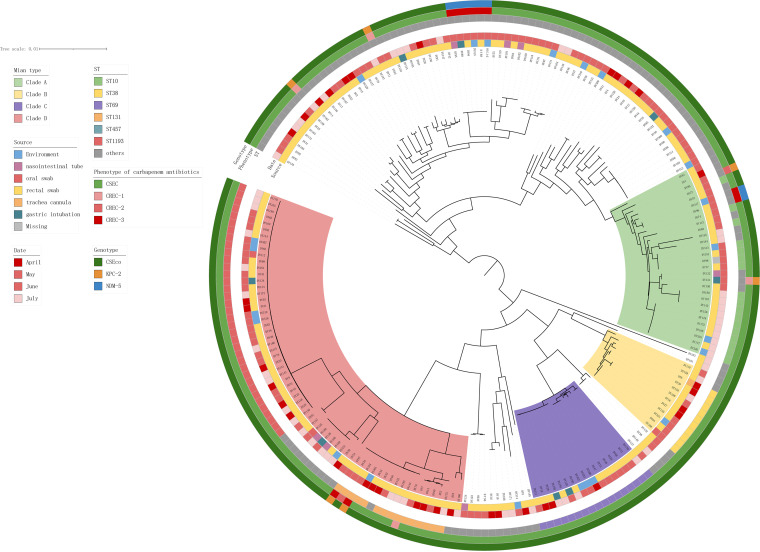
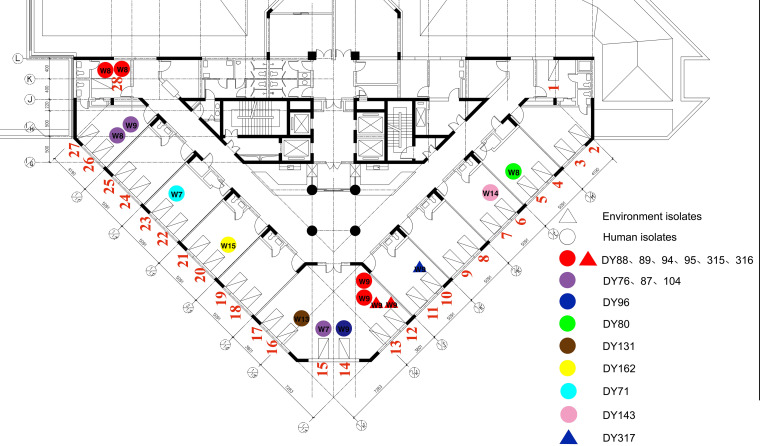
This 4-month-long prospective observational study investigated the epidemiological characteristics, genetic composition, transmission pattern, and infection control of carbapenem-resistant Escherichia coli (CREC) colonization in patients at an intensive care unit (ICU) in China. Phenotypic confirmation testing was performed on nonduplicated isolates from patients and their environments. Whole-genome sequencing was performed for all E. coli isolates, followed by multilocus sequence typing (MLST), and antimicrobial resistance genes and single nucleotide polymorphisms (SNPs) were screened. The colonization rates of CREC were 7.29% from the patient specimens and 0.39% from the environmental specimens. Among the 214 E. coli isolates tested, 16 were carbapenem resistant, with the gene identified as the dominant carbapenemase-encoding gene. Among the low-homology sporadic strains isolated in this study, the main sequence type (ST) of carbapenem-sensitive Escherichia coli (CSEC) was ST1193, whereas the majority of CREC isolates belonged to ST1656, followed by ST131. CREC isolates were more sensitive to disinfectants than were the carbapenem-resistant Klebsiella pneumoniae (CRKP) isolates obtained in the same period, which may explain the lower separation rate. Therefore, effective interventions and active screening are beneficial to the prevention and control of CREC. CREC represents a public health threat worldwide, and its colonization precedes or occurs simultaneously with infection; once the colonization rate increases, the infection rate rises sharply. In our hospital, the colonization rate of CREC remained low, and almost all of the CREC isolates detected were ICU acquired. Contamination of the surrounding environment by CREC carrier patients shows a very limited spatiotemporal distribution. As the dominant ST of the CSEC isolates found, ST1193 CREC might be considered a strain of notable concern with potential to cause a future outbreak. ST1656 and ST131 also deserve attention, as they comprised the majority of the CREC isolates found, while gene screening should play an important role in medication guidance as the main carbapenem resistance gene identified. The disinfectant chlorhexidine, which is used commonly in the hospital, is effective for CREC rather than CRKP, possibly explaining the lower positivity rate for CREC than for CRKP.
这项为期4个月的前瞻性观察性研究调查了中国一家重症监护病房(ICU)患者中耐碳青霉烯类大肠杆菌(CREC)定植的流行病学特征、基因组成、传播模式及感染控制情况。对来自患者及其环境的非重复分离株进行表型确证检测。对所有大肠杆菌分离株进行全基因组测序,随后进行多位点序列分型(MLST),并筛选抗菌药物耐药基因和单核苷酸多态性(SNP)。CREC在患者标本中的定植率为7.29%,在环境标本中的定植率为0.39%。在检测的214株大肠杆菌分离株中,16株对碳青霉烯类耐药, 基因被确定为主要的碳青霉烯酶编码基因。在本研究分离出的低同源性散发病菌株中,碳青霉烯类敏感大肠杆菌(CSEC)的主要序列型(ST)为ST1193,而大多数CREC分离株属于ST1656,其次是ST131。与同期获得的耐碳青霉烯类肺炎克雷伯菌(CRKP)分离株相比,CREC分离株对消毒剂更敏感,这可能解释了其较低的分离率。因此,有效的干预措施和主动筛查有利于CREC的防控。CREC是全球公共卫生威胁,其定植先于感染或与感染同时发生;一旦定植率上升,感染率会急剧上升。在我院,CREC的定植率仍然较低,几乎所有检测到的CREC分离株都是在ICU获得的。CREC携带者患者对周围环境的污染呈现出非常有限的时空分布。作为所发现的CSEC分离株的主要ST,ST1193 CREC可能被视为一个值得关注的菌株,有引发未来疫情的潜力。ST1656和ST131也值得关注,因为它们构成了所发现的大多数CREC分离株,而 基因筛查作为确定的主要碳青霉烯类耐药基因,应在用药指导中发挥重要作用。医院常用的消毒剂洗必泰对CREC有效,而对CRKP无效,这可能解释了CREC的阳性率低于CRKP的原因。