Department of Psychology and Mental Health, University of Manchester, Manchester, Greater Manchester, UK.
Division of Population Health, Health Services Research & Primary Care, University of Manchester, Manchester, Greater Manchester, UK.
J Youth Adolesc. 2023 Apr;52(4):734-753. doi: 10.1007/s10964-023-01740-7. Epub 2023 Feb 20.
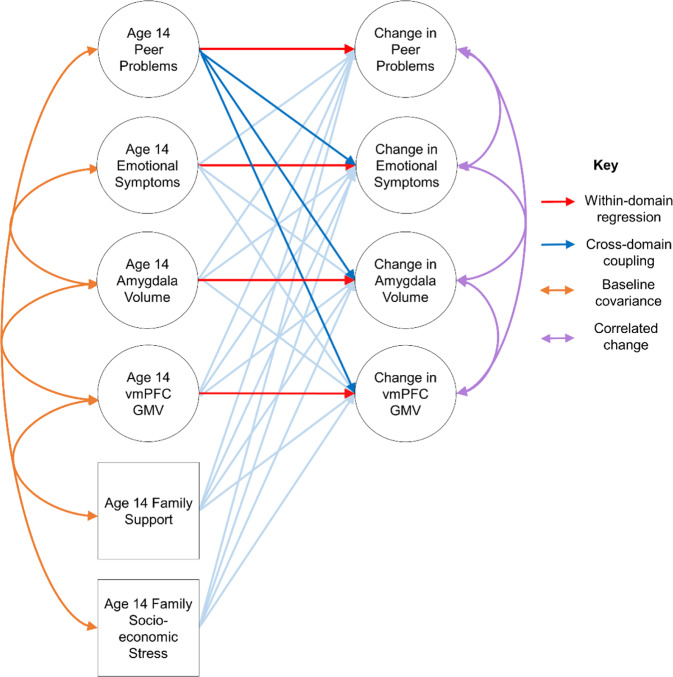
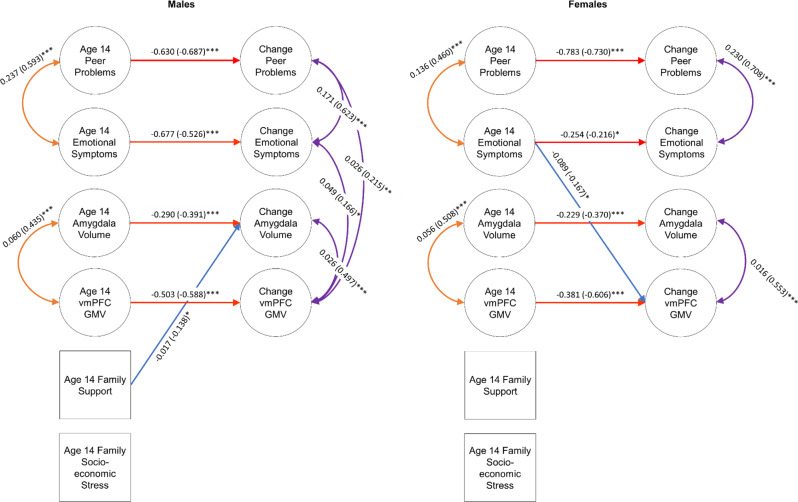
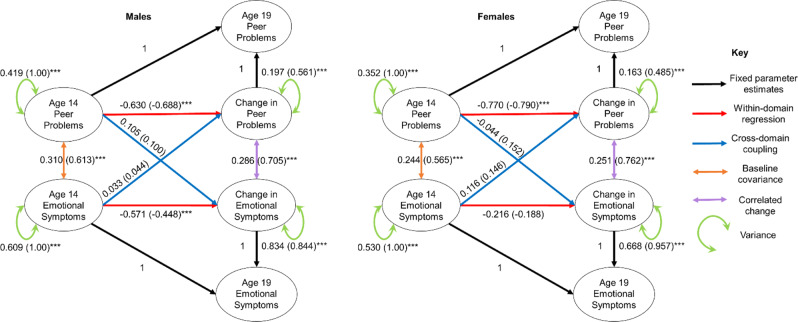
The period of adolescence brings with it a dynamic interaction between social context and behaviour, structural brain development, and anxiety and depressive symptoms. The rate of volumetric change in the ventromedial prefrontal cortex (vmPFC) and amygdala have been implicated in socioemotional development in adolescence; typically, there is thinning of grey matter volume (GMV) in the vmPFC and growth in the amygdala during this time. The directionality of the associations between social, emotional, and neuroanatomical factors has yet to be untangled, such as the degree to which social variables impact regional brain development, and vice versa. To add, the differences between sexes are still up for debate. In this study, longitudinal associations between peer problems, family support, socioeconomic stress, emotional symptoms, amygdala volume, and vmPFC GMV were investigated for both sexes using latent change score models. Data from a multi-site European study at baseline (mean (SD) age = 14.40 (0.38) years; % female = 53.19) and follow-up 2 (mean (SD) age = 18.90 (0.69) years, % female = 53.19) were used. Results revealed that peer problems did not predict emotional symptoms, rather they changed together over time. For males only, there was positive correlated change between vmPFC GMV, peer problems and emotional symptoms, indicating that slower vmPFC GMV thinning was associated with poorer social and emotional functioning. Additionally, greater family support at age 14 years was associated with slower growth of amygdala volume between ages 14 and 19 years for males; previous research has related slower amygdala growth to resilience to mental health disorders. The findings have extended understanding of mutual social, emotional and brain development, and avenues to protect mental health.
青春期带来了社会环境与行为、大脑结构发育以及焦虑和抑郁症状之间的动态相互作用。腹内侧前额叶皮质 (vmPFC) 和杏仁核的体积变化率与青春期的社会情绪发展有关;通常,在此期间,vmPFC 的灰质体积 (GMV) 变薄,而杏仁核生长。社会、情感和神经解剖因素之间的关联方向尚未理清,例如社会变量对区域大脑发育的影响程度,反之亦然。此外,性别差异仍存在争议。在这项研究中,使用潜在变化分数模型研究了同伴问题、家庭支持、社会经济压力、情绪症状、杏仁核体积和 vmPFC GMV 之间的纵向关联,同时考虑了性别差异。该研究的数据来自一个多地点的欧洲研究,基线时(平均(标准差)年龄= 14.40(0.38)岁;女性比例= 53.19%)和随访 2 时(平均(标准差)年龄= 18.90(0.69)岁,女性比例= 53.19%)。结果表明,同伴问题并不能预测情绪症状,而是随着时间的推移一起变化。仅对男性而言,vmPFC GMV、同伴问题和情绪症状之间存在正相关变化,这表明 vmPFC GMV 变薄较慢与较差的社会和情绪功能有关。此外,14 岁时更大的家庭支持与 14 至 19 岁期间男性杏仁核体积的增长较慢有关;先前的研究已经将杏仁核生长较慢与心理健康障碍的弹性相关联。这些发现扩展了对相互的社会、情感和大脑发育的理解,并为保护心理健康提供了途径。