Advanced Membranes and Porous Materials Center and KAUST Catalysis Center, Division of Physical Science and Engineering, King Abdullah University of Science and Technology (KAUST), Thuwal 23955-6900, Kingdom of Saudi Arabia.
Materials Science and Engineering, Division of Physical Sciences and Engineering (PSE), King Abdullah University of Science and Technology (KAUST), Thuwal 23955-6900, Kingdom of Saudi Arabia.
J Phys Chem B. 2023 Mar 2;127(8):1819-1827. doi: 10.1021/acs.jpcb.2c08844. Epub 2023 Feb 21.
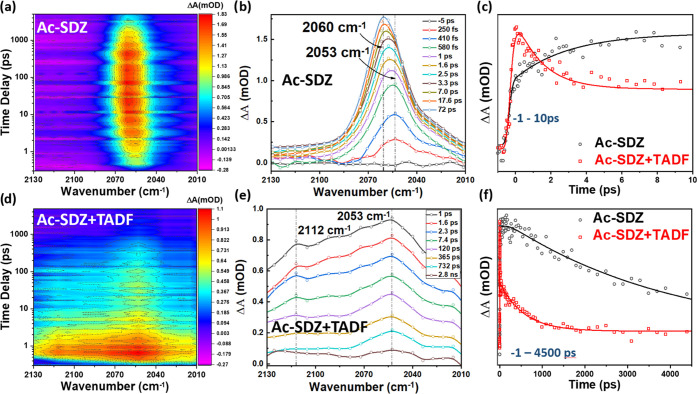
Structural modifications to molecular systems that lead to the control of photon emission processes at the interfaces between photoactive materials play a key role in the development of fluorescence sensors, X-ray imaging scintillators, and organic light-emitting diodes (OLEDs). In this work, two donor-acceptor systems were used to explore and reveal the effects of slight changes in chemical structure on interfacial excited-state transfer processes. A thermally activated delayed fluorescence (TADF) molecule was chosen as the molecular acceptor. Meanwhile, two benzoselenadiazole-core MOF linker precursors, Ac-SDZ and SDZ, with the presence and absence of a C≡C bridge, respectively, were carefully chosen as energy and/or electron-donor moieties. We found that the SDZ -TADF donor-acceptor system exhibited efficient energy transfer, as evidenced by steady-state and time-resolved laser spectroscopy. Furthermore, our results demonstrated that the Ac-SDZ-TADF system exhibited both interfacial energy and electron transfer processes. Femtosecond-mid-IR (fs-mid-IR) transient absorption measurements revealed that the electron transfer process takes place on the picosecond timescale. Time-dependent density functional theory (TD-DFT) calculations confirmed that photoinduced electron transfer occurred in this system and demonstrated that it takes place from C≡C in Ac-SDZ to the central unit of the TADF molecule. This work provides a straightforward way to modulate and tune excited-state energy/charge transfer processes at donor-acceptor interfaces.
结构修饰分子系统,导致在光活性材料之间的界面处的光子发射过程的控制在荧光传感器,X 射线成像闪烁体和有机发光二极管(OLED)的发展中起着关键作用。在这项工作中,使用了两个给体-受体系统来探索和揭示化学结构的微小变化对界面激发态转移过程的影响。选择热激活延迟荧光(TADF)分子作为分子受体。同时,选择了两个苯并硒二唑核 MOF 连接体前体,Ac-SDZ 和 SDZ,分别具有和不具有 C≡C 桥,作为能量和/或电子供体部分。我们发现 SDZ-TADF 给体-受体系统表现出有效的能量转移,这可以通过稳态和时间分辨激光光谱证明。此外,我们的结果表明,Ac-SDZ-TADF 系统表现出界面能量和电子转移过程。飞秒中红外(fs-mid-IR)瞬态吸收测量表明,电子转移过程发生在皮秒时间尺度上。含时密度泛函理论(TD-DFT)计算证实了该体系中发生了光诱导电子转移,并且表明它是从 Ac-SDZ 中的 C≡C 到 TADF 分子的中心单元发生的。这项工作提供了一种简单的方法来调节和调整给体-受体界面处的激发态能量/电荷转移过程。