Department of Public Health, North South University, Dhaka, Bangladesh.
Department of Public Health, School of Research, Chattogram, Bangladesh.
BMJ Paediatr Open. 2023 Feb;7(1). doi: 10.1136/bmjpo-2022-001759.
People are becoming more dependent on technology than ever before. Today's children and adults are heavily plugged into electronics, which raises concerns for their physical and cognitive development. This cross-sectional study was conducted to assess the relationship between media usage and cognitive function among school-going children.
This cross-sectional study was conducted in 11 schools in 3 of Bangladesh's most populous metropolitan areas: Dhaka, Chattogram and Cumilla. A semistructured questionnaire with three sections was used to obtain data from the respondents: (1) background information, (2) PedsQL Cognitive Functioning Scale and (3) Problematic Media Use Measure Short Form. Stata (V.16) was used for statistical analysis. Mean and SD were used to summarise quantitative variables. Qualitative variables were summarised using frequency and percentage. The χ test was used to explore bivariate association between categorical variables, and a binary logistic regression model was fit to investigate the factors associated with the cognitive function of the study participants after adjusting for confounders.
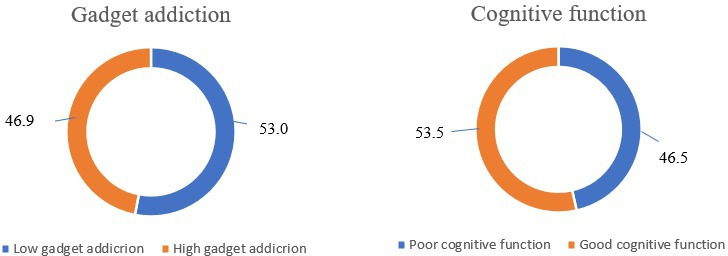
The mean age of total of 769 participants was 12.0±1.8 years, and the majority (67.31%) were females. The prevalence of high gadget addiction and poor cognitive function was 46.9% and 46.5%, respectively, among the participants. After adjusting the factors, this study found a statistically significant relationship (adjusted OR 0.4, 95% CI 0.3 to 0.7) between gadget addiction and cognitive function. In addition, the duration of breast feeding was a predictor of cognitive function as well.
This study found digital media addiction as a predictor of decreased cognitive performance in children who use digital gadgets regularly. Although the cross-sectional design of the study precludes causal relationships from being determined, the study finding deserves further examination via longitudinal research.
人们对技术的依赖程度前所未有。如今,儿童和成年人都大量使用电子产品,这引发了人们对其身体和认知发展的担忧。本横断面研究旨在评估在校儿童的媒体使用与认知功能之间的关系。
本横断面研究在孟加拉国人口最多的三个大都市区的 11 所学校进行:达卡、吉大港和库米拉。使用带有三个部分的半结构式问卷从受访者那里获取数据:(1)背景信息,(2)PedsQL 认知功能量表和(3)问题媒体使用量表简表。使用 Stata(V.16)进行统计分析。使用均值和标准差来总结定量变量。使用频率和百分比总结定性变量。使用 χ 检验探索分类变量之间的双变量关联,并且拟合二元逻辑回归模型以在调整混杂因素后调查与研究参与者认知功能相关的因素。
总共 769 名参与者的平均年龄为 12.0±1.8 岁,其中大多数(67.31%)为女性。参与者中高电子设备成瘾和认知功能差的患病率分别为 46.9%和 46.5%。在调整了因素后,本研究发现电子设备成瘾与认知功能之间存在统计学显著关系(调整后的 OR 0.4,95%CI 0.3 至 0.7)。此外,母乳喂养的时间也是认知功能的预测因素。
本研究发现,数字媒体成瘾是经常使用数字小工具的儿童认知表现下降的一个预测因素。尽管研究的横断面设计排除了因果关系的确定,但该研究结果值得通过纵向研究进一步研究。