Berchiolli Raffaella, Troisi Nicola, Bertagna Giulia, Colli Andrea, Besola Laura, Silingardi Roberto, Simonte Gioele, Isernia Giacomo
Vascular Surgery Unit, Department of Translational Research and of New Technologies in Medicine and Surgery, University of Pisa, Cisanello Hospital, Via Roma 67, 56126, Pisa, Italy.
Division of Cardiac Surgery, Department of Surgical, Medical and Molecular Pathology and Critical Care, University of Pisa, Pisa, Italy.
CVIR Endovasc. 2023 Feb 21;6(1):7. doi: 10.1186/s42155-023-00351-4.
The Najuta stent-graft (Kawasumi Laboratories Inc., Tokyo, Japan) is usually easily advanced to the correct deployment position in the ascending aorta thanks to the pre-curved delivery J-sheath with all fenestrations automatically oriented towards the supra-aortic vessels. Aortic arch anatomy and delivery system stiffness could however represent limitations for proper endograft advancement, especially when the aortic arch bends sharply. The aim of this technical note is to report a series of bail-out procedures that could be useful to overcome the difficulties encountered during the Najuta stent-graft advancement up to the ascending aorta.
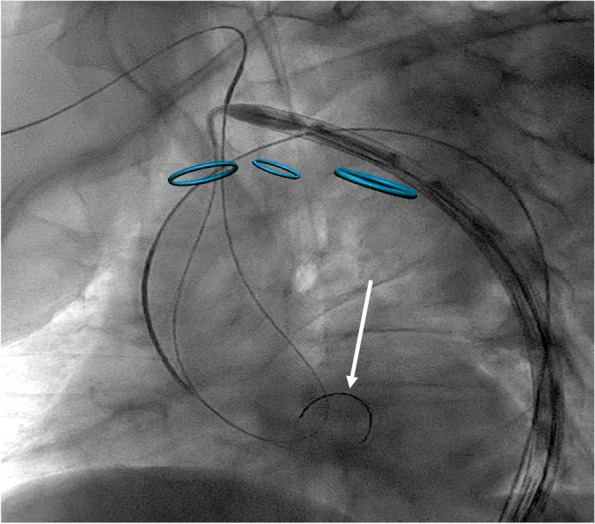
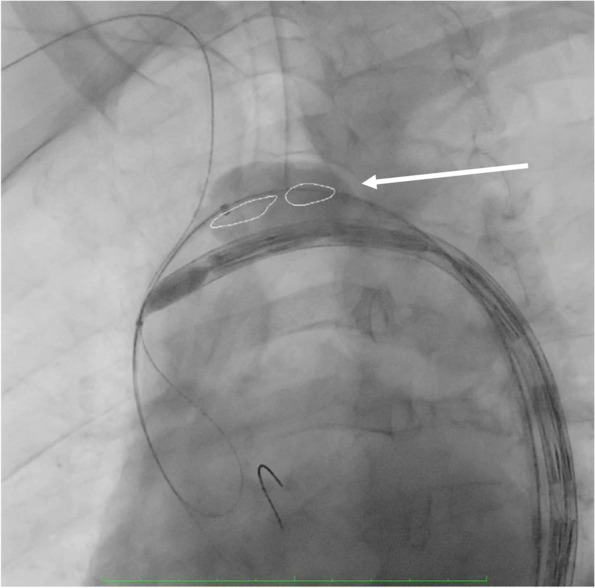
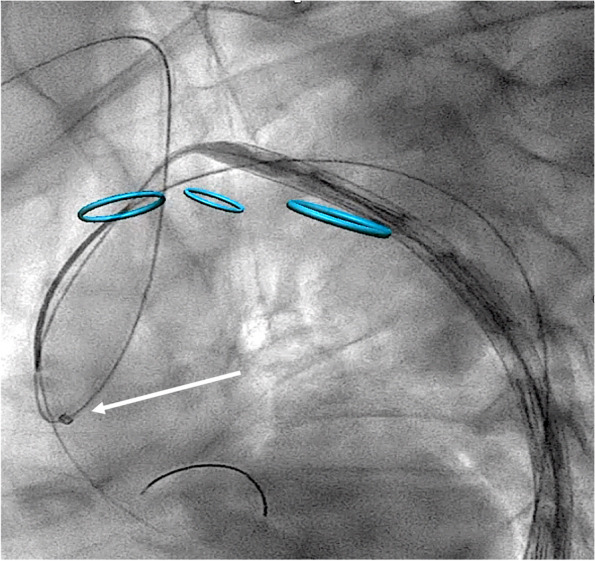
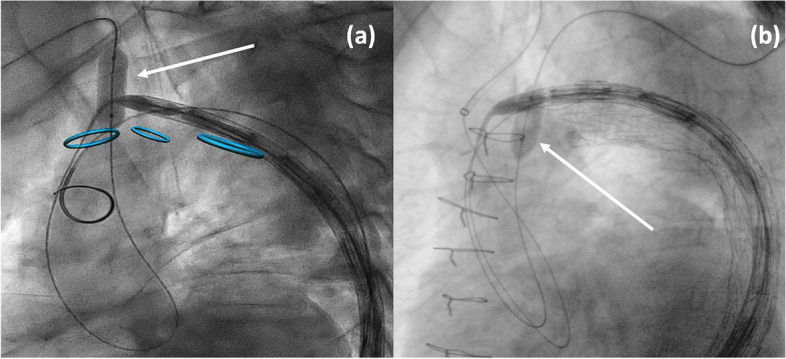
The insertion, positioning and deployment of a Najuta stent-graft requires a through-and-through guidewire technique using a .035″ 400 cm hydrophilic nitinol guidewire (Radifocus™ Guidewire M Non-Vascular, Terumo Corporation, Tokyo, Japan) with right brachial and both femoral accesses. When standard maneuver to put the endograft tip into the aortic arch, some bail-out procedures can be applied to obtain proper positioning. Five techniques are described into the text: positioning of a coaxial extra-stiff guidewire; positioning of a long introducer sheath down to the aortic root from the right brachial access; inflation of a balloon inside the ostia of the supra-aortic vessels; inflation of a balloon inside the aortic arch (coaxial to the device); and transapical access technique. This is a troubleshooting guide for allowing physicians to overcome various difficulties with the Najuta endograft as well as for other similar devices.
Technical issues in advancing the delivery system of Najuta stent-graft could occur. Therefore, the rescue procedures described in this technical note could be useful to guarantee the correct positioning and deployment of the stent-graft.
Najuta覆膜支架(日本东京川澄实验室公司)通常能够轻松地推进至升主动脉的正确释放位置,这得益于预弯曲的输送J型鞘管,其所有开窗均自动朝向主动脉弓上血管。然而,主动脉弓解剖结构和输送系统的硬度可能会限制覆膜支架的正确推进,尤其是当主动脉弓急剧弯曲时。本技术说明的目的是报告一系列补救操作程序,这些操作可能有助于克服在将Najuta覆膜支架推进至升主动脉过程中遇到的困难。
Najuta覆膜支架的插入、定位和释放需要采用贯穿导丝技术,使用一根0.035英寸×400厘米的亲水镍钛合金导丝(Radifocus™ 非血管用导丝M,日本东京泰尔茂公司),通过右肱动脉和双侧股动脉入路。当采用标准操作将覆膜支架尖端置入主动脉弓时,可应用一些补救操作程序以实现正确定位。本文描述了五种技术:同轴超硬导丝的定位;从右肱动脉入路将长的导入鞘管送至主动脉根部;在主动脉弓上血管开口处球囊扩张;在主动脉弓内(与装置同轴)球囊扩张;以及经心尖入路技术。这是一份故障排除指南,可帮助医生克服Najuta覆膜支架以及其他类似装置的各种困难。
在推进Najuta覆膜支架输送系统时可能会出现技术问题。因此,本技术说明中描述的补救操作程序可能有助于确保覆膜支架的正确定位和释放。