Department of Anthropology, University of Toronto, Toronto, Ontario, Canada.
Kaiser Permanente Washington Health Research Institute, Seattle, Washington, USA.
J Gerontol B Psychol Sci Soc Sci. 2023 May 26;78(6):1060-1072. doi: 10.1093/geronb/gbad030.
To examine the circumstances and needs of older adults who were "kinless," defined as having no living spouse or children, when they developed dementia.
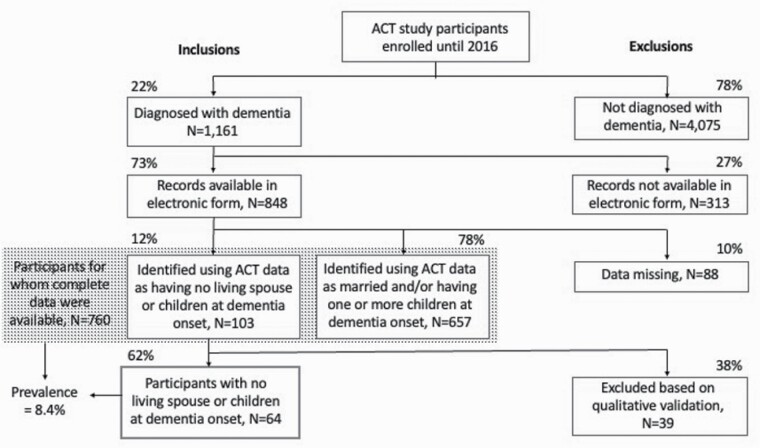
We conducted a secondary analysis of information from the Adult Changes in Thought study. Among 848 participants diagnosed with dementia between 1994 and 2016, we identified 64 who had no living spouse or child at dementia onset. We then conducted a qualitative analysis of administrative documents pertaining to these participants: handwritten comments recorded after each study visit, and medical history documents containing clinical chart notes from participants' medical records.
In this community-dwelling cohort of older adults diagnosed with dementia, 8.4% were kinless at dementia onset. Participants in this sample had an average age of 87 years old, half lived alone, and one third lived with unrelated persons. Through inductive content analysis, we identified 4 themes that describe their circumstances and needs: (1) life trajectories, (2) caregiving resources, (3) care needs and gaps, and (4) turning points in caregiving arrangements.
Our qualitative analysis reveals that the life trajectories that led members of the analytic cohort to be kinless at dementia onset were quite varied. This research highlights the importance of nonfamily caregivers and participants' own roles as caregivers. Our findings suggest that clinicians and health systems may need to work with other parties to directly provide dementia caregiving support rather than rely on family, and address factors such as neighborhood affordability that particularly affect older adults who have limited family support.
研究在患有痴呆症时没有配偶或子女的老年人(定义为“无亲属”)的情况和需求。
我们对成人思维变化研究的信息进行了二次分析。在 1994 年至 2016 年间被诊断患有痴呆症的 848 名参与者中,我们确定了 64 名在痴呆症发病时没有配偶或子女的参与者。然后,我们对与这些参与者相关的行政文件进行了定性分析:每次研究访问后的手写评论,以及包含参与者病历中临床图表注释的病史文件。
在这个被诊断患有痴呆症的社区居住的老年人群体中,8.4%的人在痴呆症发病时没有亲属。该样本中的参与者平均年龄为 87 岁,一半独居,三分之一与无亲属的人住在一起。通过归纳内容分析,我们确定了描述他们情况和需求的 4 个主题:(1)生活轨迹,(2)照护资源,(3)照护需求和差距,以及(4)照护安排的转折点。
我们的定性分析表明,导致分析队列成员在痴呆症发病时无亲属的生活轨迹差异很大。这项研究强调了非家庭照护者和参与者自身作为照护者的重要性。我们的研究结果表明,临床医生和卫生系统可能需要与其他方合作,直接提供痴呆症照护支持,而不是依赖家庭,并解决邻里负担能力等特别影响家庭支持有限的老年人的因素。