Department of Breast and Thyroid Surgery, Hangzhou Linping District Maternal and child Care Hospital, Hangzhou, China.
Department of General Surgery, Comprehensive Breast Health Center, Ruijin Hospital, Shanghai Jiao Tong University School of Medicine, 197 Ruijin Er Road, 200025, Shanghai, China.
BMC Cancer. 2023 Feb 21;23(1):173. doi: 10.1186/s12885-023-10634-7.
Novel antibody‒drug conjugates (ADC) have shown great efficacy in HER2-low advanced breast cancer. However, the clinical features of HER2-low disease still need to be clarified. The current study aims to evaluate the distribution and dynamic change in HER2 expression in patients with disease recurrence and the clinical outcome of those patients.
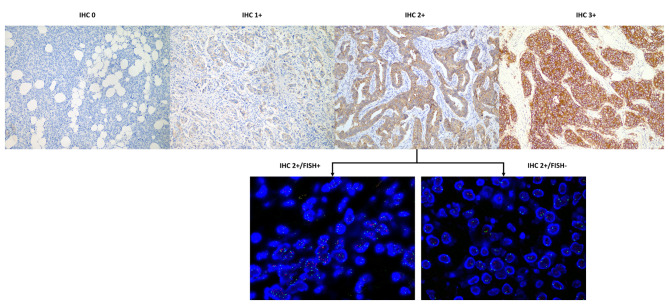
Patients with pathologically diagnosed relapsed breast cancer between 2009 and 2018 were included. Samples were considered HER2-zero when the immunohistochemistry (IHC) score was 0, HER2-low when the IHC score was 1 + or 2 + with negative fluorescence in situ hybridization (FISH) results, and HER2-positive when the IHC score was 3 + or the FISH results were positive. Breast cancer-specific survival (BCSS) was compared among the three HER2 groups. Changes in HER2 status were also evaluated.
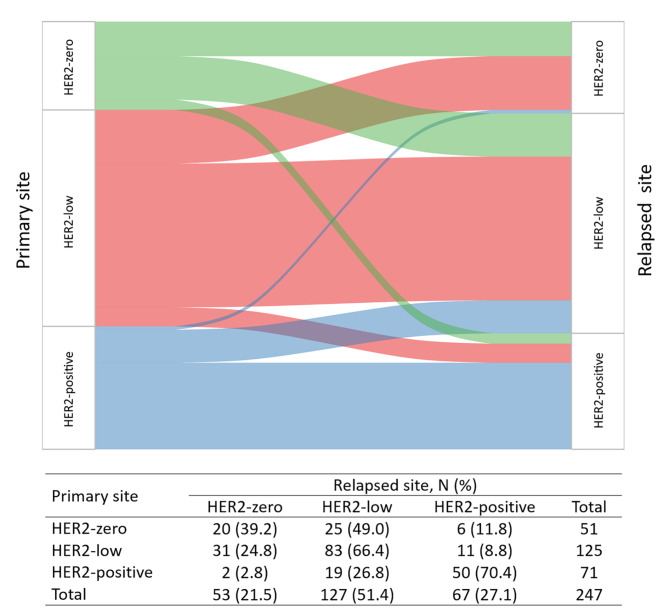
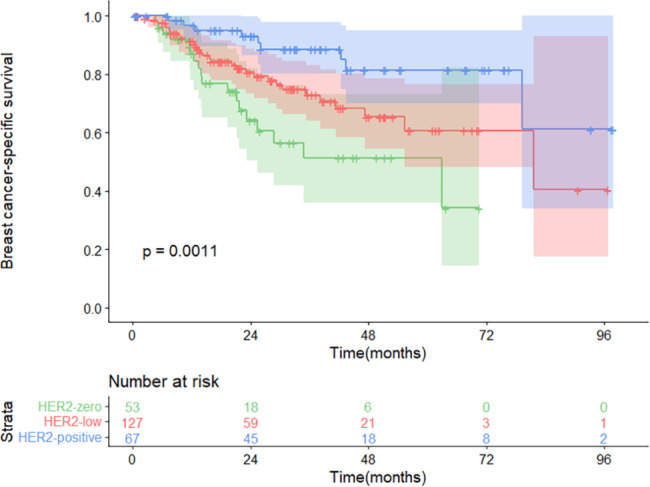
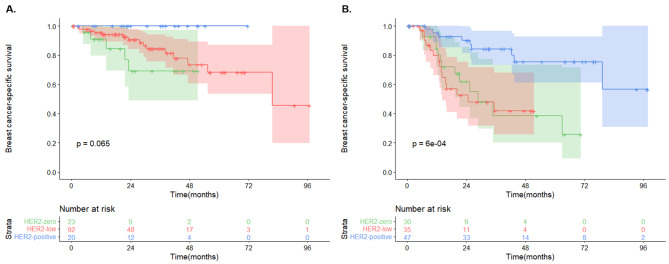
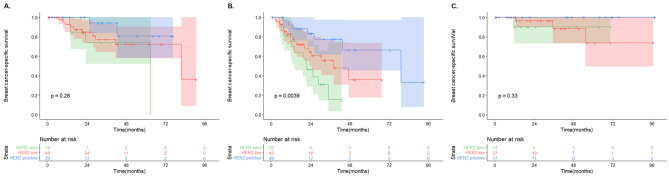
A total of 247 patients were included. Among recurrent tumors, 53 (21.5%) were HER2-zero, 127 (51.4%) were HER2-low, and 67 (27.1%) were HER2-positive. The HER2-low subtype represented 68.1% of the HR-positive breast cancer group and 31.3% of the HR-negative group (P < 0.001). This three-group classification of HER2 status was prognostic in advanced breast cancer (P = 0.0011), with HER2-positive patients having the best clinical outcome after disease recurrence (P = 0.024), while only marginal survival advantages were observed in HER2-low patients versus HER2-zero patients (P = 0.051). In the subgroup analysis, the survival difference was observed only in patients with HR-negative recurrent tumors (P = 0.0006) or with distant metastasis (P = 0.0037). The overall discordance rate of HER2 status between primary and recurrent tumors was 38.1%, with 25 (49.0%) primary HER2-zero patients and 19 (26.8%) HER2-positive patients shifting to HER2-low at recurrence.
Nearly half of the advanced breast cancer patients had HER2-low disease, which indicates a poorer prognosis than HER2-positive disease and marginally better outcomes than HER2-zero disease. During disease progression, one-fifth of tumors convert to HER2-low entities, and the corresponding patients may benefit from ADC treatment.
新型抗体药物偶联物(ADC)在 HER2 低表达晚期乳腺癌中显示出了很好的疗效。然而,HER2 低表达疾病的临床特征仍需要进一步明确。本研究旨在评估复发患者中 HER2 表达的分布和动态变化,以及这些患者的临床结局。
纳入 2009 年至 2018 年间经病理诊断复发的乳腺癌患者。免疫组化(IHC)评分 0 时为 HER2-0,IHC 评分 1+或 2+且荧光原位杂交(FISH)结果阴性时为 HER2-低,IHC 评分 3+或 FISH 结果阳性时为 HER2 阳性。比较三组 HER2 患者的乳腺癌特异性生存(BCSS)。还评估了 HER2 状态的变化。
共纳入 247 例患者。在复发性肿瘤中,53 例(21.5%)为 HER2-0,127 例(51.4%)为 HER2-低,67 例(27.1%)为 HER2 阳性。HER2-低亚型在 HR 阳性乳腺癌组占 68.1%,在 HR 阴性组占 31.3%(P<0.001)。HER2 状态的三组分类在晚期乳腺癌中有预后意义(P=0.0011),HER2 阳性患者复发后临床结局最好(P=0.024),而 HER2-低患者与 HER2-0 患者的生存优势仅为边缘性(P=0.051)。亚组分析显示,生存差异仅在 HR 阴性复发性肿瘤(P=0.0006)或远处转移(P=0.0037)患者中观察到。原发肿瘤和复发肿瘤的 HER2 状态总体不一致率为 38.1%,25 例(49.0%)原发 HER2-0 患者和 19 例(26.8%)HER2 阳性患者在复发时转为 HER2-低。
近一半的晚期乳腺癌患者存在 HER2-低表达疾病,其预后较 HER2 阳性患者差,较 HER2-0 患者稍好。在疾病进展过程中,有五分之一的肿瘤转化为 HER2-低实体,相应患者可能从 ADC 治疗中获益。