Vascular Biology and Translational Research, Faculty of Medicine and Health, School of Medical Sciences, University of New South Wales, Sydney, NSW, 2052, Australia.
Centre for Vision Research, Westmead Institute for Medical Research, University of Sydney, Westmead, Australia.
J Transl Med. 2023 Feb 21;21(1):133. doi: 10.1186/s12967-023-03937-7.
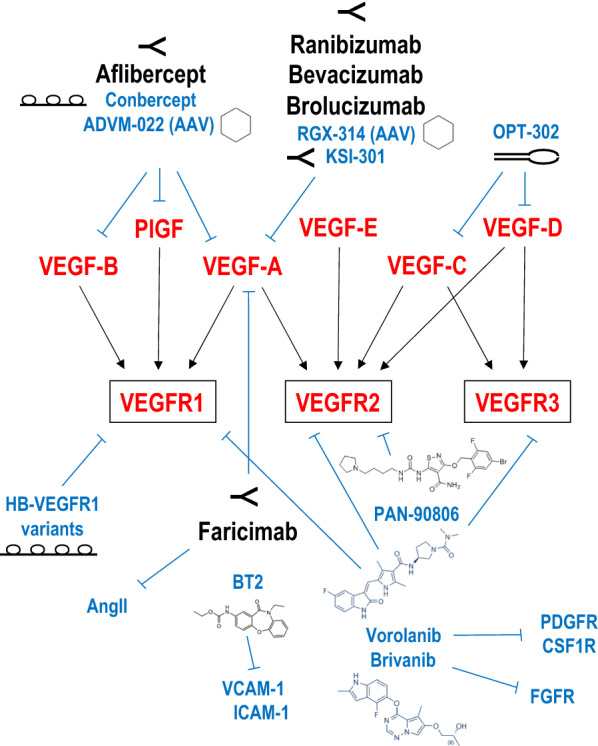
Neovascular age-related macular degeneration (nAMD) is a major cause of visual impairment and blindness. Anti-vascular endothelial growth factor (VEGF) agents, such as ranibizumab, bevacizumab, aflibercept, brolucizumab and faricimab have revolutionized the clinical management of nAMD. However, there remains an unmet clinical need for new and improved therapies for nAMD, since many patients do not respond optimally, may lose response over time or exhibit sub-optimal durability, impacting on real world effectiveness. Evidence is emerging that targeting VEGF-A alone, as most agents have done until recently, may be insufficient and agents that target multiple pathways (e.g., aflibercept, faricimab and others in development) may be more efficacious. This article reviews issues and limitations that have arisen from the use of existing anti-VEGF agents, and argues that the future may lie in multi-targeted therapies including alternative agents and modalities that target both the VEGF ligand/receptor system as well as other pathways.
与年龄相关的新生血管性黄斑变性(nAMD)是导致视力损害和失明的主要原因。抗血管内皮生长因子(VEGF)药物,如雷珠单抗、贝伐珠单抗、阿柏西普、康柏西普和 faricimab,已经彻底改变了 nAMD 的临床治疗方法。然而,对于 nAMD 仍存在未满足的临床治疗需求,因为许多患者的治疗效果并不理想,可能会随着时间的推移而失去反应或表现出不理想的持久性,从而影响实际效果。有证据表明,最近大多数药物的靶点都是 VEGF-A 本身,这可能还不够,而靶向多种途径(如 aflibercept、faricimab 及其他正在研发中的药物)的药物可能更有效。本文综述了现有抗 VEGF 药物应用中出现的问题和局限性,并认为未来可能在于包括替代药物和新方法在内的多靶点治疗,这些方法既可以靶向 VEGF 配体/受体系统,也可以靶向其他途径。