Non-Communicable Diseases Research Center, Rafsanjan University of Medical Sciences, Rafsanjan, Iran.
Department of Internal Medicine, Ali-Ibn Abi-Talib Hospital, School of Medicine, Rafsanjan University of Medical Sciences, Rafsanjan, Iran.
Trials. 2023 Feb 21;24(1):129. doi: 10.1186/s13063-023-07083-9.
N-acetylcysteine (NAC) has broadly been used as an anti-oxidant agent in various types of diseases. This study aimed to assess the effect of NAC on the systemic lupus erythematosus (SLE) disease activity and outcome.
In this randomized, double-blind clinical trial study, 80 SLE patients were recruited that were classified into two groups: 40 patients received NAC (1800 mg/day; 3 times per day with 8-h intervals) for 3 months and 40 patients as the control group received normal therapies. Laboratory measurements and disease activity based on the British Isles Lupus Assessment Group (BILAG) and SLE Disease Activity Index (SLEDAI) were determined before the initiation of treatment and after the study time period.
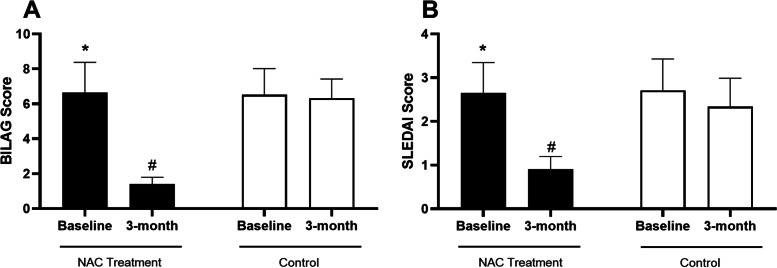
A statistically significant decrease in BILAG (P= 0.023) and SLEDAI (P= 0.034) scores after receiving NAC for a 3-month period was observed. BILAG (P= 0.021) and SLEDAI (P= 0.030) scores were significantly lower in NAC-receiving patients compared to the control group after 3 months. The disease activity in each organ based on BILAG score after treatment indicated a significant decrease in the NAC group compared to the baseline level in general (P=0.018), mucocutaneous (P=0.003), neurological (P=0.015), musculoskeletal (P=0.048), cardiorespiratory (P=0.047), renal (P=0.025), and vascular (P=0.048) complications. Analysis indicated a significant increase in CH50 level in the NAC group after treatment compared to the baseline level (P=0.049). No adverse event was reported by the study subjects.
It appears that the administration of 1800 mg/day NAC to SLE patients can decrease the SLE disease activity and its complications.
N-乙酰半胱氨酸(NAC)已广泛用作各种类型疾病的抗氧化剂。本研究旨在评估 NAC 对系统性红斑狼疮(SLE)疾病活动和结局的影响。
在这项随机、双盲临床试验研究中,招募了 80 名 SLE 患者,将他们分为两组:40 名患者接受 NAC(1800mg/天;每天 3 次,间隔 8 小时)治疗 3 个月,40 名患者作为对照组接受常规治疗。在开始治疗前和研究期间后,测定实验室测量值和基于英国狼疮评估组(BILAG)和系统性红斑狼疮疾病活动指数(SLEDAI)的疾病活动。
接受 NAC 治疗 3 个月后,BILAG(P=0.023)和 SLEDAI(P=0.034)评分均显著下降。与对照组相比,接受 NAC 治疗 3 个月后,BILAG(P=0.021)和 SLEDAI(P=0.030)评分显著降低。基于 BILAG 评分,治疗后每个器官的疾病活动均表明 NAC 组与基线水平相比总体显著降低(P=0.018),皮肤黏膜(P=0.003)、神经(P=0.015)、肌肉骨骼(P=0.048)、心肺(P=0.047)、肾脏(P=0.025)和血管(P=0.048)并发症。分析表明,与基线水平相比,NAC 组治疗后 CH50 水平显著升高(P=0.049)。研究对象未报告任何不良事件。
每天给予 1800mg NAC 似乎可以降低 SLE 患者的 SLE 疾病活动度及其并发症。