Tian Xiao-Peng, Zhang Yu-Chen, Lin Ning-Jing, Wang Liang, Li Zhi-Hua, Guo Han-Guo, Ma Shu-Yun, An Ming-Jie, Yang Jing, Hong Yu-Heng, Wang Xian-Huo, Zhou Hui, Li Ya-Jun, Rao Hui-Lan, Li Mei, Hu Shao-Xuan, Lin Tong-Yu, Li Zhi-Ming, Huang He, Liang Yang, Xia Zhong-Jun, Lv Yue, Liu Yu-Ying, Duan Zhao-Hui, Chen Qing-Yu, Wang Jin-Ni, Cai Jun, Xie Ying, Ong Choon-Kiat, Liu Fang, Liu Yan-Yan, Yan Zheng, Huang Liang, Tao Rong, Li Wen-Yu, Huang Hui-Qiang, Cai Qing-Qing
Department of Medical Oncology, Sun Yat-sen University Cancer Center, Guangzhou, P.R. China; State Key Laboratory of Oncology in South China, Collaborative Innovation Center of Cancer Medicine, Sun Yat-sen University Cancer Center, Guangzhou, P.R. China.
Key Laboratory of Carcinogenesis and Translational Research (Ministry of Education), Department of Lymphoma, Peking University Cancer Hospital & Institute, Beijing, P.R. China.
Cell Rep Med. 2023 Feb 21;4(2):100859. doi: 10.1016/j.xcrm.2022.100859.
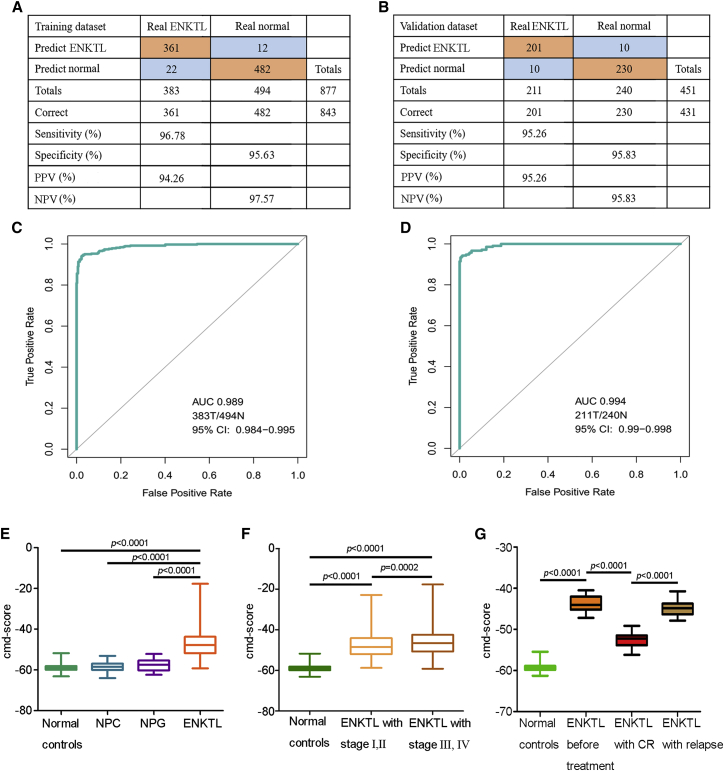
Circulating tumor DNA (ctDNA) carries tumor-specific genetic and epigenetic variations. To identify extranodal natural killer/T cell lymphoma (ENKTL)-specific methylation markers and establish a diagnostic and prognosis prediction model for ENKTL, we describe the ENKTL-specific ctDNA methylation patterns by analyzing the methylation profiles of ENKTL plasma samples. We construct a diagnostic prediction model based on ctDNA methylation markers with both high specificity and sensitivity and close relevance to tumor staging and therapeutic response. Subsequently, we built a prognostic prediction model showing excellent performance, and its predictive accuracy is significantly better than the Ann Arbor staging and prognostic index of natural killer lymphoma (PINK) risk system. Notably, we further establish a PINK-C risk grading system to select individualized treatment for patients with different prognostic risks. In conclusion, these results suggest that ctDNA methylation markers are of great value in diagnosis, monitoring, and prognosis, which might have implications for clinical decision-making of patients with ENKTL.
循环肿瘤DNA(ctDNA)携带肿瘤特异性的基因和表观遗传变异。为了鉴定结外自然杀伤/T细胞淋巴瘤(ENKTL)特异性甲基化标志物并建立ENKTL的诊断和预后预测模型,我们通过分析ENKTL血浆样本的甲基化谱来描述ENKTL特异性ctDNA甲基化模式。我们基于具有高特异性和敏感性且与肿瘤分期及治疗反应密切相关的ctDNA甲基化标志物构建了一个诊断预测模型。随后,我们构建了一个表现优异的预后预测模型,其预测准确性显著优于自然杀伤淋巴瘤(PINK)风险系统的Ann Arbor分期和预后指数。值得注意的是,我们进一步建立了PINK-C风险分级系统,以便为不同预后风险的患者选择个体化治疗。总之,这些结果表明ctDNA甲基化标志物在诊断、监测和预后方面具有重要价值,这可能对ENKTL患者的临床决策具有启示意义。