From the Department of Neurology (B.R., E.S., L.H.O., M.T., M.P.F., K.S.L., U.R.), Charité-Universitätsmedizin Berlin; Clinician Scientist Program (B.R.), Berlin Institute of Health at Charité (BIH); and Universitätsmedizin Greifswald (U.R.), Germany.
Neurology. 2023 Apr 25;100(17):e1825-e1835. doi: 10.1212/WNL.0000000000207114. Epub 2023 Feb 22.
Sex hormones may modulate calcitonin gene-related peptide (CGRP) release in the trigeminovascular system. We studied CGRP concentrations in plasma and tear fluid in female participants with episodic migraine (EM) and a regular menstrual cycle (RMC), female participants with EM and combined oral contraception (COC), and female participants with EM in the postmenopause. For control, we analyzed 3 corresponding groups of age-matched female participants without EM.
Participants with an RMC had 2 visits: during menstruation on menstrual cycle day 2 ± 2 and in the periovulatory period on day 13 ± 2. Participants with COC were examined at day 4 ± 2 of the hormone-free interval (HFI) and between days 7 and 14 of hormone intake (HI). Postmenopausal participants were assessed once at a random time point. Plasma and tear fluid samples were collected at each visit for determination of CGRP levels with an ELISA.
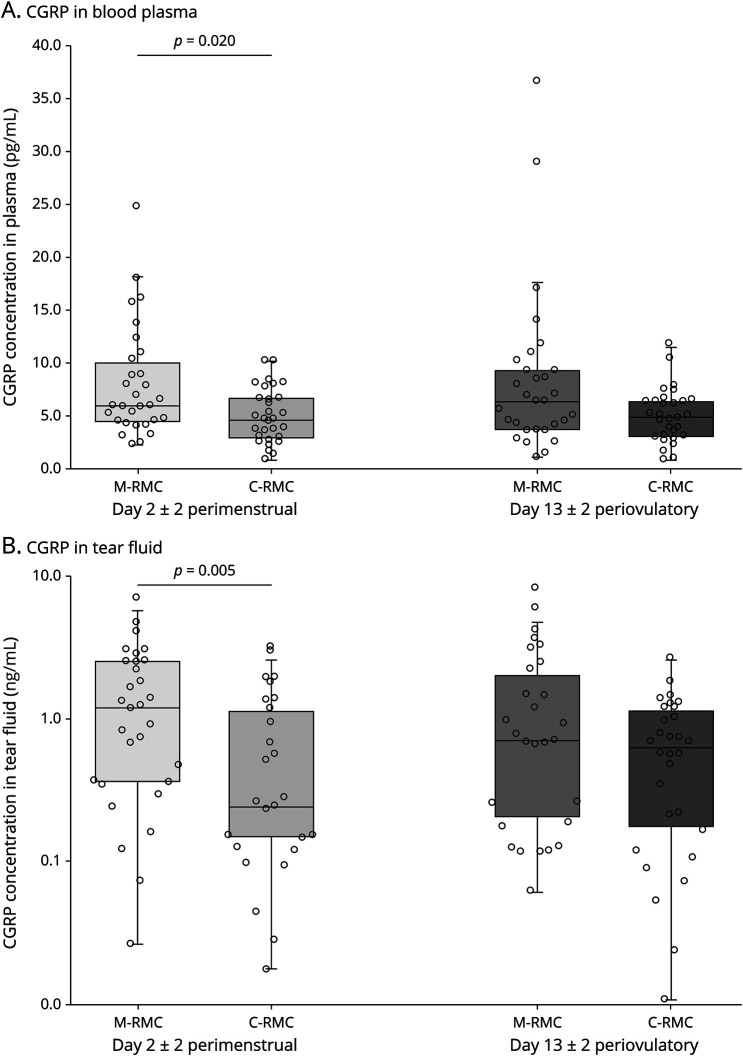
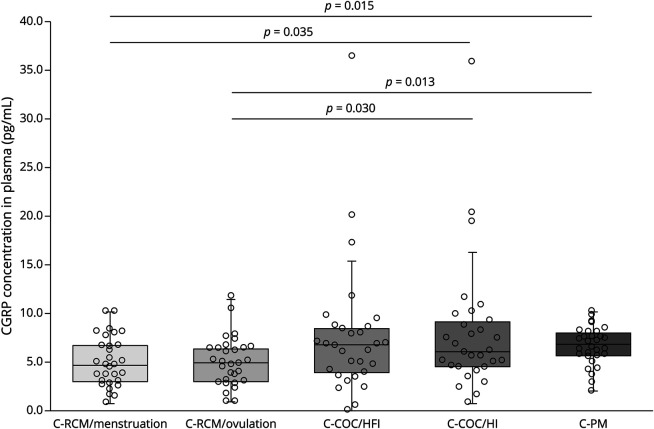
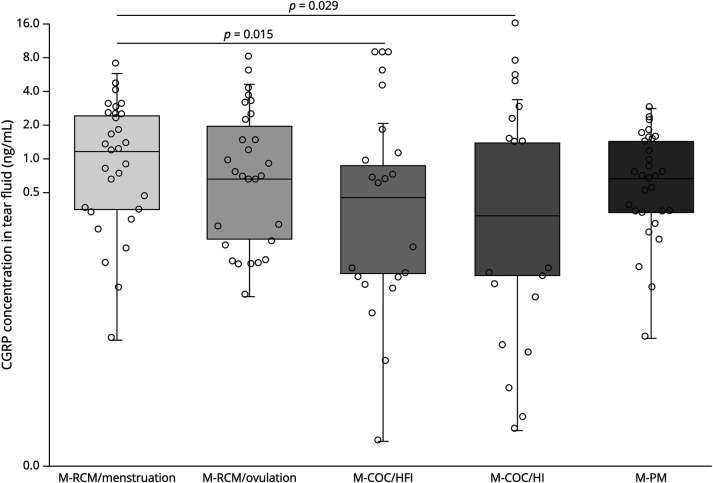
A total of 180 female participants (n = 30 per group) completed the study. Participants with migraine and an RMC showed statistically significantly higher CGRP concentrations in plasma and tear fluid during menstruation compared with female participants without migraine (plasma: 5.95 pg/mL [IQR 4.37-10.44] vs 4.61 pg/mL [IQR 2.83-6.92], = 0.020 [Mann-Whitney test]; tear fluid: 1.20 ng/mL [IQR 0.36-2.52] vs 0.4 ng/mL [IQR 0.14-1.22], = 0.005 [Mann-Whitney test]). In contrast, female participants with COC and in the postmenopause had similar CGRP levels in the migraine and the control groups. In migraine participants with an RMC, tear fluid but not plasma CGRP concentrations during menstruation were statistically significantly higher compared with migraine participants under COC ( = 0.015 vs HFI and = 0.029 vs HI, Mann-Whitney test).
Different sex hormone profiles may influence CGRP concentrations in people, with current or past capacity to menstruate, with migraine. Measurement of CGRP in tear fluid was feasible and warrants further investigation.
性激素可能调节三叉血管系统中降钙素基因相关肽(CGRP)的释放。我们研究了在有发作性偏头痛(EM)和正常月经周期(RMC)的女性参与者、有 EM 和口服避孕药(COC)的女性参与者以及绝经后 EM 女性参与者的血浆和泪液中的 CGRP 浓度。作为对照,我们分析了 3 组年龄匹配的无 EM 女性参与者。
RMC 参与者有 2 次就诊:月经期在月经周期第 2 ± 2 天和排卵前第 13 ± 2 天。COC 参与者在激素无间隔第 4 ± 2 天和激素摄入第 7-14 天接受检查。绝经后参与者在任意时间点进行一次评估。在每次就诊时采集血浆和泪液样本,用 ELISA 测定 CGRP 水平。
共有 180 名女性参与者(每组 30 名)完成了研究。与无偏头痛的女性参与者相比,有偏头痛且有 RMC 的女性参与者在月经期的血浆和泪液中的 CGRP 浓度显著升高(血浆:5.95 pg/mL [IQR 4.37-10.44] vs 4.61 pg/mL [IQR 2.83-6.92], = 0.020 [Mann-Whitney 检验];泪液:1.20 ng/mL [IQR 0.36-2.52] vs 0.4 ng/mL [IQR 0.14-1.22], = 0.005 [Mann-Whitney 检验])。相比之下,COC 和绝经后女性参与者的偏头痛和对照组的 CGRP 水平相似。在有 RMC 的偏头痛参与者中,月经期的泪液而不是血浆 CGRP 浓度与 COC 下的偏头痛参与者相比显著升高( = 0.015 对 HFI 和 = 0.029 对 HI,Mann-Whitney 检验)。
不同的性激素谱可能会影响有月经或曾有月经能力的偏头痛患者的 CGRP 浓度。泪液中的 CGRP 测量是可行的,值得进一步研究。