• 文献检索
  • 文档翻译
  • 深度研究
  • 学术资讯
  • Suppr Zotero 插件Zotero 插件
  • 邀请有礼
  • 套餐&价格
  • 历史记录
应用&插件
Suppr Zotero 插件Zotero 插件浏览器插件Mac 客户端Windows 客户端微信小程序
定价
高级版会员购买积分包购买API积分包
服务
文献检索文档翻译深度研究API 文档MCP 服务
关于我们
关于 Suppr公司介绍联系我们用户协议隐私条款
关注我们

Suppr 超能文献

核心技术专利:CN118964589B侵权必究
粤ICP备2023148730 号-1Suppr @ 2026

文献检索

告别复杂PubMed语法,用中文像聊天一样搜索,搜遍4000万医学文献。AI智能推荐,让科研检索更轻松。

立即免费搜索

文件翻译

保留排版,准确专业,支持PDF/Word/PPT等文件格式,支持 12+语言互译。

免费翻译文档

深度研究

AI帮你快速写综述,25分钟生成高质量综述,智能提取关键信息,辅助科研写作。

立即免费体验

比较四种产时胎心监护图分类方法预测新生儿出生时酸中毒的价值。

Comparison of Four Intrapartum Cardiotocography Classifications for Predicting Neonatal Acidemia at Birth.

机构信息

Department of Perinatology, Division of Obstetrics and Gynecology, University Medical Center Ljubljana, Ljubljana, Slovenia.

Department of Obstetrics and Gynecology, General Hospital Slovenj Gradec, Slovenj Gradec, Slovenia.

出版信息

J Pregnancy. 2023 Feb 13;2023:5853889. doi: 10.1155/2023/5853889. eCollection 2023.

DOI:10.1155/2023/5853889
PMID:36814692
原文链接:https://pmc.ncbi.nlm.nih.gov/articles/PMC9940944/
Abstract

OBJECTIVE

To compare diagnostic values of four intrapartum cardiotocography (CTG) classifications in predicting neonatal acidemia at birth.

METHODS

Retrospective case-control study. Forty-three CTG traces with an umbilical artery pH < 7.00 (study group) and 43 traces with a pH ≥ 7.00 (control group) were analyzed. Inclusion criteria were singleton pregnancy, cephalic presentation, admission to labour ward during active phase of first stage of labour, and gestational age 37 to 41 weeks. Exclusion criteria were suspected intrauterine growth restriction, oligohydramnios, polyhydramnios, pregestational or gestational insulin-dependent diabetes mellitus, and preeclampsia. Last 30-60 minutes before delivery of CTG traces was classified retrospectively according to four classification systems-International Federation of Gynecology and Obstetrics (FIGO), Royal College of Obstetricians and Gynaecologists (RCOG), National Institute of Child Health and Human Development (NICHD), and the 5-tier system by Parer and Ikeda. Predictive value of each classification for neonatal acidemia was assessed using receiver operating characteristics (ROC) analysis.

RESULTS

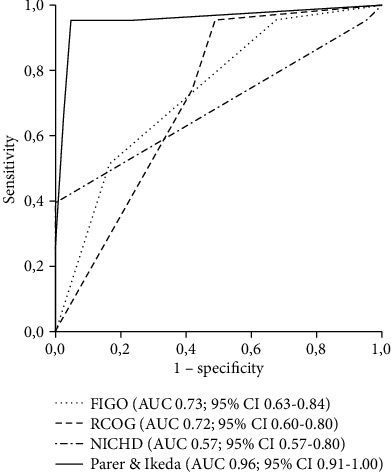
FIGO, RCOG, and NICHD classifications predicted neonatal acidemia with areas under the ROC curves (AUC) of 0.73, 95% confidence interval (CI) 0.63-0.84; 0.72, 95% CI 0.60-0.83; and 0.69, 95% CI 0.57-0.80, respectively. The five-tier system by Parer and Ikeda had significantly better predictive value with an AUC of 0.96, 95% CI 0.91-1.00.

CONCLUSIONS

The 5-tier classification system proposed by Parer and Ikeda for assessing CTG in labour was superior to FIGO, RCOG, and NICHD intrapartum CTG classifications in predicting severe neonatal acidemia at birth.

摘要

目的

比较 4 种产时胎心监护(CTG)分类方法在预测出生时新生儿酸中毒中的诊断价值。

方法

回顾性病例对照研究。分析 43 份脐动脉 pH 值<7.00 的 CTG 图(研究组)和 43 份 pH 值≥7.00 的 CTG 图(对照组)。纳入标准为单胎妊娠、头位、第一产程活跃期入院、孕龄 37 至 41 周。排除标准为可疑宫内生长受限、羊水过少、羊水过多、孕前或妊娠期胰岛素依赖型糖尿病、子痫前期。分娩前最后 30-60 分钟的 CTG 图按国际妇产科联合会(FIGO)、英国皇家妇产科医师学院(RCOG)、美国国立儿童健康与人类发育研究所(NICHD)和 Parer 和 Ikeda 的 5 级系统进行回顾性分类。使用受试者工作特征(ROC)曲线分析每种分类方法对新生儿酸中毒的预测价值。

结果

FIGO、RCOG 和 NICHD 分类预测新生儿酸中毒的 ROC 曲线下面积(AUC)分别为 0.73、95%可信区间(CI)0.63-0.84;0.72、95% CI 0.60-0.83;0.69、95% CI 0.57-0.80。Parer 和 Ikeda 的 5 级系统具有更好的预测价值,AUC 为 0.96、95% CI 0.91-1.00。

结论

Parer 和 Ikeda 提出的用于评估产时 CTG 的 5 级分类系统在预测出生时严重新生儿酸中毒方面优于 FIGO、RCOG 和 NICHD 产时 CTG 分类。
https://cdn.ncbi.nlm.nih.gov/pmc/blobs/3021/9940944/a7ba2c00ab39/JP2023-5853889.001.jpg

相似文献

1
Comparison of Four Intrapartum Cardiotocography Classifications for Predicting Neonatal Acidemia at Birth.比较四种产时胎心监护图分类方法预测新生儿出生时酸中毒的价值。
J Pregnancy. 2023 Feb 13;2023:5853889. doi: 10.1155/2023/5853889. eCollection 2023.
2
Comparison of five classification systems for interpreting electronic fetal monitoring in predicting neonatal status at birth.五种用于解读电子胎儿监护以预测新生儿出生状态的分类系统的比较。
J Matern Fetal Neonatal Med. 2013 Mar;26(5):487-90. doi: 10.3109/14767058.2012.735726. Epub 2012 Nov 6.
3
Quantification of Posterior Risk Related to Intrapartum FIGO 2015 Criteria for Cardiotocography in the Second Stage of Labor.第二产程中应用 FIGO 2015 胎心监护标准的相关风险的量化评估。
Fetal Diagn Ther. 2021;48(2):149-157. doi: 10.1159/000512658. Epub 2021 Jan 28.
4
Diagnostic Accuracy of the FIGO and the 5-Tier Fetal Heart Rate Classification Systems in the Detection of Neonatal Acidemia.国际妇产科联盟(FIGO)和五级胎儿心率分类系统在检测新生儿酸血症方面的诊断准确性
Am J Perinatol. 2017 Apr;34(5):508-514. doi: 10.1055/s-0036-1593810. Epub 2016 Oct 25.
5
Impaired validity of the new FIGO and Swedish CTG classification templates to identify fetal acidosis in the first stage of labor.新 FIGO 和瑞典 CTG 分类模板在识别产程第一阶段胎儿酸中毒方面的有效性受损。
J Matern Fetal Neonatal Med. 2022 Dec;35(25):4853-4860. doi: 10.1080/14767058.2020.1869931. Epub 2021 Jan 6.
6
Diagnostic capacity and interobserver variability in FIGO, ACOG, NICE and Chandraharan cardiotocographic guidelines to predict neonatal acidemia.FIGO、ACOG、NICE 和 Chandraharan 胎心监护指南预测新生儿酸中毒的诊断能力和观察者间变异性。
J Matern Fetal Neonatal Med. 2022 Dec;35(25):8498-8506. doi: 10.1080/14767058.2021.1986479. Epub 2021 Oct 15.
7
Comparison of the predictive ability for perinatal acidemia in neonates between the NICHD 3-tier FHR system combined with clinical risk factors and the fetal reserve index.比较 NICHD 3 级胎心监护系统联合临床危险因素与胎儿储备指数对新生儿围产期酸中毒的预测能力。
PLoS One. 2022 Oct 20;17(10):e0276451. doi: 10.1371/journal.pone.0276451. eCollection 2022.
8
Cardiotocographic findings in the second stage of labor among fetuses delivered with acidemia: a comparison of two classification systems.分娩时伴有酸血症的胎儿第二产程的胎心监护结果:两种分类系统的比较
Eur J Obstet Gynecol Reprod Biol. 2016 Aug;203:297-302. doi: 10.1016/j.ejogrb.2016.06.028. Epub 2016 Jul 5.
9
Hazard and cumulative incidence of umbilical cord metabolic acidemia at birth in fetuses experiencing the second stage of labor and pathologic intrapartum fetal heart rate requiring expedited delivery.分娩第二产程中胎儿出现代谢性酸中毒和胎心监护异常需紧急分娩的胎儿脐血发生酸中毒的危险度和累积发生率。
Arch Gynecol Obstet. 2023 Apr;307(4):1225-1232. doi: 10.1007/s00404-022-06594-1. Epub 2022 May 21.
10
A prospective cohort study of fetal heart rate monitoring: deceleration area is predictive of fetal acidemia.前瞻性胎儿心率监测队列研究:减速面积可预测胎儿酸中毒。
Am J Obstet Gynecol. 2018 May;218(5):523.e1-523.e12. doi: 10.1016/j.ajog.2018.01.026. Epub 2018 Feb 1.

引用本文的文献

1
The iPREFACE score is useful for predicting fetal acidemia: A retrospective cohort study of 113 patients who underwent emergency cesarean section for non-reassuring fetal status during labor.iPREFACE评分有助于预测胎儿酸血症:一项对113例因产时胎儿状况不佳而接受急诊剖宫产的患者的回顾性队列研究。
AJOG Glob Rep. 2024 Apr 4;4(2):100343. doi: 10.1016/j.xagr.2024.100343. eCollection 2024 May.
2
Labor management and neonatal outcomes in cardiotocography categories II and III (Review).胎心监护II类和III类中的产时管理与新生儿结局(综述)
Med Int (Lond). 2024 Apr 1;4(3):27. doi: 10.3892/mi.2024.151. eCollection 2024 May-Jun.
3

本文引用的文献

1
Diagnostic capacity and interobserver variability in FIGO, ACOG, NICE and Chandraharan cardiotocographic guidelines to predict neonatal acidemia.FIGO、ACOG、NICE 和 Chandraharan 胎心监护指南预测新生儿酸中毒的诊断能力和观察者间变异性。
J Matern Fetal Neonatal Med. 2022 Dec;35(25):8498-8506. doi: 10.1080/14767058.2021.1986479. Epub 2021 Oct 15.
2
Evaluation of 3-tier and 5-tier FHR pattern classifications using umbilical blood pH and base excess at delivery.评估分娩时脐血 pH 值和碱剩余的 3 级和 5 级胎心监护图形分类。
PLoS One. 2020 Feb 6;15(2):e0228630. doi: 10.1371/journal.pone.0228630. eCollection 2020.
3
Contribution of proactive management of healthcare risks to the reduction of adverse events in a maternity hospital.
积极管理医疗保健风险对减少妇产医院不良事件的贡献。
BMJ Open Qual. 2024 Feb 29;13(1):e002456. doi: 10.1136/bmjoq-2023-002456.
Agreement and accuracy using the FIGO, ACOG and NICE cardiotocography interpretation guidelines.
采用国际妇产科联盟(FIGO)、美国妇产科医师学会(ACOG)和英国国家卫生与临床优化研究所(NICE)的胎心监护解读指南的一致性和准确性。
Acta Obstet Gynecol Scand. 2017 Feb;96(2):166-175. doi: 10.1111/aogs.13064. Epub 2017 Jan 6.
4
Diagnostic Accuracy of the FIGO and the 5-Tier Fetal Heart Rate Classification Systems in the Detection of Neonatal Acidemia.国际妇产科联盟(FIGO)和五级胎儿心率分类系统在检测新生儿酸血症方面的诊断准确性
Am J Perinatol. 2017 Apr;34(5):508-514. doi: 10.1055/s-0036-1593810. Epub 2016 Oct 25.
5
Continuous cardiotocography during labour: Analysis, classification and management.分娩期间的连续胎心监护:分析、分类与管理。
Best Pract Res Clin Obstet Gynaecol. 2016 Jan;30:33-47. doi: 10.1016/j.bpobgyn.2015.03.022. Epub 2015 Jun 25.
6
Mechanism of reduction of newborn metabolic acidemia following application of a rule-based 5-category color-coded fetal heart rate management framework.应用基于规则的5类颜色编码胎儿心率管理框架后新生儿代谢性酸血症降低的机制。
J Matern Fetal Neonatal Med. 2015 Sep;28(13):1608-13. doi: 10.3109/14767058.2014.963044.
7
Comparison of five classification systems for interpreting electronic fetal monitoring in predicting neonatal status at birth.五种用于解读电子胎儿监护以预测新生儿出生状态的分类系统的比较。
J Matern Fetal Neonatal Med. 2013 Mar;26(5):487-90. doi: 10.3109/14767058.2012.735726. Epub 2012 Nov 6.
8
Immediate newborn outcome and mode of delivery: use of standardized fetal heart rate pattern management.新生儿即刻结局与分娩方式:标准化胎儿心率模式管理的应用
J Matern Fetal Neonatal Med. 2013 Jan;26(1):71-4. doi: 10.3109/14767058.2012.728645. Epub 2012 Oct 3.
9
The 5-tier system of assessing fetal heart rate tracings is superior to the 3-tier system in identifying fetal acidemia.评估胎儿心率图的 5 级系统优于 3 级系统,可识别胎儿酸中毒。
Am J Obstet Gynecol. 2012 Mar;206(3):226.e1-5. doi: 10.1016/j.ajog.2011.12.014. Epub 2011 Dec 22.
10
Assessment of the concordance among 2-tier, 3-tier, and 5-tier fetal heart rate classification systems.评估 2 级、3 级和 5 级胎儿心率分类系统之间的一致性。
Am J Obstet Gynecol. 2011 Sep;205(3):288.e1-4. doi: 10.1016/j.ajog.2011.06.065. Epub 2011 Jun 24.