Department of Biomolecular Health Sciences, Faculty of Veterinary Medicine, Utrecht University, Utrecht, The Netherlands.
Biomolecular Mass Spectrometry and Proteomics, Bijvoet Centre for Biomolecular Research and Utrecht Institute for Pharmaceutical Sciences, Utrecht University, Utrecht, The Netherlands.
Andrology. 2023 Oct;11(7):1460-1471. doi: 10.1111/andr.13413. Epub 2023 Mar 9.
Previously, we reported that cysteine-rich secretory protein 2 is involved in high molecular weight complexes in boar spermatozoa. These cysteine-rich secretory protein 2protein complexes are formed at the last phase of sperm formation in the testis and play a role in sperm shaping and functioning.
This study aimed to identify cysteine-rich secretory protein 2 interacting partners. These binding partner interactions were investigated under different conditions, namely, non-capacitating conditions, after the induction of in vitro sperm capacitation and subsequently during an ionophore A23187-induced acrosome reaction.
The incubated pig sperm samples were subjected to protein extraction. Extracted proteins were subjected to blue native gel electrophoresis and native immunoblots. Immunoreactive gel bands were excised and subjected to liquid chromatography-mass spectrometry (LC-MS) analysis for protein identification. Protein extracts were also subjected to CRISP2 immunoprecipitation and analyzed by LC-MS for protein identification. The most prominent cystein-rich secretory protein 2 interacting proteins that appeared in both independent LC-MS analyses were studied with a functional in situ proximity interaction assay to validate their property to interact with cystein-rich secretory protein 2 in pig sperm.
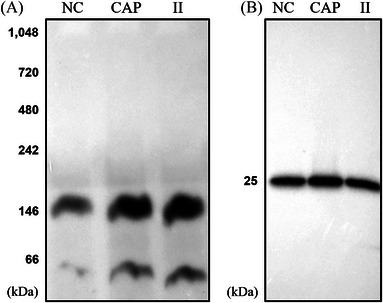
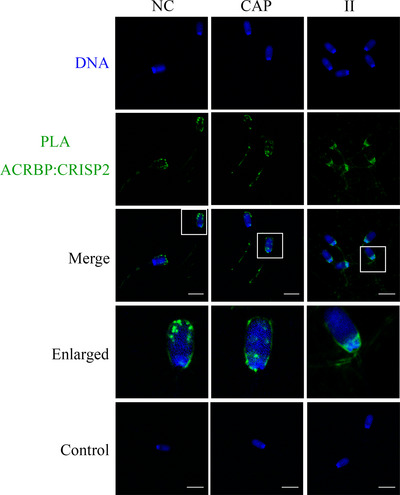
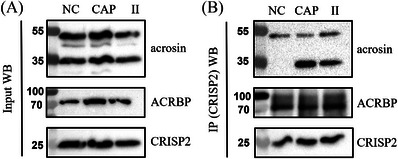
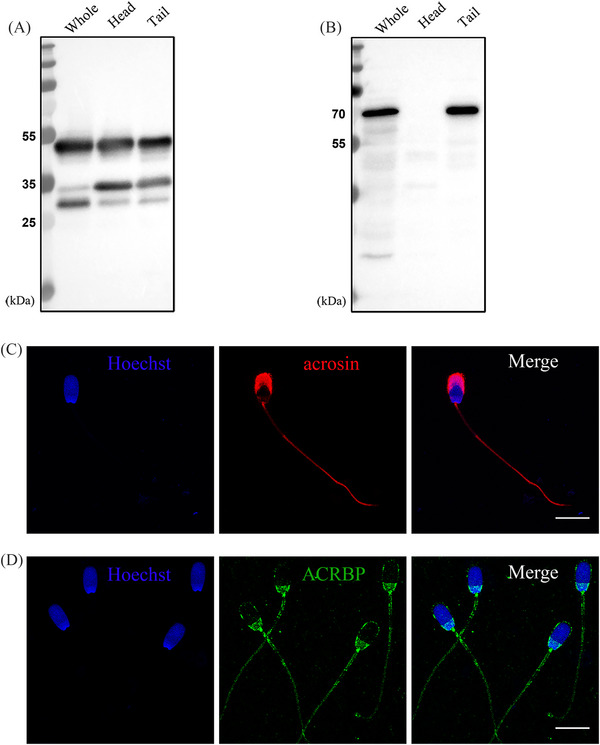
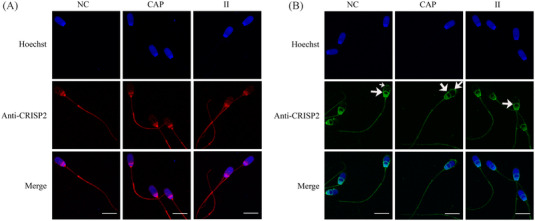
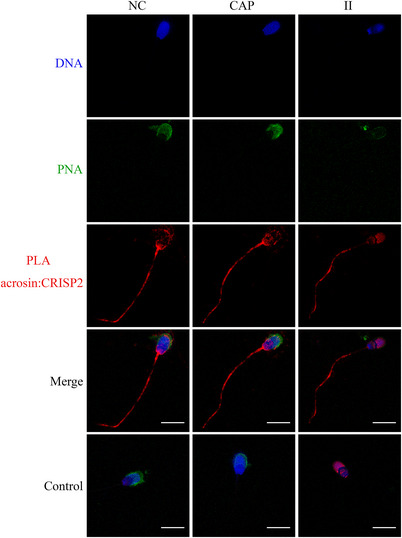
Blue native gel electrophoresis and native immunoblots revealed that cystein-rich secretory protein 2 was present within a ∼150 kDa protein complex under all three conditions. Interrogation of cystein-rich secretory-protein 2-immunoreactive bands from blue native gels as well as cystein-rich secretory protein 2 immunoprecipitated products using mass spectrometry consistently revealed that, beyond cystein-rich secretory protein 2, acrosin and acrosin binding protein were among the most abundant interacting proteins and did interact under all three conditions. Co-immunoprecipitation and immunoblotting indicated that cystein-rich secretory protein 2 interacted with pro-acrosin (∼53 kDa) and Aacrosin binding protein under all three conditions and additionally to acrosin (∼35 kDa) after capacitation and the acrosome reaction. The colocalization of these interacting proteins with cystein-rich secretory protein 2 was assessed via in situ proximity ligation assays. The colocalization signal of cystein-rich secretory protein 2 and acrosin in the acrosome seemed dispersed after capacitation but was consistently present in the sperm tail under all conditions. The fluorescent foci of cystein-rich secretory protein 2 and acrsin binding protein colocalization appeared to be redistributed within the sperm head from the anterior acrosome to the post-acrosomal sheath region upon capacitation.
These results suggest that CRISP2 may act as a scaffold for protein complex formation and dissociation to ensure the correct positioning of proteins required for the acrosome reaction and zona pellucida penetration.
此前,我们报道了富含半胱氨酸的分泌蛋白 2 参与了猪精子中的高分子量复合物。这些富含半胱氨酸的分泌蛋白 2 蛋白复合物是在睾丸中精子形成的最后阶段形成的,在精子塑形和功能中发挥作用。
本研究旨在鉴定富含半胱氨酸的分泌蛋白 2 的相互作用伙伴。在不同条件下研究了这些结合伴侣的相互作用,即在非诱导精子获能条件下、体外诱导精子获能后以及随后的离子载体 A23187 诱导顶体反应时。
孵育的猪精子样本进行蛋白质提取。提取的蛋白质进行蓝色非变性凝胶电泳和天然免疫印迹。免疫反应性凝胶带被切除并进行液相色谱-质谱(LC-MS)分析以鉴定蛋白质。蛋白质提取物还进行了 CRISP2 免疫沉淀,并通过 LC-MS 进行蛋白质鉴定。在两个独立的 LC-MS 分析中均出现的最显著的富含半胱氨酸的分泌蛋白 2 相互作用蛋白,通过功能原位邻近相互作用测定进行研究,以验证它们与猪精子中富含半胱氨酸的分泌蛋白 2 相互作用的特性。
蓝色非变性凝胶电泳和天然免疫印迹显示,在所有三种条件下,富含半胱氨酸的分泌蛋白 2 存在于约 150 kDa 的蛋白质复合物中。使用质谱法对蓝色非变性凝胶中的富含半胱氨酸的分泌蛋白 2-免疫反应性条带以及富含半胱氨酸的分泌蛋白 2 免疫沉淀产物进行分析,结果一致表明,除了富含半胱氨酸的分泌蛋白 2 外,顶体酶和顶体酶结合蛋白也是最丰富的相互作用蛋白之一,并在所有三种条件下均相互作用。共免疫沉淀和免疫印迹表明,富含半胱氨酸的分泌蛋白 2 在所有三种条件下均与原顶体酶(约 53 kDa)和 A 顶体酶结合蛋白相互作用,并在获能和顶体反应后与顶体酶(约 35 kDa)相互作用。通过原位邻近连接测定评估了这些相互作用蛋白与富含半胱氨酸的分泌蛋白 2 的共定位。顶体酶在顶体反应后的获能后似乎分散了富含半胱氨酸的分泌蛋白 2 和顶体酶的共定位信号,但在所有条件下都始终存在于精子尾部。富含半胱氨酸的分泌蛋白 2 和 acrsin 结合蛋白的荧光焦点共定位似乎在获能后从顶体前部到顶体后鞘区域在精子头部内重新分布。
这些结果表明,CRISP2 可能作为蛋白质复合物形成和解离的支架,以确保顶体反应和透明带穿透所需的蛋白质正确定位。