Departamento de Bioquímica Clínica, Facultad de Ciencias Químicas, Universidad Nacional de Córdoba, Córdoba, Argentina.
Centro de Investigaciones en Bioquímica Clínica e Inmunología (CIBICI), Consejo Nacional de Investigaciones Científicas y Técnicas (CONICET), Córdoba, Argentina.
Front Immunol. 2023 Feb 1;14:1111797. doi: 10.3389/fimmu.2023.1111797. eCollection 2023.
COVID-19 severity has been linked to an increased production of inflammatory mediators called "cytokine storm". Available data is mainly restricted to the first international outbreak and reports highly variable results. This study compares demographic and clinical features of patients with COVID-19 from Córdoba, Argentina, during the first two waves of the pandemic and analyzes association between comorbidities and disease outcome with the "cytokine storm", offering added value to the field.
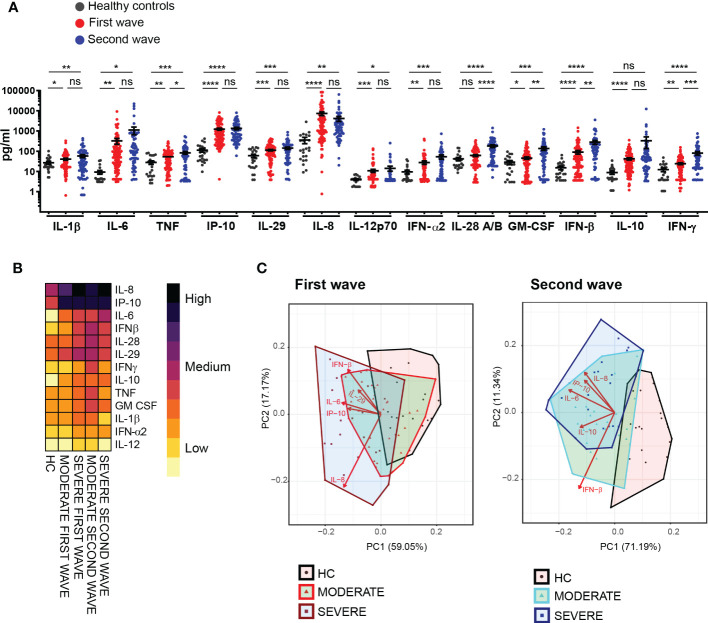
We investigated serum concentration of thirteen soluble mediators, including cytokines and chemokines, in hospitalized patients with moderate and severe COVID-19, without previous rheumatic and autoimmune diseases, from the central region of Argentina during the first and second infection waves. Samples from healthy controls were also assayed. Clinical and biochemical parameters were collected.
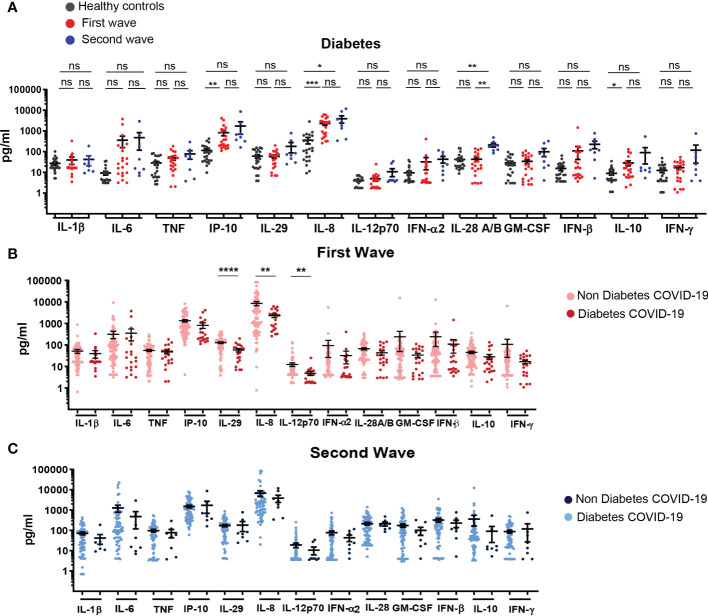
Comparison between the two first COVID-19 waves in Argentina highlighted that patients recruited during the second wave were younger and showed less concurrent comorbidities than those from the first outbreak. We also recognized particularities in the signatures of systemic cytokines and chemokines in patients from both infection waves. We determined that concurrent pre-existing comorbidities did not have contribution to serum concentration of systemic cytokines and chemokines in COVID-19 patients. We also identified immunological and biochemical parameters associated to inflammation which can be used as prognostic markers. Thus, IL-6 concentration, C reactive protein level and platelet count allowed to discriminate between death and discharge in patients hospitalized with severe COVID-19 only during the first but not the second wave.
Our data provide information that deepens our understanding of COVID-19 pathogenesis linking demographic features of a COVID-19 cohort with cytokines and chemokines systemic concentration, presence of comorbidities and different disease outcomes. Altogether, our findings provide information not only at local level by delineating inflammatory/anti-inflammatory response of patients but also at international level addressing the impact of comorbidities and the infection wave in the variability of cytokine and chemokine production upon SARS-CoV-2 infection.
COVID-19 的严重程度与称为“细胞因子风暴”的炎症介质的产生增加有关。现有数据主要限于第一次国际爆发,报告结果差异很大。本研究比较了阿根廷科尔多瓦 COVID-19 患者在大流行的前两个波期间的人口统计学和临床特征,并分析了合并症与疾病结局与“细胞因子风暴”之间的关系,为该领域提供了附加价值。
我们研究了来自阿根廷中部地区住院的中度和重度 COVID-19 患者血清中十三种可溶性介质(包括细胞因子和趋化因子)的浓度,这些患者没有先前的风湿和自身免疫性疾病,并且在第一次和第二次感染波期间进行了分析。还对健康对照者的样本进行了检测。收集了临床和生化参数。
阿根廷的前两次 COVID-19 波之间的比较突出表明,第二次波中招募的患者比第一次爆发中的患者年轻,并且并发合并症较少。我们还认识到来自两个感染波的患者的系统性细胞因子和趋化因子特征的特殊性。我们确定并发的预先存在的合并症对 COVID-19 患者的系统性细胞因子和趋化因子的血清浓度没有贡献。我们还确定了与炎症相关的免疫和生化参数,这些参数可作为预后标志物。因此,IL-6 浓度,C 反应蛋白水平和血小板计数仅在第一次波而不是第二次波中可用于区分患有严重 COVID-19 的住院患者的死亡和出院。
我们的数据提供了有关 COVID-19 发病机制的信息,将 COVID-19 队列的人口统计学特征与细胞因子和趋化因子的系统浓度,合并症的存在以及不同的疾病结局联系起来。总的来说,我们的发现不仅在当地水平提供了有关患者炎症/抗炎反应的信息,而且还在国际水平上阐明了合并症和感染波对 SARS-CoV-2 感染时细胞因子和趋化因子产生的影响的变异性。