Chen Si-Ming, Zhang Si-Chao, Gao Huai-Ling, Wang Quan, Zhou LiChuan, Zhao Hao-Yu, Li Xin-Yu, Gong Ming, Pan Xiao-Feng, Cui Chen, Wang Ze-Yu, Zhang YongLiang, Wu HengAn, Yu Shu-Hong
Department of Chemistry, Institute of Biomimetic Materials & Chemistry, Anhui Engineering Laboratory of Biomimetic Materials, Division of Nanomaterials & Chemistry, Hefei National Research Center for Physical Sciences at the Microscale, Institute of Energy, Hefei Comprehensive National Science Center, University of Science and Technology of China, Hefei 230026, China.
CAS Key Laboratory of Mechanical Behavior and Design of Materials, Department of Modern Mechanics, Engineering and Materials Science Experiment Center, University of Science and Technology of China, Hefei 230027, China.
Natl Sci Rev. 2022 Sep 22;10(2):nwac195. doi: 10.1093/nsr/nwac195. eCollection 2023 Feb.
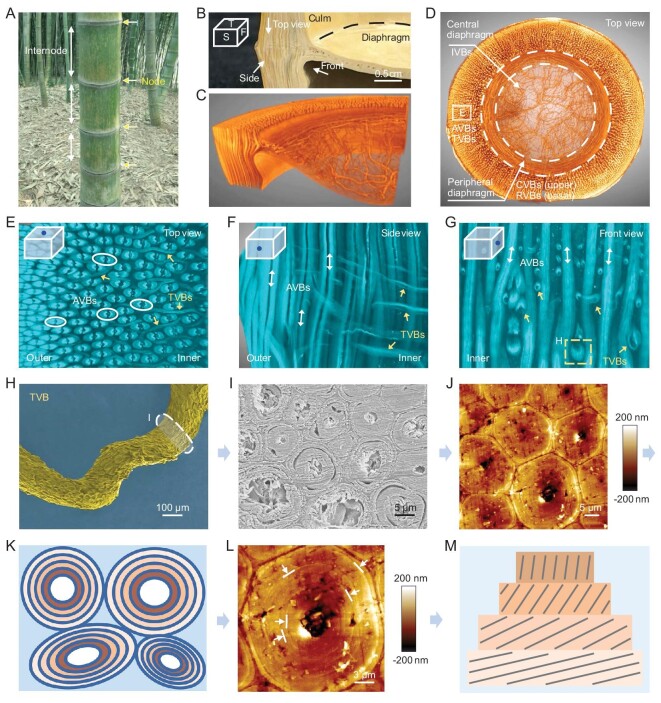
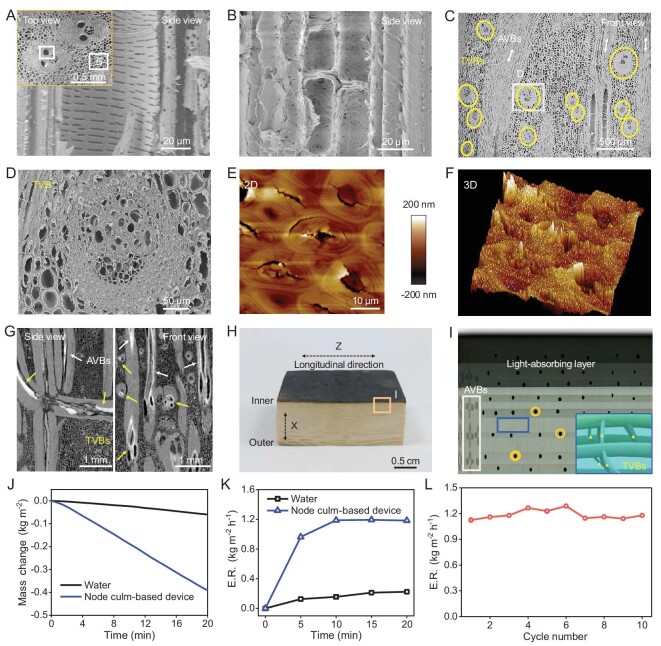
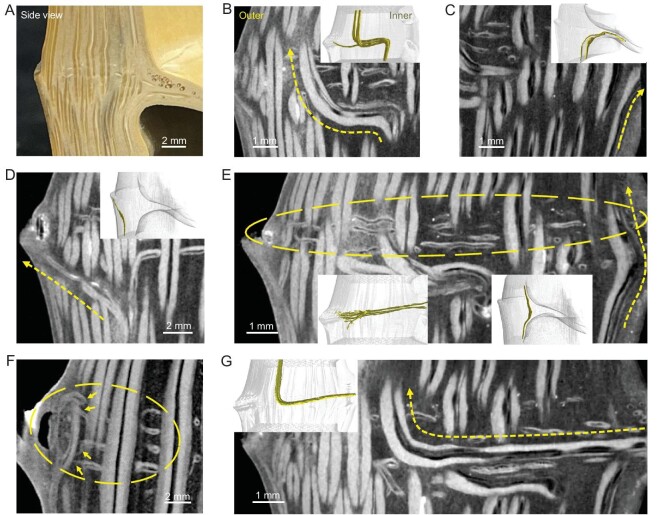
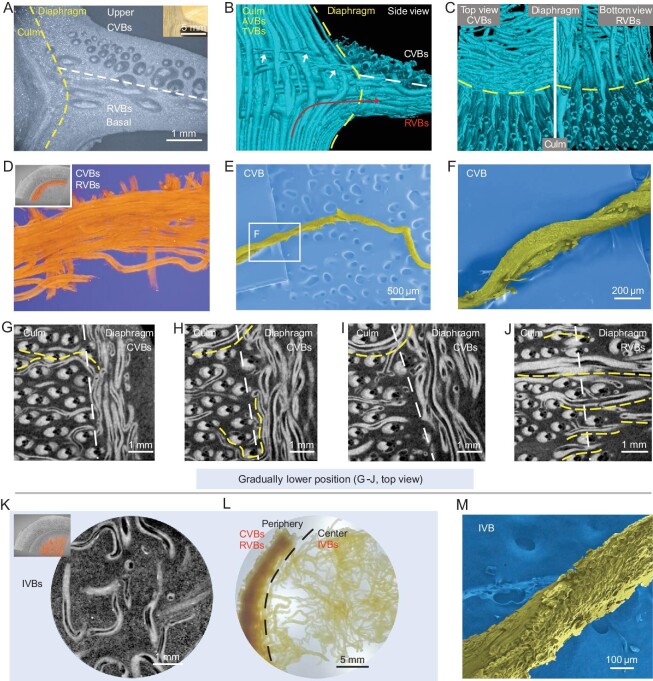
Although short bamboo nodes function in mechanical support and fluid exchange for bamboo survival, their structures are not fully understood compared to unidirectional fibrous internodes. Here, we identify the spatial heterostructure of the bamboo node via multiscale imaging strategies and investigate its mechanical properties by multimodal mechanical tests. We find three kinds of hierarchical fiber reinforcement schemes that originate from the bamboo node, including spatially tightened interlocking, triaxial interconnected scaffolding and isotropic intertwining. These reinforcement schemes, built on porous vascular bundles, microfibers and more-refined twist-aligned nanofibers, govern the structural stability of the bamboo via hierarchical toughening. In addition, the spatial liquid transport associated with these multiscale fibers within the bamboo node is experimentally verified, which gives perceptible evidence for life-indispensable multidirectional fluid exchange. The functional integration of mechanical reinforcement and liquid transport reflects the fact that the bamboo node has opted for elaborate structural optimization rather than ingredient richness. This study will advance our understanding of biological materials and provide insight into the design of fiber-reinforced structures and biomass utilization.
尽管短竹节对竹子的生存起着机械支撑和流体交换的作用,但与单向纤维状的竹节间相比,其结构尚未得到充分了解。在这里,我们通过多尺度成像策略确定了竹节的空间异质结构,并通过多模态力学测试研究了其力学性能。我们发现了三种源自竹节的分级纤维增强方案,包括空间紧密联锁、三轴互连支架和各向同性缠绕。这些增强方案基于多孔维管束、微纤维和更精细的扭曲排列纳米纤维,通过分级增韧来控制竹子的结构稳定性。此外,通过实验验证了竹节内与这些多尺度纤维相关的空间液体传输,这为生命不可或缺的多向流体交换提供了明显证据。机械增强和液体传输的功能整合反映了竹节选择了精细的结构优化而非成分丰富这一事实。这项研究将增进我们对生物材料的理解,并为纤维增强结构的设计和生物质利用提供见解。