Noorbhai M H, Noakes T D
Department of Human Movement Science, Faculty of Health Sciences, University of Fort Hare, Alice, South Africa.
Division of Exercise Science and Sports Medicine, Department of Human Biology, Faculty of Health Sciences, University of Cape Town, Cape Town, South Africa.
S Afr J Sports Med. 2019 Jan 1;31(1):v31i1a5460. doi: 10.17159/2078-516X/2019/v31i1a5460. eCollection 2019.
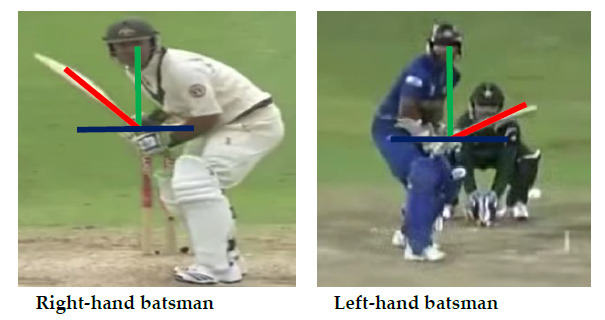
This study aimed primarily to investigate the lateral batting backlift technique (LBBT) among semi-professional, professional and current international cricket players. A key question was to investigate whether this technique is a factor that contributes to success for cricket players at the highest levels of the game.
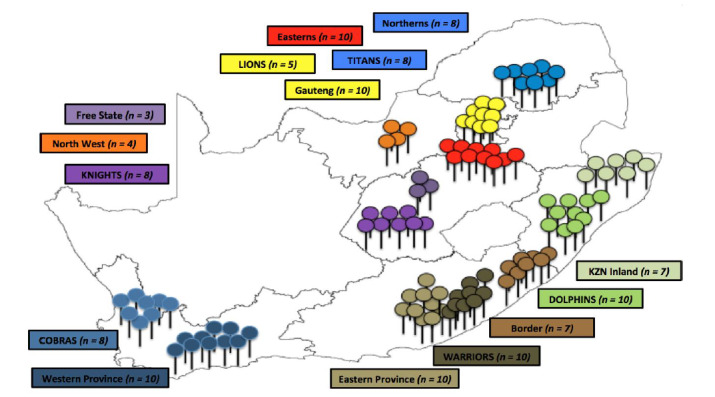
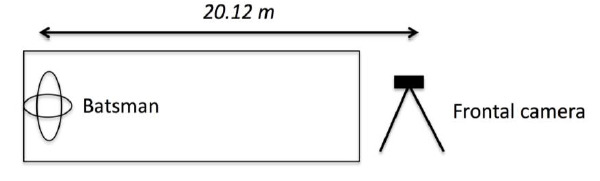
The participants in this study's sample (n = 130) were South African semi-professional players (SP) (n = 69), professional players (PP) (n = 49) and South African international professional players (SAI) (n = 12). Biomechanical and video analyses were performed on all the participating groups. Classifiers were utilised to identify the batting backlift technique type (BBTT) employed by all batsmen. All statistics and wagon wheels (scoring areas of the batsmen on a cricket field) were sourced online. A Pearson's Chi-squared test, Student T-test, one-way analysis of variance and T-test were performed in this study. All analyses were performed using R (R Core Team) at a significance level of α = 0.05.
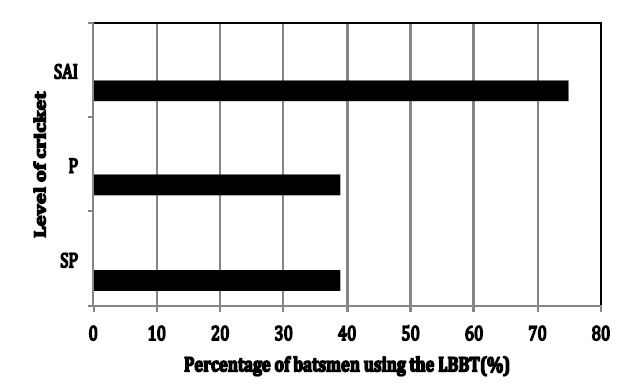
This study found that a LBBT is more common at the highest levels of batsmanship with batsmen at the various levels of cricket having percentages of the LBBT as follows: SP = 37%; PP = 38%; SAI = 75%; p = 0.001. There was also a noticeably higher difference in the highest scores and career averages between all groups of players, as well as batsmen who either use a straight batting backlift technique (SBBT) or a LBBT. This study also found that SAI batsmen who used the LBBT were more proficient at scoring runs in various areas around the cricket field (according to the wagon wheel analysis).
This study found that a LBBT is a contributing factor for success regarding players wanting to play cricket at the highest levels. Cricket coaches should also pay attention to the direction of the backlift with players, especially when correlating it to various scoring areas on the cricket field. Further in-depth research is required to fully investigate the change in batting backlift techniques among cricket players over a long-term period.
本研究主要旨在调查半职业、职业和现役国际板球运动员中的横向击球后摆技术(LBBT)。一个关键问题是研究该技术是否是顶级板球比赛中球员取得成功的一个因素。
本研究样本中的参与者(n = 130)包括南非半职业球员(SP)(n = 69)、职业球员(PP)(n = 49)和南非国际职业球员(SAI)(n = 12)。对所有参与组进行了生物力学和视频分析。使用分类器来识别所有击球手采用的击球后摆技术类型(BBTT)。所有统计数据和击球区域图(板球场上击球手的得分区域)均来自网络。本研究进行了皮尔逊卡方检验、学生t检验、单因素方差分析和t检验。所有分析均使用R(R核心团队)进行,显著性水平为α = 0.05。
本研究发现,LBBT在顶级击球水平中更为常见,不同水平的板球运动员中采用LBBT的百分比分别为:SP = 37%;PP = 38%;SAI = 75%;p = 0.001。所有球员组之间以及采用直线击球后摆技术(SBBT)或LBBT的击球手之间,最高得分和职业生涯平均得分也存在显著更高的差异。本研究还发现,采用LBBT的SAI击球手在板球场不同区域得分更熟练(根据击球区域图分析)。
本研究发现,LBBT是想要在顶级水平参加板球比赛的球员取得成功的一个促成因素。板球教练也应关注球员后摆的方向,尤其是在将其与板球场上的不同得分区域相关联时。需要进一步深入研究以全面调查板球运动员击球后摆技术在长期内的变化。