Cho In-Jeong, Wi Jin, Lee Sang-Eun, Kim Dong-Hyeok, Pyun Wook Bum
Division of Cardiology, Department of Internal Medicine, Ewha Womans University Seoul Hospital, Ewha Womans University College of Medicine, Seoul, Korea.
Division of Cardiology, Department of Internal Medicine, Gachon University Gil Medical Center, Incheon, Korea.
Int J Heart Fail. 2023 Jan 31;5(1):36-47. doi: 10.36628/ijhf.2022.0029. eCollection 2023 Jan.
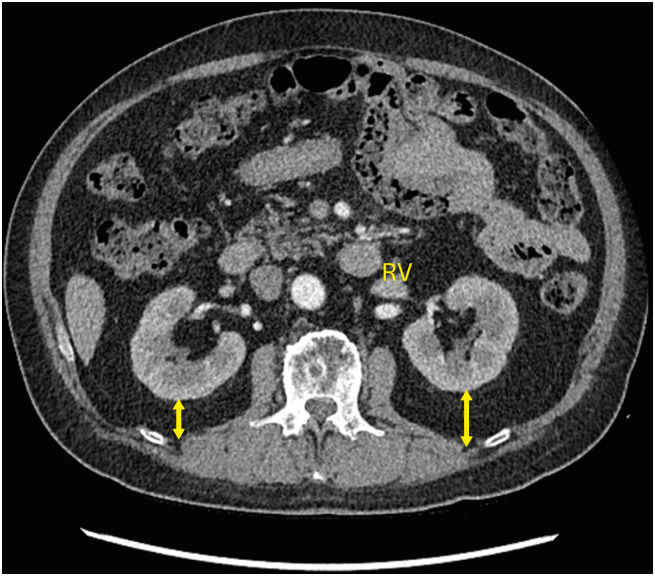
The thick perirenal fat pad can induce high intracapsular pressure and cause compression of the renal vasculature and resultant congestive nephropathy. The current study investigated the association of perirenal fat thickness with kidney dysfunction in patients with acute decompensated heart failure (ADHF).
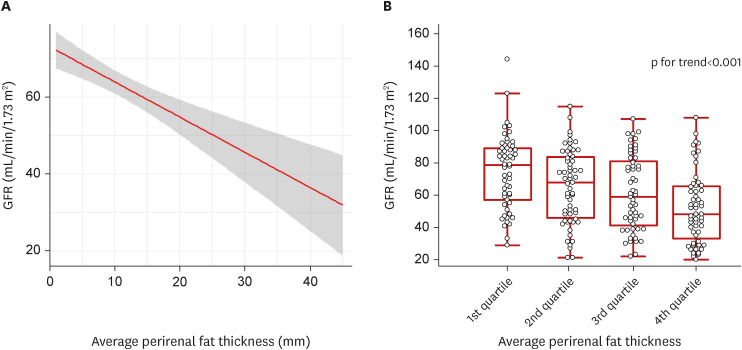
Data from 266 patients hospitalized with ADHF were analyzed. Patients were divided into two groups according to the glomerular filtration rate (GFR) at admission (preserved kidney function [GFR ≥60 mL/min/1.73 m] and reduced kidney function [GFR <60 mL/min/1.73 m] groups). Right and left posterior perirenal fat thicknesses were measured using computed tomography, and their average values were calculated. Associated factors with reduced kidney function was assessed by logistic regression model, presenting with odds ratio (OR) and confidence interval (CI).
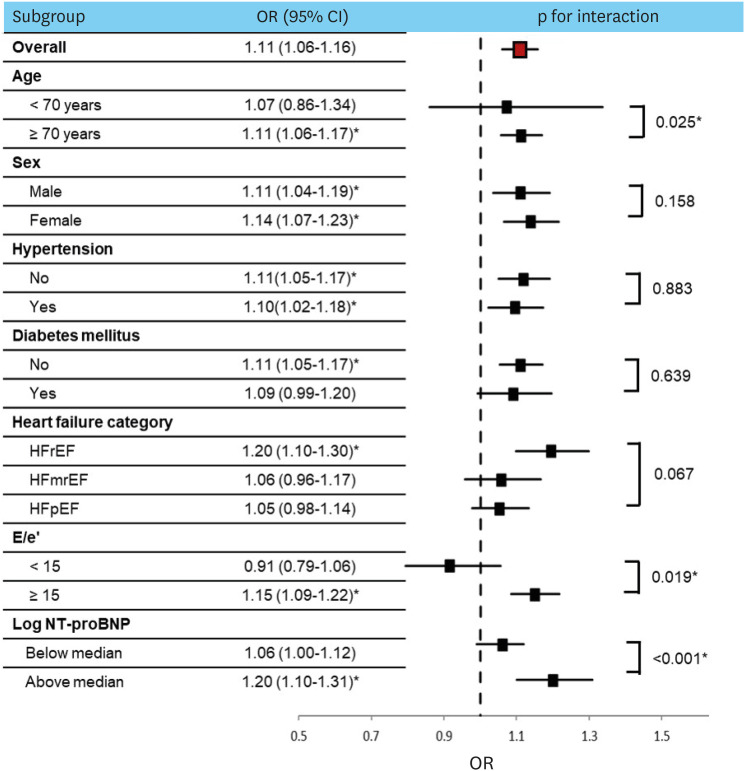
Increasing age (OR, 1.08; 95% CI, 1.04-1.12; p<0.001), diabetes mellitus (OR, 2.46; 95% CI, 1.18-5.12; p<0.017), increased log N-terminal pro-B-type natriuretic peptide (NT-proBNP) (OR, 1.82; 95% CI, 1.32-2.52; p<0.001), and increased average perirenal fat thickness (OR, 1.11; 95% CI, 1.06-1.16; p<0.001) were independently associated with reduced kidney function. In the subgroup analyses, patients over 70 years old, the ratio of mitral-to-mitral annular velocity >15, elevated log NT-proBNP had a significantly higher association with increased perirenal fat thickness with reduced kidney function.
Thick perirenal fat pads were independently associated with kidney function deterioration in patients hospitalized with ADHF.
肾周脂肪垫增厚可导致囊内压升高,压迫肾血管,进而引起充血性肾病。本研究探讨急性失代偿性心力衰竭(ADHF)患者肾周脂肪厚度与肾功能不全之间的关系。
分析266例因ADHF住院患者的数据。根据入院时的肾小球滤过率(GFR)将患者分为两组(肾功能正常组[GFR≥60 mL/min/1.73 m²]和肾功能降低组[GFR<60 mL/min/1.73 m²])。采用计算机断层扫描测量左右肾周后脂肪厚度,并计算其平均值。通过逻辑回归模型评估肾功能降低的相关因素,给出比值比(OR)和置信区间(CI)。
年龄增加(OR,1.08;95%CI,1.04~1.12;p<0.001)、糖尿病(OR,2.46;95%CI,1.18~5.12;p<0.017)、N末端B型脑钠肽原(NT-proBNP)对数升高(OR,1.82;95%CI,1.32~2.52;p<0.001)以及肾周脂肪平均厚度增加(OR,1.11;95%CI,1.06~1.16;p<0.001)与肾功能降低独立相关。在亚组分析中,70岁以上患者、二尖瓣与二尖瓣环速度比值>15、NT-proBNP对数升高与肾功能降低时肾周脂肪厚度增加的相关性显著更高。
肾周脂肪垫增厚与ADHF住院患者的肾功能恶化独立相关。