Zhang Yingrui, Chen Shiyu, Fan Fangfang, Xu Ning, Meng Xian-Li, Zhang Yi, Lin Jin-Ming
State Key Laboratory of Southwestern Chinese Medicine Resources, School of Pharmacy, Chengdu University of Traditional Chinese Medicine, Chengdu, 611137, China.
Beijing Key Laboratory of Microanalytical Methods and Instrumentation, Department of Chemistry, Tsinghua University, Beijing, 100084, China.
J Pharm Anal. 2023 Jan;13(1):88-98. doi: 10.1016/j.jpha.2022.11.007. Epub 2022 Nov 23.
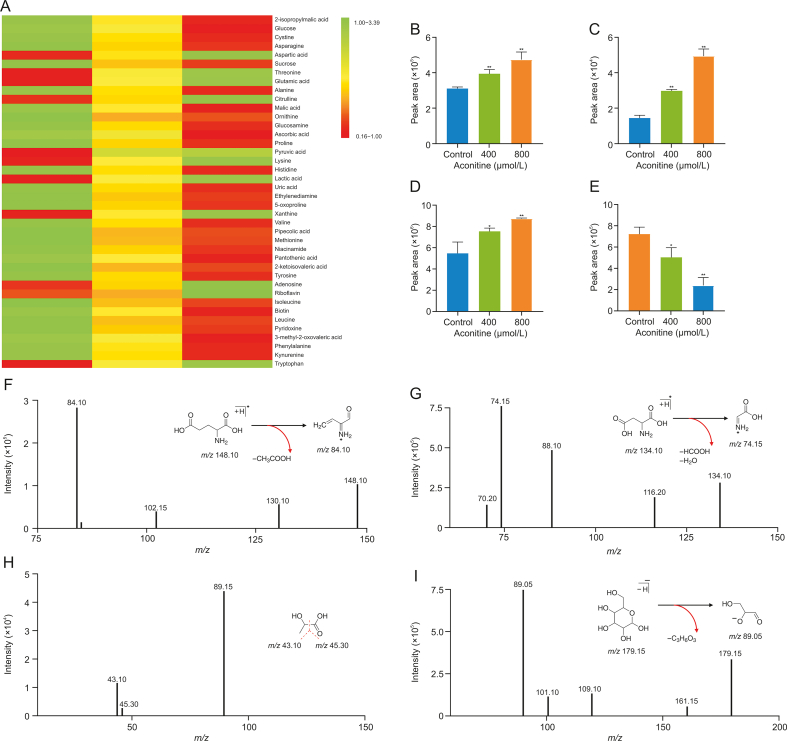
Aconitine, a common and main toxic component of , is toxic to the central nervous system. However, the mechanism of aconitine neurotoxicity is not yet clear. In this work, we had the hypothesis that excitatory amino acids can trigger excitotoxicity as a pointcut to explore the mechanism of neurotoxicity induced by aconitine. HT22 cells were simulated by aconitine and the changes of target cell metabolites were real-time online investigated based on a microfluidic chip-mass spectrometry system. Meanwhile, to confirm the metabolic mechanism of aconitine toxicity on HT22 cells, the levels of lactate dehydrogenase, intracellular Ca, reactive oxygen species, glutathione and superoxide dismutase, and ratio of Bax/Bcl-2 protein were detected by molecular biotechnology. Integration of the detected results revealed that neurotoxicity induced by aconitine was associated with the process of excitotoxicity caused by glutamic acid and aspartic acid, which was followed by the accumulation of lactic acid and reduction of glucose. The surge of extracellular glutamic acid could further lead to a series of cascade reactions including intracellular Ca overload and oxidative stress, and eventually result in cell apoptosis. In general, we illustrated a new mechanism of aconitine neurotoxicity and presented a novel analysis strategy that real-time online monitoring of cell metabolites can provide a new approach to mechanism analysis.
乌头碱是[某种物质]常见且主要的毒性成分,对中枢神经系统有毒性。然而,乌头碱神经毒性的机制尚不清楚。在本研究中,我们提出假说,即兴奋性氨基酸可引发兴奋毒性,以此为切入点来探究乌头碱所致神经毒性的机制。用乌头碱模拟HT22细胞,并基于微流控芯片 - 质谱系统实时在线研究靶细胞代谢物的变化。同时,为确认乌头碱对HT22细胞的毒性代谢机制,采用分子生物技术检测乳酸脱氢酶、细胞内钙、活性氧、谷胱甘肽和超氧化物歧化酶水平以及Bax/Bcl - 2蛋白比值。整合检测结果表明,乌头碱所致神经毒性与谷氨酸和天冬氨酸引起的兴奋毒性过程相关,随后伴有乳酸积累和葡萄糖减少。细胞外谷氨酸激增可进一步导致一系列级联反应,包括细胞内钙超载和氧化应激,最终导致细胞凋亡。总体而言,我们阐明了乌头碱神经毒性的新机制,并提出了一种新的分析策略,即细胞代谢物的实时在线监测可为机制分析提供新方法。