Clara D. Bloomfield Center for Leukemia Outcomes Research, The Ohio State University Comprehensive Cancer Center, Columbus, OH, USA.
Alliance Statistics and Data Management Center, The Ohio State University Comprehensive Cancer Center, Columbus, OH, USA.
Leukemia. 2023 Apr;37(4):788-798. doi: 10.1038/s41375-023-01846-8. Epub 2023 Feb 23.
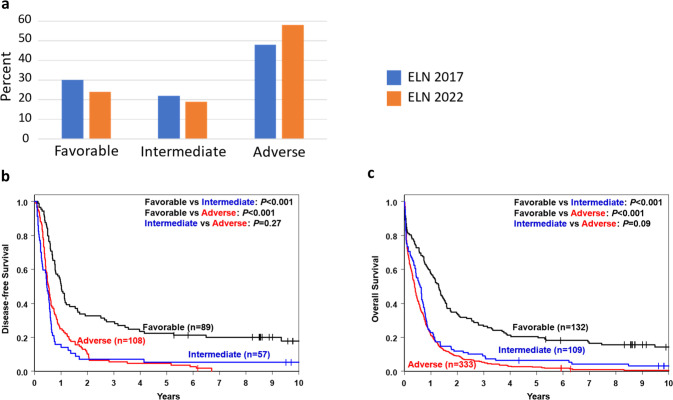
Recently, the European LeukemiaNet (ELN) revised its genetic-risk classification of acute myeloid leukemia (AML). We categorized 1637 adults with AML treated with cytarabine/anthracycline regimens according to the 2022 and 2017 ELN classifications. Compared with the 2017 ELN classification, 2022 favorable group decreased from 40% to 35% and adverse group increased from 37% to 41% of patients. The 2022 genetic-risk groups seemed to accurately reflect treatment outcomes in all patients and patients aged <60 years, but in patients aged ≥60 years, relapse rates, disease-free (DFS) and overall (OS) survival were not significantly different between intermediate and adverse groups. In younger African-American patients, DFS and OS did not differ between intermediate-risk and adverse-risk patients nor did DFS between favorable and intermediate groups. In Hispanic patients, DFS and OS did not differ between favorable and intermediate groups. Outcome prediction abilities of 2022 and 2017 ELN classifications were similar. Among favorable-risk patients, myelodysplasia-related mutations did not affect patients with CEBPA mutations or core-binding factor AML, but changed risk assignment of NPM1-mutated/FLT3-ITD-negative patients to intermediate. NPM1-mutated patients with adverse-risk cytogenetic abnormalities were closer prognostically to the intermediate than adverse group. Our analyses both confirm and challenge prognostic significance of some of the newly added markers.
最近,欧洲白血病网络(ELN)修订了其急性髓系白血病(AML)的遗传风险分类。我们根据 2022 年和 2017 年 ELN 分类,对 1637 例接受阿糖胞苷/蒽环类药物治疗的 AML 成年患者进行了分类。与 2017 年 ELN 分类相比,2022 年有利组患者从 40%降至 35%,不利组患者从 37%增至 41%。2022 年的遗传风险组似乎能够准确反映所有患者和年龄<60 岁患者的治疗结果,但在年龄≥60 岁的患者中,中危和高危组之间的复发率、无病生存(DFS)和总生存(OS)无显著差异。在年轻的非裔美国患者中,中危和高危组之间的 DFS 和 OS 无差异,有利和中危组之间的 DFS 也无差异。在西班牙裔患者中,有利和中危组之间的 DFS 和 OS 无差异。2022 年和 2017 年 ELN 分类的预后预测能力相似。在有利风险患者中,骨髓增生异常相关突变不影响 CEBPA 突变或核心结合因子 AML 患者,但改变了 NPM1 突变/FLT3-ITD 阴性患者从中危到高危的风险分配。具有不良核型异常的 NPM1 突变患者在预后上更接近中危组,而不是高危组。我们的分析既证实了一些新添加标志物的预后意义,也对其提出了挑战。