Istituto Nazionale Tumori - IRCCS - Fondazione "G. Pascale", Naples, Italy.
J Transl Med. 2023 Feb 23;21(1):140. doi: 10.1186/s12967-023-03971-5.
Prognostic factors for initial response of advanced cutaneous squamous cell carcinoma to cemiplimab treatment are lacking. Il-6 has been found to affect immune cell populations which impact tumor development. The aim was to investigate the prognostic significance of IL-6 serum levels before and during treatment.
Serum levels of IL-6 were correlated with clinical outcomes in a retrospective study.
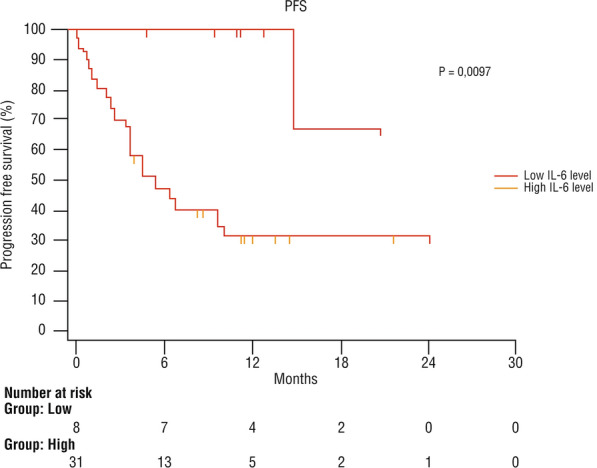
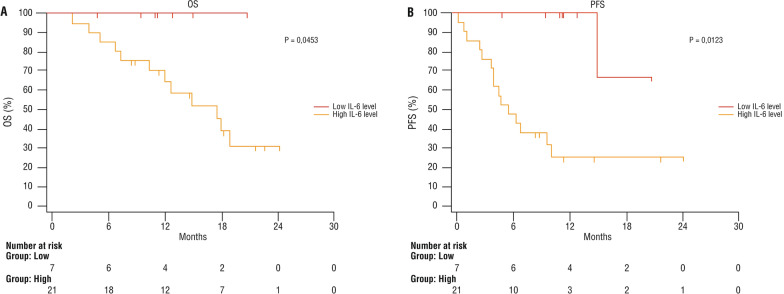
Overall, 39 patients were enrolled. High serum levels of IL-6 (> 5.6 pg/ml) were associated with poorer survival (45.1% vs 0 deaths; OS: 16.1 ± 1.5 vs 20.8 ± 0 months, 95% CI 13,046 to 19,184) and shorter PFS (10.3 ± 1.9 vs 18.9 ± 1.5 months; 95% CI 3433 to 10,133) in patients with advanced CSCC treated with cemiplimab. In addition, patients whose IL-6 level increased after treatment with cemiplimab, independently of the basal level, had a poorer response to treatment than patients whose level was reduced or stable after immunotherapy.
Serum levels of IL-6 at baseline and changes after cemiplimab immunotherapy may have a prognostic significance in patients with advanced cutaneous squamous cell carcinoma.
目前缺乏预测晚期皮肤鳞状细胞癌患者对西普单抗初始治疗反应的预后因素。白细胞介素-6(IL-6)已被发现影响影响肿瘤发展的免疫细胞群。本研究旨在探讨治疗前和治疗过程中血清 IL-6 水平的预后意义。
在回顾性研究中,将血清 IL-6 水平与临床结局相关联。
共纳入 39 例患者。高血清 IL-6 水平(>5.6 pg/ml)与生存较差相关(45.1% vs 0 例死亡;OS:16.1±1.5 个月 vs 20.8±0 个月,95%CI:13,046 至 19,184),且无进展生存期(PFS)更短(10.3±1.9 个月 vs 18.9±1.5 个月;95%CI:3433 至 10,133)。此外,与治疗后 IL-6 水平降低或稳定的患者相比,接受西普单抗治疗后 IL-6 水平升高的患者对治疗的反应较差,而不论基础水平如何。
晚期皮肤鳞状细胞癌患者基线和西普单抗免疫治疗后 IL-6 水平的变化可能具有预后意义。