Osman Einas A, Yokoyama Maho, Altayb Hisham N, Cantillon Daire, Wille Julia, Seifert Harald, Higgins Paul G, Al-Hassan Leena
Bioscience Research Institute, Ibn Sina University, Khartoum 11111, Sudan.
Department of Global Health and Infection, Brighton & Sussex Medical School, Brighton BN1 9PX, UK.
Antibiotics (Basel). 2023 Jan 21;12(2):233. doi: 10.3390/antibiotics12020233.
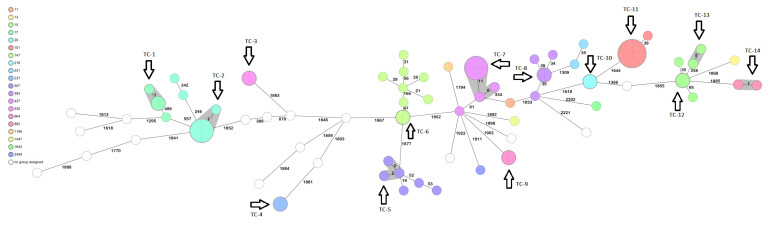
The emergence and global expansion of hyper-virulent and multidrug resistant (MDR) is an increasing healthcare threat worldwide. The epidemiology of MDR is under-characterized in many parts of the world, particularly Africa. In this study, isolates from hospitals in Khartoum, Sudan, have been whole-genome sequenced to investigate their molecular epidemiology, virulence, and resistome profiles. Eighty-six were recovered from patients in five hospitals in Khartoum between 2016 and 2020. Antimicrobial susceptibility was performed by disk-diffusion and broth microdilution. All isolates underwent whole genome sequencing using Illumina MiSeq; cgMLST was determined using Ridom SeqSphere+, and 7-loci MLST virulence genes and resistomes were identified. MDR was observed at 80%, with 35 isolates (41%) confirmed carbapenem-resistant. Thirty-seven sequence types were identified, and 14 transmission clusters (TC). Five of these TCs involved more than one hospital. was the most common virulence gene detected, in addition to some isolates harbouring and . There is a diverse population of in Khartoum hospitals, harbouring multiple resistance genes, including genes coding for ESBLs, carbapenemases, and aminoglycoside-modifying enzymes, across multiple ST's. The majority of isolates were singletons and transmissions were rare.
高毒力和多重耐药(MDR)菌株的出现及全球传播对全球医疗保健构成了日益严重的威胁。在世界许多地区,尤其是非洲,MDR菌株的流行病学特征尚不明确。在本研究中,对苏丹喀土穆医院分离出的菌株进行了全基因组测序,以调查其分子流行病学、毒力和耐药组概况。2016年至2020年间,从喀土穆五家医院的患者中分离出86株菌株。采用纸片扩散法和肉汤微量稀释法进行药敏试验。所有分离株均使用Illumina MiSeq进行全基因组测序;使用Ridom SeqSphere+确定核心基因组多位点序列分型(cgMLST),并鉴定7个位点的多位点序列分型(MLST)毒力基因和耐药组。观察到80%的菌株为MDR,35株(41%)被确认为耐碳青霉烯类。鉴定出37种序列类型和14个传播簇(TC)。其中5个TC涉及多家医院。除了一些携带[具体基因1]和[具体基因2]的分离株外,[具体基因3]是检测到的最常见毒力基因。喀土穆医院的菌株群体多样,在多个序列型中携带多种耐药基因,包括编码超广谱β-内酰胺酶(ESBLs)、碳青霉烯酶和氨基糖苷类修饰酶的基因。大多数分离株为单株,传播罕见。