• 文献检索
  • 文档翻译
  • 深度研究
  • 学术资讯
  • Suppr Zotero 插件Zotero 插件
  • 邀请有礼
  • 套餐&价格
  • 历史记录
应用&插件
Suppr Zotero 插件Zotero 插件浏览器插件Mac 客户端Windows 客户端微信小程序
定价
高级版会员购买积分包购买API积分包
服务
文献检索文档翻译深度研究API 文档MCP 服务
关于我们
关于 Suppr公司介绍联系我们用户协议隐私条款
关注我们

Suppr 超能文献

核心技术专利:CN118964589B侵权必究
粤ICP备2023148730 号-1Suppr @ 2026

文献检索

告别复杂PubMed语法,用中文像聊天一样搜索,搜遍4000万医学文献。AI智能推荐,让科研检索更轻松。

立即免费搜索

文件翻译

保留排版,准确专业,支持PDF/Word/PPT等文件格式,支持 12+语言互译。

免费翻译文档

深度研究

AI帮你快速写综述,25分钟生成高质量综述,智能提取关键信息,辅助科研写作。

立即免费体验

具有特定光谱比例的LED灯对北京油鸡生长和繁殖的影响

Effects of LED Lights with Defined Spectral Proportion on Growth and Reproduction of Indigenous Beijing-You Chickens.

作者信息

Sun Yanyan, Li Yunlei, Ma Shumei, Shi Lei, Chen Chao, Li Dongli, Guo Jiangpeng, Ma Hui, Yuan Jingwei, Chen Jilan

机构信息

Key Laboratory of Animal (Poultry) Genetics Breeding and Reproduction, Ministry of Agriculture and Rural Affairs, Institute of Animal Science, Chinese Academy of Agricultural Sciences, Beijing 100193, China.

Pingliang Academy of Agricultural Sciences, Pingliang 744000, China.

出版信息

Animals (Basel). 2023 Feb 9;13(4):616. doi: 10.3390/ani13040616.

DOI:10.3390/ani13040616
PMID:36830401
原文链接:https://pmc.ncbi.nlm.nih.gov/articles/PMC9951764/
Abstract

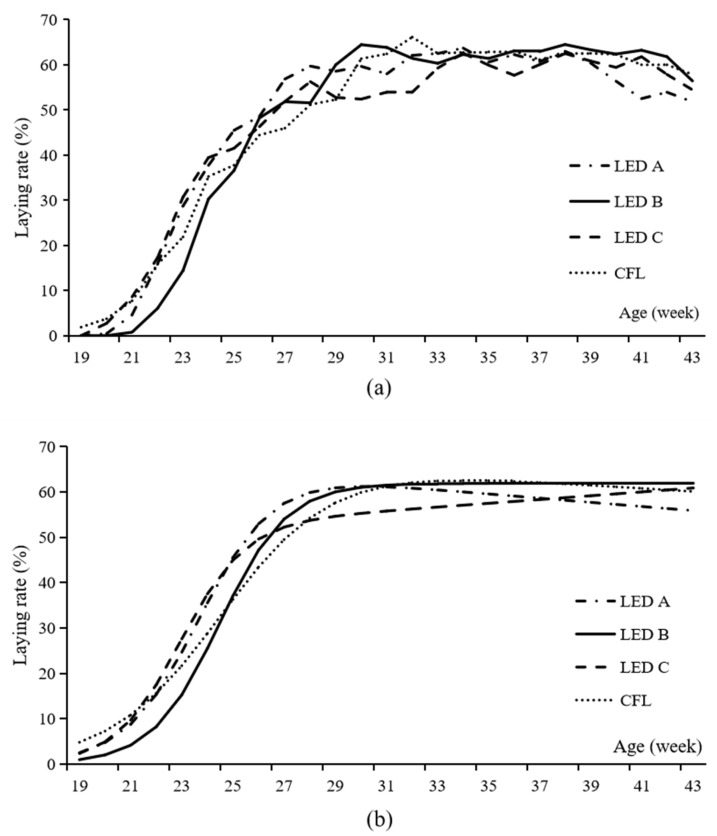
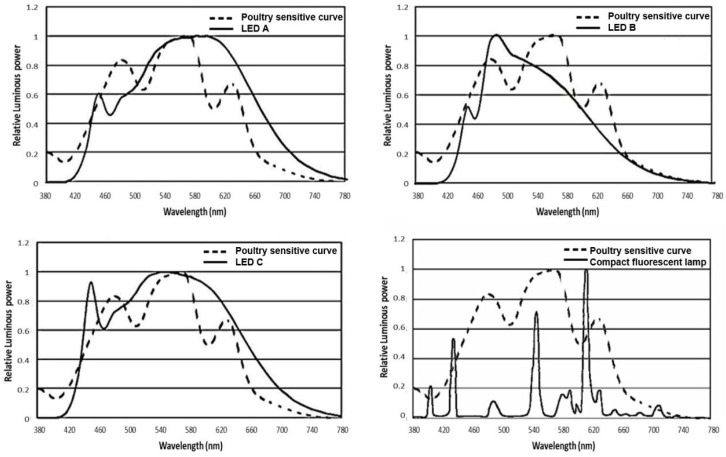
Light presents an important exogenous factor for poultry. This study examined effects of LED lights with different defined spectrums on growth and reproduction of indigenous Beijing-You chickens. A total of 576 one-day old female chicks were divided into 16 rooms, and each were exposed to four different lights: LED A (21% green light, 30% blue light, 24% yellow light, and 25% red light), B (35%, 35%, 18%, and 12%), C (27%, 30%, 22%, and 21%), or compact fluorescent lamps (CFL, 15%, 28%, 41%, and 16%). Results showed that feed intake and feed conversion ratio were comparable among treatments throughout the 17 week rearing period ( > 0.05). LED C showed similar body weight gain with CFL, but higher than LED A and B. The CFL birds start to lay on 132.25 d, while LED B did not lay until 148.25 d. The age at 50% egg production did not vary among groups ( = 0.12). Total egg number until 43 week of LED B was higher than others ( < 0.05). Therefore, LED lights with defined spectral proportion have different effects on chickens' growth and reproduction. The LED C promotes the prepubertal growth, and the LED B provides proper sexual maturation age and better egg-laying persistence.

摘要

光照是家禽重要的外源因素。本研究考察了不同光谱的LED灯对北京油鸡生长和繁殖的影响。总共576只1日龄雌性雏鸡被分为16个房间,每个房间接受四种不同的光照:LED A(21%绿光、30%蓝光、24%黄光和25%红光)、B(35%、35%、18%和12%)、C(27%、30%、22%和21%),或紧凑型荧光灯(CFL,15%、28%、41%和16%)。结果显示,在整个17周的饲养期内,各处理组的采食量和饲料转化率相当(P>0.05)。LED C组的体重增加与CFL组相似,但高于LED A组和B组。CFL组的鸡在132.25日龄开始产蛋,而LED B组直到148.25日龄才开始产蛋。各实验组50%蛋产量时的日龄没有差异(P=0.12)。直到43周龄时,LED B组的总产蛋数高于其他组(P<0.05)。因此,光谱比例确定的LED灯对鸡的生长和繁殖有不同影响。LED C促进青春期前生长,LED B提供合适的性成熟年龄和更好的产蛋持续性。
https://cdn.ncbi.nlm.nih.gov/pmc/blobs/8a9a/9951764/ac4d0c57d8e4/animals-13-00616-g002.jpg
https://cdn.ncbi.nlm.nih.gov/pmc/blobs/8a9a/9951764/cd561ca82944/animals-13-00616-g001.jpg
https://cdn.ncbi.nlm.nih.gov/pmc/blobs/8a9a/9951764/ac4d0c57d8e4/animals-13-00616-g002.jpg
https://cdn.ncbi.nlm.nih.gov/pmc/blobs/8a9a/9951764/cd561ca82944/animals-13-00616-g001.jpg
https://cdn.ncbi.nlm.nih.gov/pmc/blobs/8a9a/9951764/ac4d0c57d8e4/animals-13-00616-g002.jpg

相似文献

1
Effects of LED Lights with Defined Spectral Proportion on Growth and Reproduction of Indigenous Beijing-You Chickens.具有特定光谱比例的LED灯对北京油鸡生长和繁殖的影响
Animals (Basel). 2023 Feb 9;13(4):616. doi: 10.3390/ani13040616.
2
Effect of fluorescent vs. poultry-specific light-emitting diode lights on production performance and egg quality of W-36 laying hens.荧光灯与家禽专用发光二极管灯对 W-36 产蛋鸡生产性能和蛋品质的影响。
Poult Sci. 2018 Mar 1;97(3):834-844. doi: 10.3382/ps/pex371.
3
Effect of light-emitting diode vs. fluorescent lighting on laying hens in aviary hen houses: Part 1 - Operational characteristics of lights and production traits of hens.发光二极管与荧光灯对笼养蛋鸡舍蛋鸡的影响:第1部分 - 灯光的运行特性及母鸡的生产性能
Poult Sci. 2016 Jan;95(1):1-11. doi: 10.3382/ps/pev121. Epub 2015 May 25.
4
Effects of blue-green LED lights with two perceived illuminance (human and poultry) on immune performance and skeletal development of layer chickens.两种人眼和家禽感知照度的蓝绿光 LED 灯对蛋鸡免疫性能和骨骼发育的影响。
Poult Sci. 2022 Jul;101(7):101855. doi: 10.1016/j.psj.2022.101855. Epub 2022 Mar 12.
5
Effects of light-emitting diode light v. fluorescent light on growing performance, activity levels and well-being of non-beak-trimmed W-36 pullets.发光二极管灯与荧光灯对未断喙 W-36 育成母鸡生长性能、活动水平和福利的影响。
Animal. 2018 Jan;12(1):106-115. doi: 10.1017/S1751731117001240. Epub 2017 Jun 5.
6
Effects of a two-phase mixed color lighting program using light-emitting diode lights on layer chickens during brooding and rearing periods.两阶段混合色光照方案对育雏期和育成期蛋鸡的影响。
Poult Sci. 2020 Oct;99(10):4695-4703. doi: 10.1016/j.psj.2020.06.072. Epub 2020 Jul 31.
7
Red light is necessary to activate the reproductive axis in chickens independently of the retina of the eye.红光可以独立于眼睛视网膜激活鸡的生殖轴。
Poult Sci. 2014 May;93(5):1289-97. doi: 10.3382/ps.2013-03799.
8
Effect of different rearing system on eggs production, hatchability, and offspring quality in layer breeders.不同饲养系统对蛋鸡产蛋性能、孵化率和后代质量的影响。
Poult Sci. 2021 Jun;100(6):101101. doi: 10.1016/j.psj.2021.101101. Epub 2021 Mar 11.
9
Intermittent lighting regime as a tool to enhance egg production and eggshell thickness in Rhode Island Red laying hens.间歇光照制度作为提高罗得岛红产蛋鸡产蛋量和蛋壳厚度的工具。
Poult Sci. 2019 Jun 1;98(6):2459-2465. doi: 10.3382/ps/pez021.
10
Effect of age of release from light or food restriction on age at sexual maturity and egg production of laying pullets.光照或食物限制解除时的年龄对蛋鸡性成熟年龄和产蛋量的影响。
Br Poult Sci. 2000 Jul;41(3):263-71. doi: 10.1080/713654932.

引用本文的文献

1
Impact of light spectrum electromagnetic radiation variations on performance and hormonal profiles in laying hens.光谱电磁辐射变化对蛋鸡生产性能和激素水平的影响。
Sci Rep. 2024 Dec 4;14(1):30250. doi: 10.1038/s41598-024-81480-1.
2
LED Light Applied to the Feeder: Impact on Growth Performances of Chickens under Productive Conditions.应用于喂料器的LED灯:对生产条件下鸡生长性能的影响
Vet Sci. 2023 Apr 21;10(4):306. doi: 10.3390/vetsci10040306.

本文引用的文献

1
Description of Light Environment in Broiler Breeder Houses with Different Light Sources-And How It Differs from Natural Forest Light.不同光源的肉种鸡舍光照环境描述——以及其与天然森林光照的差异
Animals (Basel). 2022 Dec 3;12(23):3408. doi: 10.3390/ani12233408.
2
Light color and the commercial broiler: effect on behavior, fear, and stress.浅色和商业肉鸡:对行为、恐惧和应激的影响。
Poult Sci. 2022 Nov;101(11):102052. doi: 10.1016/j.psj.2022.102052. Epub 2022 Jul 13.
3
Chronic blue light leads to accelerated aging in Drosophila by impairing energy metabolism and neurotransmitter levels.
长期蓝光通过损害能量代谢和神经递质水平导致果蝇加速衰老。
Front Aging. 2022 Aug 31;3:983373. doi: 10.3389/fragi.2022.983373. eCollection 2022.
4
Utilizing the energy transfer mechanism to realize color tunable luminescence.利用能量转移机制实现颜色可调发光。
Dalton Trans. 2022 Jul 12;51(27):10432-10440. doi: 10.1039/d2dt01259f.
5
Effects of blue-green LED lights with two perceived illuminance (human and poultry) on immune performance and skeletal development of layer chickens.两种人眼和家禽感知照度的蓝绿光 LED 灯对蛋鸡免疫性能和骨骼发育的影响。
Poult Sci. 2022 Jul;101(7):101855. doi: 10.1016/j.psj.2022.101855. Epub 2022 Mar 12.
6
Influence of Different Light Spectrums on Behaviour and Welfare in Laying Hens.不同光谱对蛋鸡行为和福利的影响
Animals (Basel). 2021 Mar 24;11(4):924. doi: 10.3390/ani11040924.
7
Effects of a two-phase mixed color lighting program using light-emitting diode lights on layer chickens during brooding and rearing periods.两阶段混合色光照方案对育雏期和育成期蛋鸡的影响。
Poult Sci. 2020 Oct;99(10):4695-4703. doi: 10.1016/j.psj.2020.06.072. Epub 2020 Jul 31.
8
Melatonin's Impact on Antioxidative and Anti-Inflammatory Reprogramming in Homeostasis and Disease.褪黑素对稳态和疾病中抗氧化和抗炎重编程的影响。
Biomolecules. 2020 Aug 20;10(9):1211. doi: 10.3390/biom10091211.
9
Evaluation of the Impact of Light Source on Reproductive Parameters in Laying Hens Housed in Individual Cages.光源对单笼饲养蛋鸡繁殖参数影响的评估
J Poult Sci. 2019 Apr 25;56(2):148-158. doi: 10.2141/jpsa.0180054.
10
Does light intensity affect the behavior, welfare, performance, meat quality, amino acid profile, and egg quality of Japanese quails?光照强度是否会影响鹌鹑的行为、福利、生产性能、肉质、氨基酸组成和蛋品质?
Poult Sci. 2019 Aug 1;98(8):3093-3102. doi: 10.3382/ps/pez089.