Baxter Mikayla, Bédécarrats Grégoy Y
Department of Animal Biosciences, University of Guelph, Guelph, Ontario, N1G2W1, Canada.
J Poult Sci. 2019 Apr 25;56(2):148-158. doi: 10.2141/jpsa.0180054.
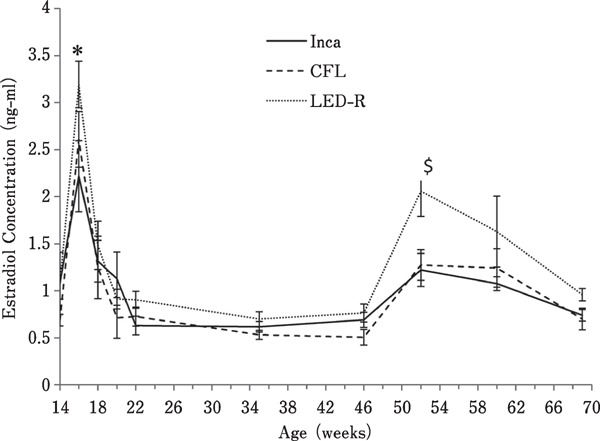
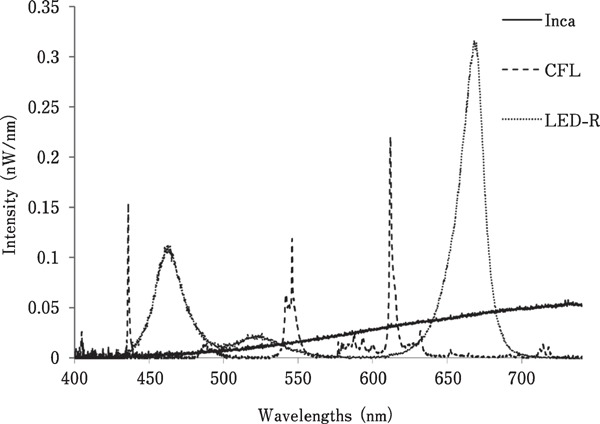
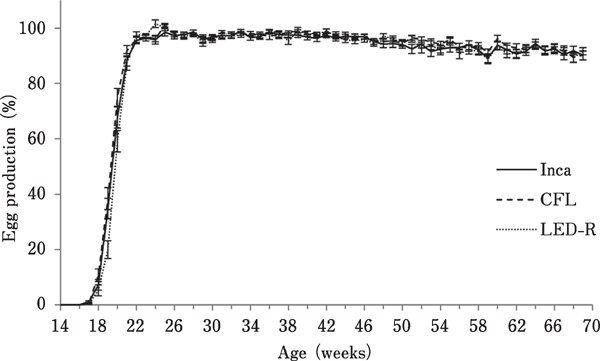
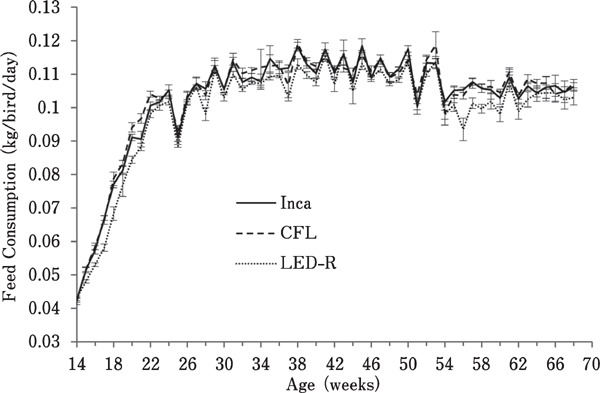
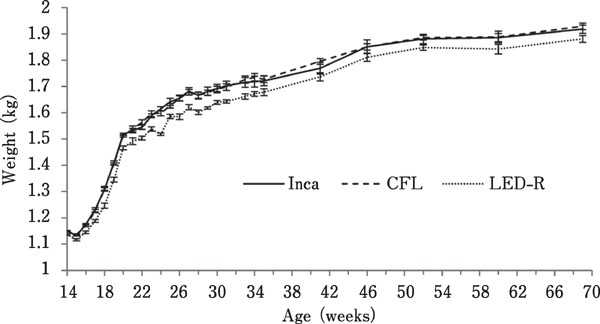
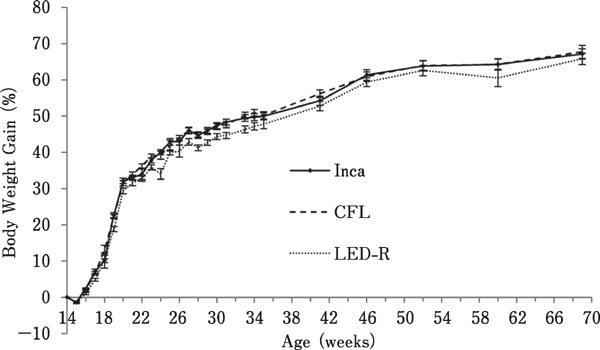
Higher light wavelengths have been shown to stimulate extra-retinal photoreceptors more efficiently than lower wavelengths to promote reproduction in poultry. We developed a light emitting diode (LED) bulb that emits 60% of its light in the red spectrum (LED-R), and evaluated the effects of different light sources on growth and reproduction in commercial layer hens. Three rooms equipped with either 100W incandescent, 15W compact fluorescent (CFL), or 10W LED-R bulbs were populated with 96 Lohmann LSL-Lite layers housed in individual cages from 14 to 69 weeks of age (woa). Pullets were initially maintained on a 10-h photoperiod, then photostimulated at 18 woa. Surprisingly, regardless of the light source, plasma levels of estradiol peaked at 16 woa, 2 weeks before photostimulation, and egg-laying was initiated at 19 woa. As a direct correlation between age at first egg and body weight was identified, metabolic cues most likely served as a primary trigger to initiate sexual maturation prior to photostimulation. Overall egg production and cumulative egg numbers were similar among treatments. Interestingly, a second increase in estradiol was observed at 52 woa under all treatments, suggesting an additional ovarian stimulation, possibly associated with an additional follicular recruitment at that age. Overall, changes in estradiol concentrations were more pronounced in hens maintained under LED-R light than in hens exposed to incandescent and CFL, especially for the second increase, suggesting that a higher amount of red light leads to stronger ovarian activity. Maintaining hens under LED-R bulbs also resulted in lower feed consumption, which combined with the lower energy consumption of LED-bulbs (LED-R: 306 kW; incandescent: 2,514 kW; CFL: 422 kW) could reduce the production cost.
研究表明,较高光波长比较低光波长更能有效地刺激视网膜外光感受器,从而促进家禽繁殖。我们研发了一种发光二极管(LED)灯泡,其发出的光有60%在红色光谱范围内(LED-R),并评估了不同光源对商品蛋鸡生长和繁殖的影响。三个房间分别配备100瓦白炽灯、15瓦紧凑型荧光灯(CFL)或10瓦LED-R灯泡,从14至69周龄(woa)饲养96只罗曼LSL-Lite蛋鸡,每只鸡单独关在笼子里。雏鸡最初保持10小时光照周期,然后在18周龄时进行光刺激。令人惊讶的是,无论光源如何,雌二醇血浆水平在16周龄时达到峰值,比光刺激提前2周,产蛋在19周龄时开始。由于确定了初产年龄与体重之间存在直接相关性,代谢信号很可能是光刺激前启动性成熟的主要触发因素。各处理组的总产蛋量和累计产蛋数相似。有趣的是,在所有处理下,52周龄时观察到雌二醇再次升高,表明存在额外的卵巢刺激,可能与该年龄时额外的卵泡募集有关。总体而言,LED-R光照下母鸡的雌二醇浓度变化比白炽灯和CFL光照下的母鸡更明显,尤其是第二次升高时,这表明较多的红光会导致更强的卵巢活动。在LED-R灯泡下饲养母鸡还能降低饲料消耗,再加上LED灯泡较低的能耗(LED-R:306千瓦;白炽灯:2514千瓦;CFL:422千瓦),可以降低生产成本。