Tudoran Cristina, Bende Felix, Bende Renata, Giurgi-Oncu Catalina, Dumache Raluca, Tudoran Mariana
Department VII, Internal Medicine II, Discipline of Cardiology, University of Medicine and Pharmacy "Victor Babes" Timisoara, E. Murgu Square, Nr. 2, 300041 Timisoara, Romania.
Center of Molecular Research in Nephrology and Vascular Disease, Faculty of Medicine, University of Medicine and Pharmacy "Victor Babes" Timisoara, E. Murgu Square, Nr. 2, 300041 Timisoara, Romania.
Biomedicines. 2023 Feb 8;11(2):492. doi: 10.3390/biomedicines11020492.
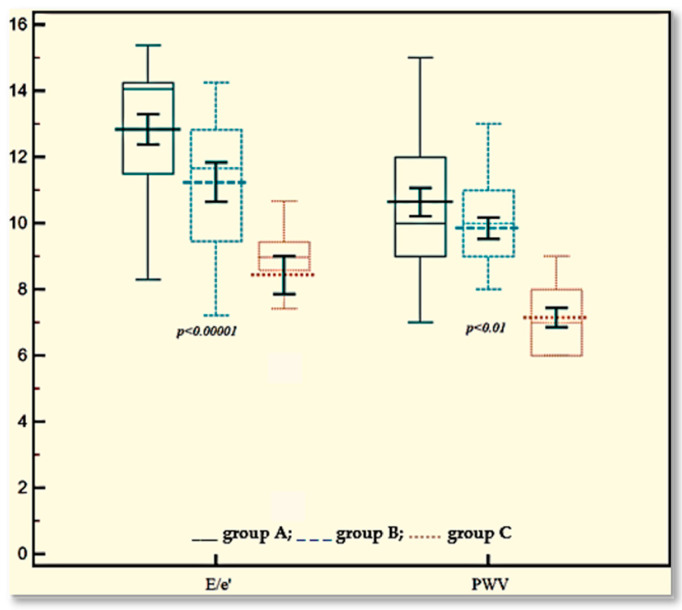
(1) Background: Abnormally increased arterial and aortic stiffness (AS and AoS), which are often associated with diastolic dysfunction (DD), represent common alterations in COVID-19. In this study, we aimed to assess, by transthoracic echocardiography (TTE) and pulse-wave velocity (PWV), the frequency of these dysfunctions in patients with post-acute COVID-19 syndrome and to highlight potential correlations between their severity and multiple clinical and laboratory parameters. (2) Methods: In total, 121 women were included in our study, all of whom were younger than 55 and had been diagnosed with post-COVID-19 syndrome. Of those women, 67 also had metabolic syndrome (MS) (group A), whereas the other 54 did not (group B); 40 age-matched healthy subjects were used as controls (group C). (3) Results: Patients in group A had worse values of indexes characterizing AS and AoS and had more frequent DD compared to those from group B and group C ( < 0.0001). The statistical analysis evidenced significant associations between these indexes and the time that had elapsed since COVID-19 diagnosis, the factors that characterize the severity of the acute disease and those that specify MS. Multivariate regression analysis identified the following as the main independent predictors for DD: values of the AoS index, the C-reactive protein, and the triglyceride-glucose index. (4) Conclusions: Altered AS, AoS, and DD are common in patients with post-COVID-19 syndrome, especially with concurrent MS, and these parameters are apparently associated not only with the severity and time elapsed since COVID-19 diagnosis but also with MS.
(1) 背景:动脉和主动脉僵硬度异常增加(AS和AoS)通常与舒张功能障碍(DD)相关,是新冠病毒病(COVID-19)常见的改变。在本研究中,我们旨在通过经胸超声心动图(TTE)和脉搏波速度(PWV)评估急性COVID-19综合征患者中这些功能障碍的发生率,并强调其严重程度与多种临床和实验室参数之间的潜在相关性。(2) 方法:我们的研究共纳入121名女性,她们均年龄小于55岁且已被诊断为COVID-19后综合征。在这些女性中,67人还患有代谢综合征(MS)(A组),而另外54人没有(B组);40名年龄匹配的健康受试者作为对照(C组)。(3) 结果:与B组和C组相比,A组患者表征AS和AoS的指标值更差,DD更常见(<0.0001)。统计分析表明,这些指标与自COVID-19诊断以来的时间、表征急性疾病严重程度的因素以及表征MS的因素之间存在显著关联。多因素回归分析确定以下因素为DD的主要独立预测因素:AoS指数值、C反应蛋白和甘油三酯-葡萄糖指数。(4) 结论:AS、AoS和DD改变在COVID-19后综合征患者中很常见,尤其是并发MS时,这些参数显然不仅与COVID-19诊断后的严重程度和时间有关,还与MS有关。